When I sat down to study for my own G1 knowledge test, regulatory road signs Ontario were the section that actually made me confused, and the marks on my first try weren’t good, not because they’re complicated, but because there are so many of them and they all look similar at first.
Round, rectangular, red circles, white backgrounds, it’s easy to mix up a “No Left Turn” with a “No U-Turn” if you’re skimming instead of studying properly.
This guide breaks down every major category of regulatory sign you’ll see on Ontario roads and on your G1 test, based directly on the official MTO Driver’s Handbook. I’ve grouped them the way they actually show up on the exam.
By function, not just by shape, so you can build real recognition instead of just memorizing pictures the night before your test.
If you haven’t already, it’s worth reading our Ontario Road Signs — Complete Guide first, since this article goes deeper specifically into the regulatory category, one of the three main sign types (regulatory, warning, and information) tested on the G1.
What Makes a Sign “Regulatory”?
Regulatory signs tell you what you must or must not do. They carry the force of law; ignoring one isn’t just bad driving etiquette. It’s a traffic violation that can get you fined or, in more serious cases, get demerit points added to your licence once you’re past the G1 stage.
You’ll recognize most regulatory signs by their shape and colour pattern:
- Red circle with a diagonal slash — something is prohibited
- White rectangle with black text/symbols — a rule or requirement
- Red octagon — Stop (always)
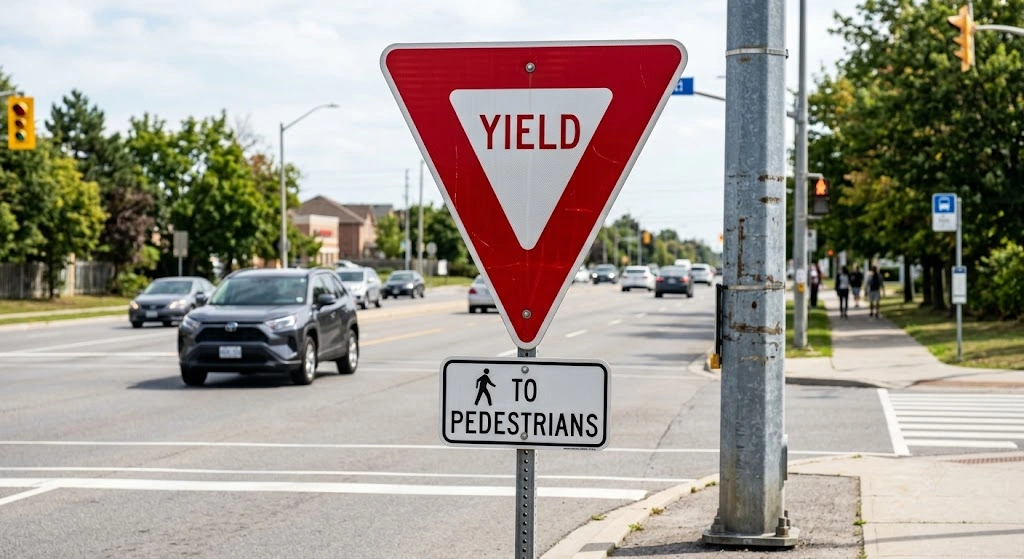
- Red-and-white inverted triangle — Yield (always)
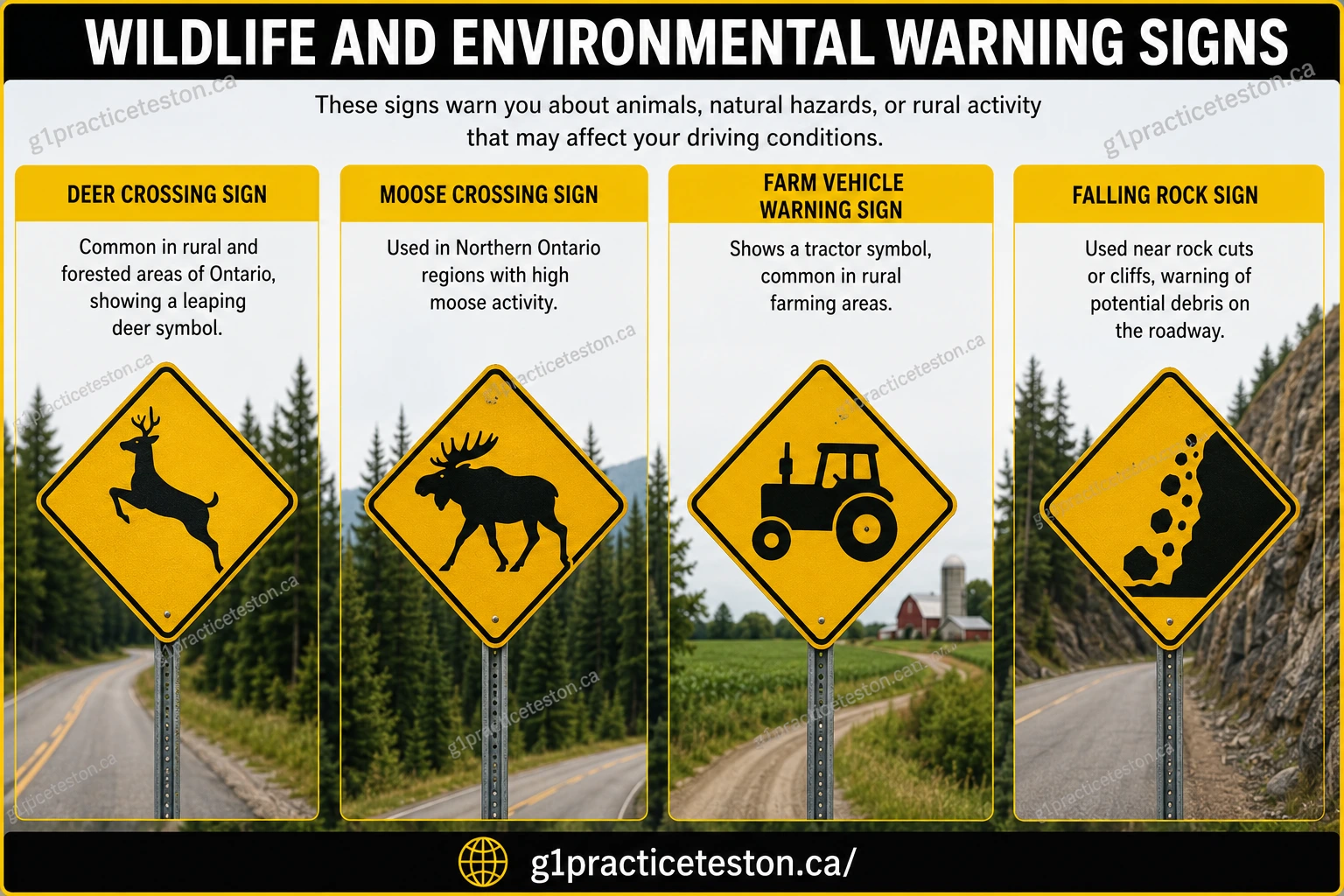
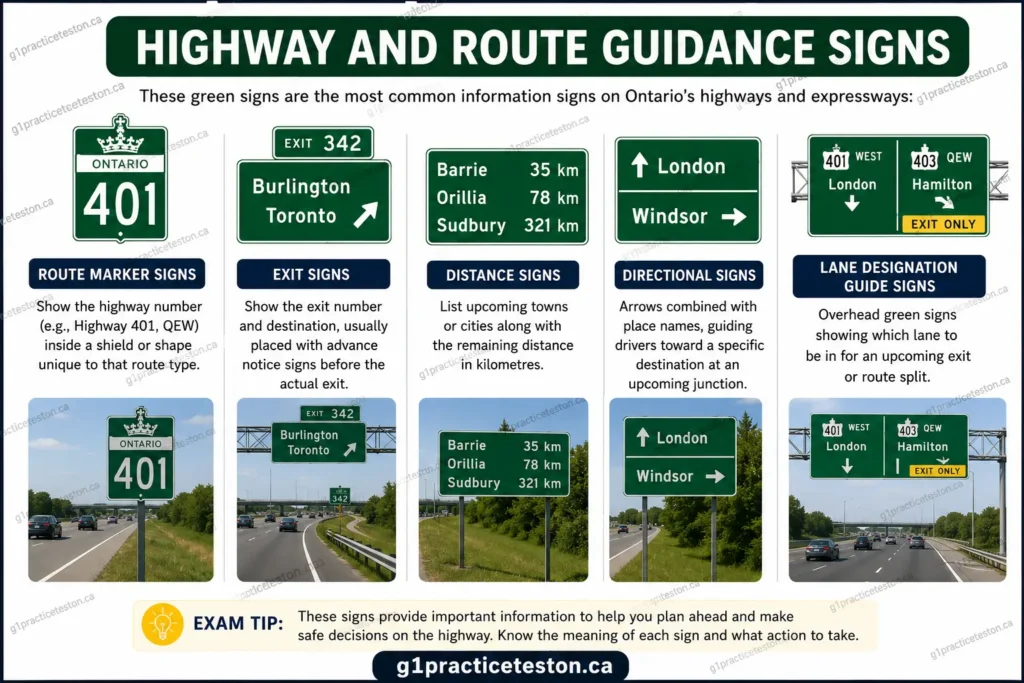
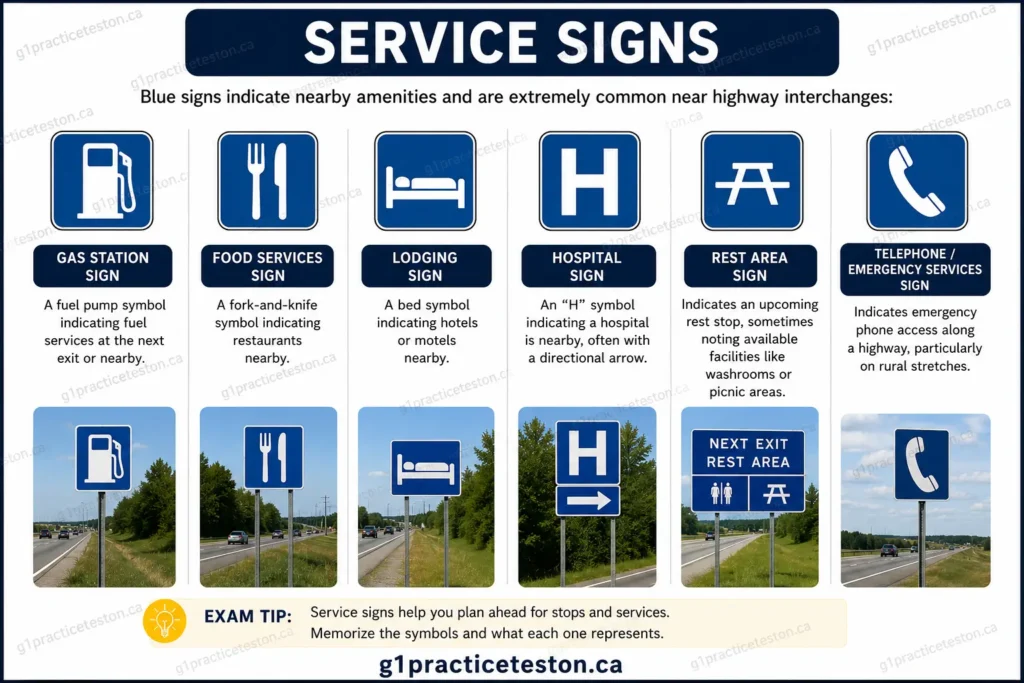
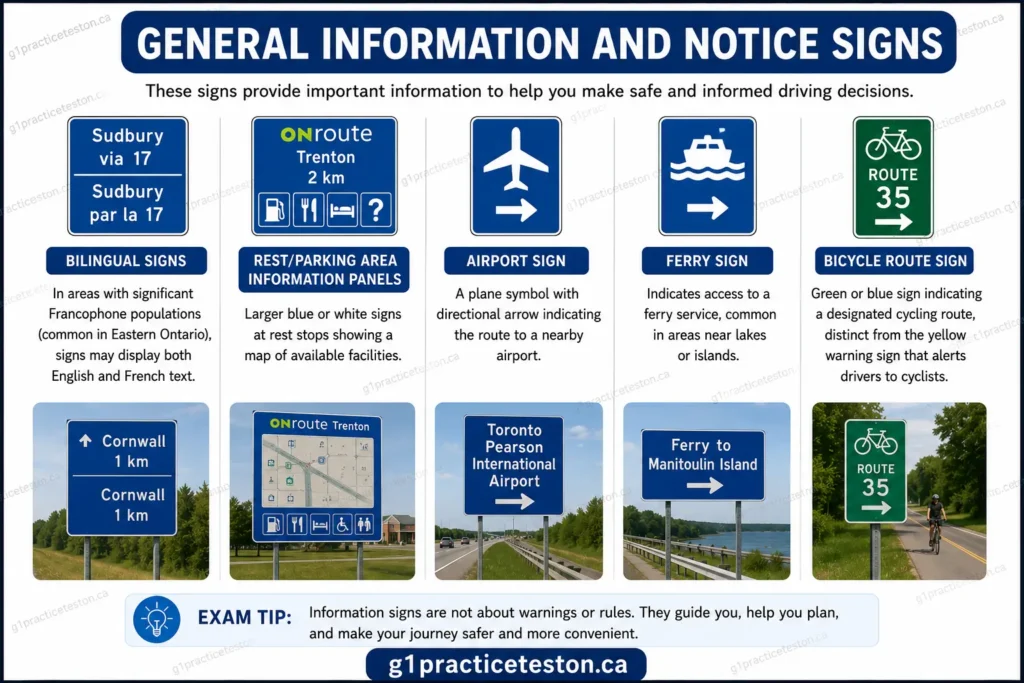
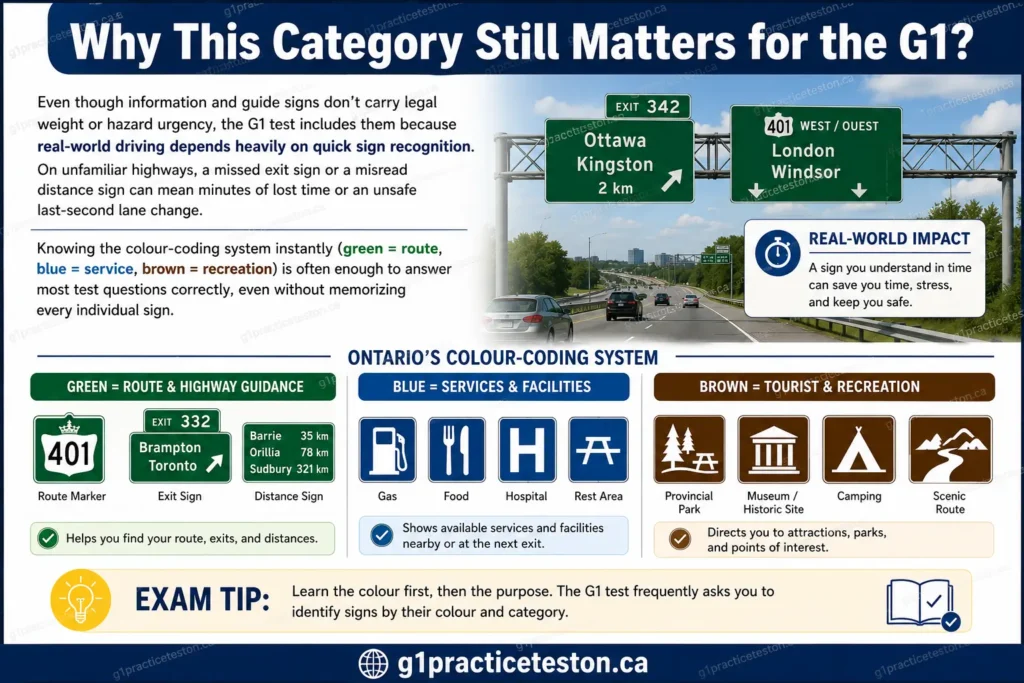
This is different from warning signs (yellow diamonds, alerting you to hazards ahead) and information/guide signs (green or blue, giving directions or services). If you mix these three categories up on the test, it’s usually because the studying was done by shape alone rather than by purpose, which is the approach we’re using here.
Stop and Yield Signs
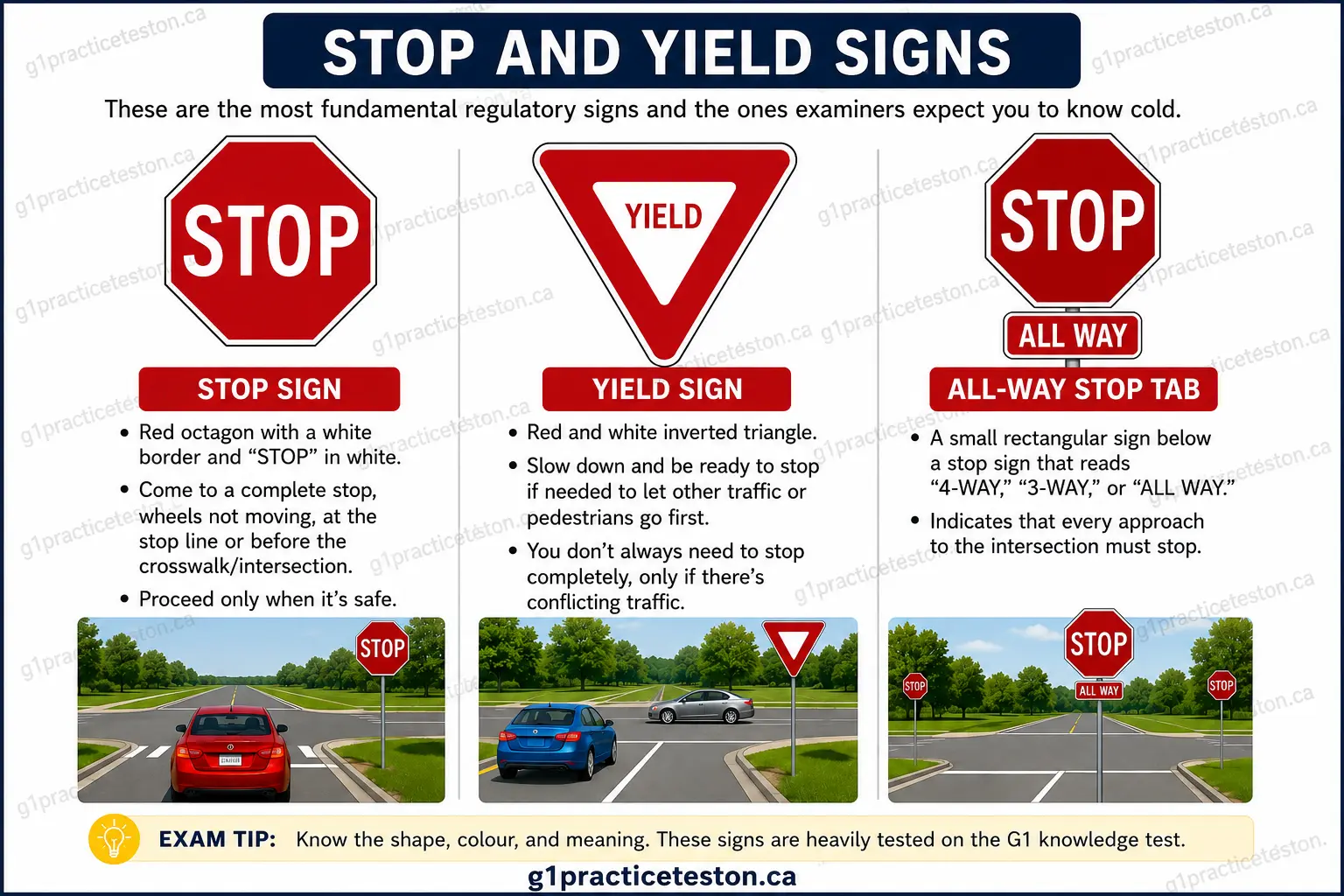
These are the most fundamental regulatory signs and the ones examiners expect you to know cold.
- Stop Sign — Red octagon with a white border and “STOP” in white. Come to a complete stop, wheels not moving, at the stop line or before the crosswalk/intersection. Proceed only when it’s safe.
- Yield Sign — Red and white inverted triangle. Slow down and be ready to stop if needed to let other traffic or pedestrians go first. You don’t always need to stop completely, only if there’s conflicting traffic.
- All-Way Stop Tab — A small rectangular sign below a stop sign that reads “4-WAY,” “3-WAY,” or “ALL WAY,” indicating that every approach to the intersection must stop.
Speed Limit Signs
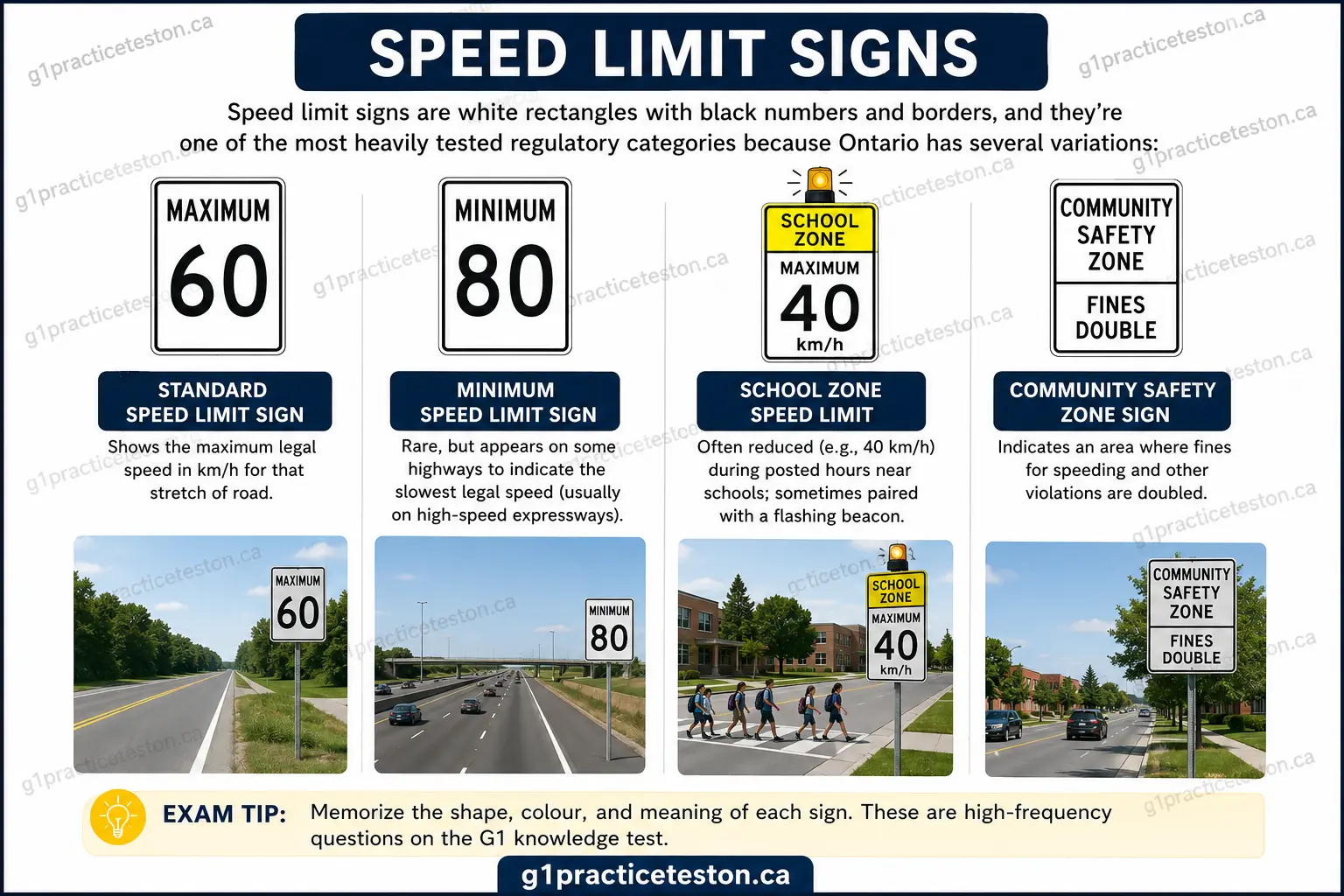
Speed limit signs are white rectangles with black numbers and borders, and they’re one of the most heavily tested regulatory categories because Ontario has several variations:
- Standard Speed Limit Sign — Shows the maximum legal speed in km/h for that stretch of road.
- Minimum Speed Limit Sign — Rare, but appears on some highways to indicate the slowest legal speed (usually on high-speed expressways).
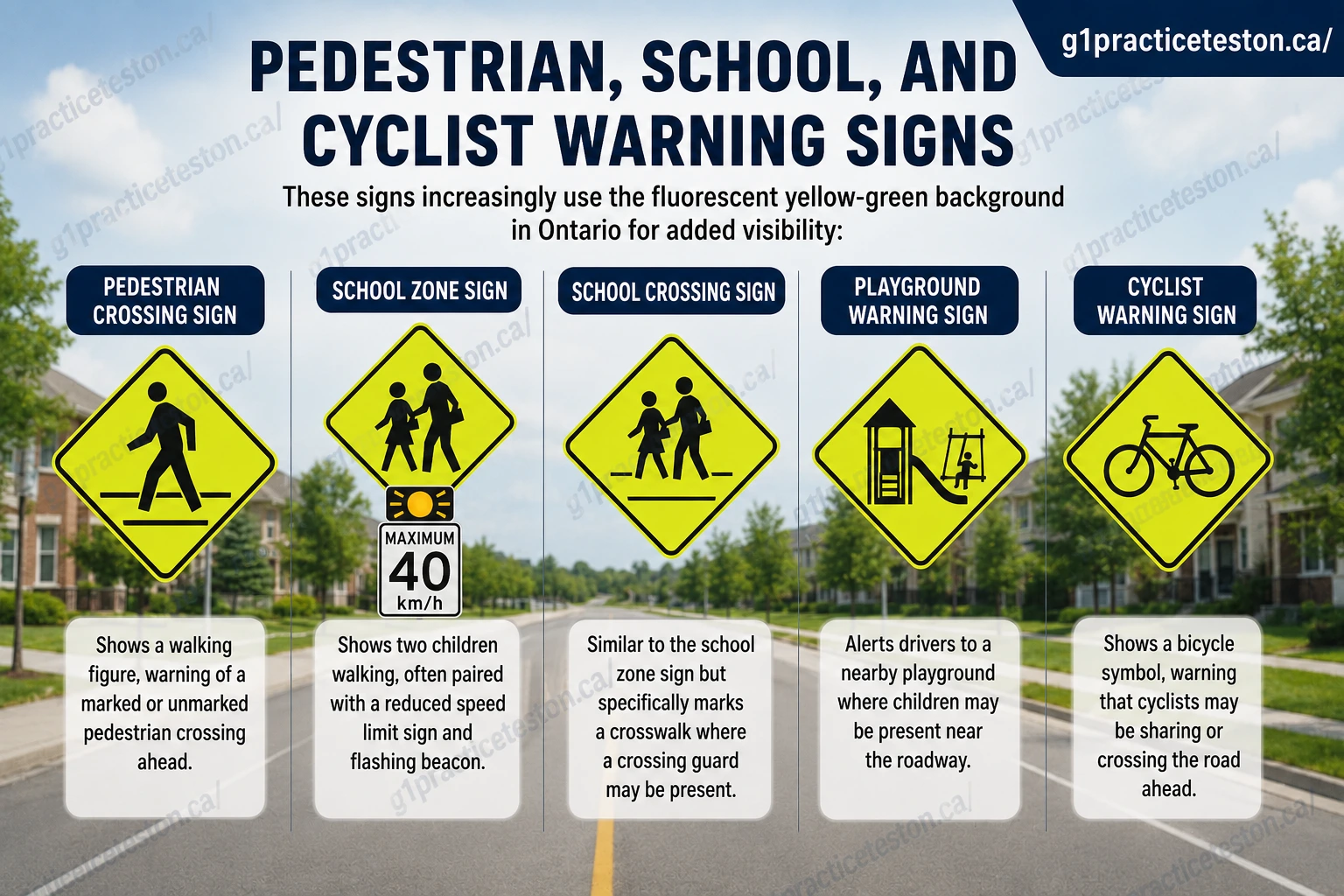
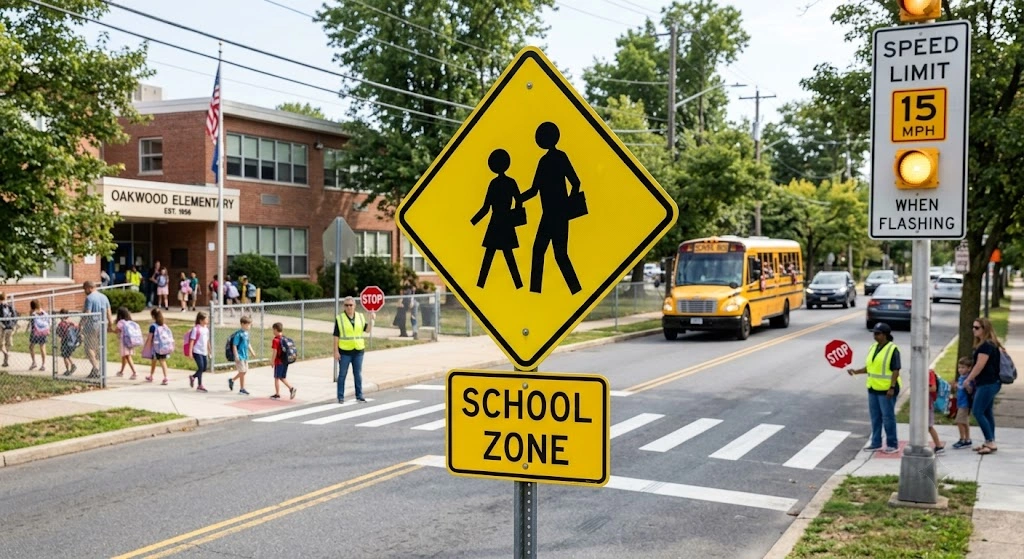
- School Zone Speed Limit — Often reduced (e.g., 40 km/h) during posted hours near schools; sometimes paired with a flashing beacon.
- Community Safety Zone Sign — Indicates an area where fines for speeding and other violations are doubled.

G1 tip
Know that the default speed limit in an Ontario municipality (if unposted) is 50 km/h, and 80 km/h on most rural roads unless otherwise signed. This is one of the most commonly tested unposted-limit questions.
Turn and Movement Restriction Signs
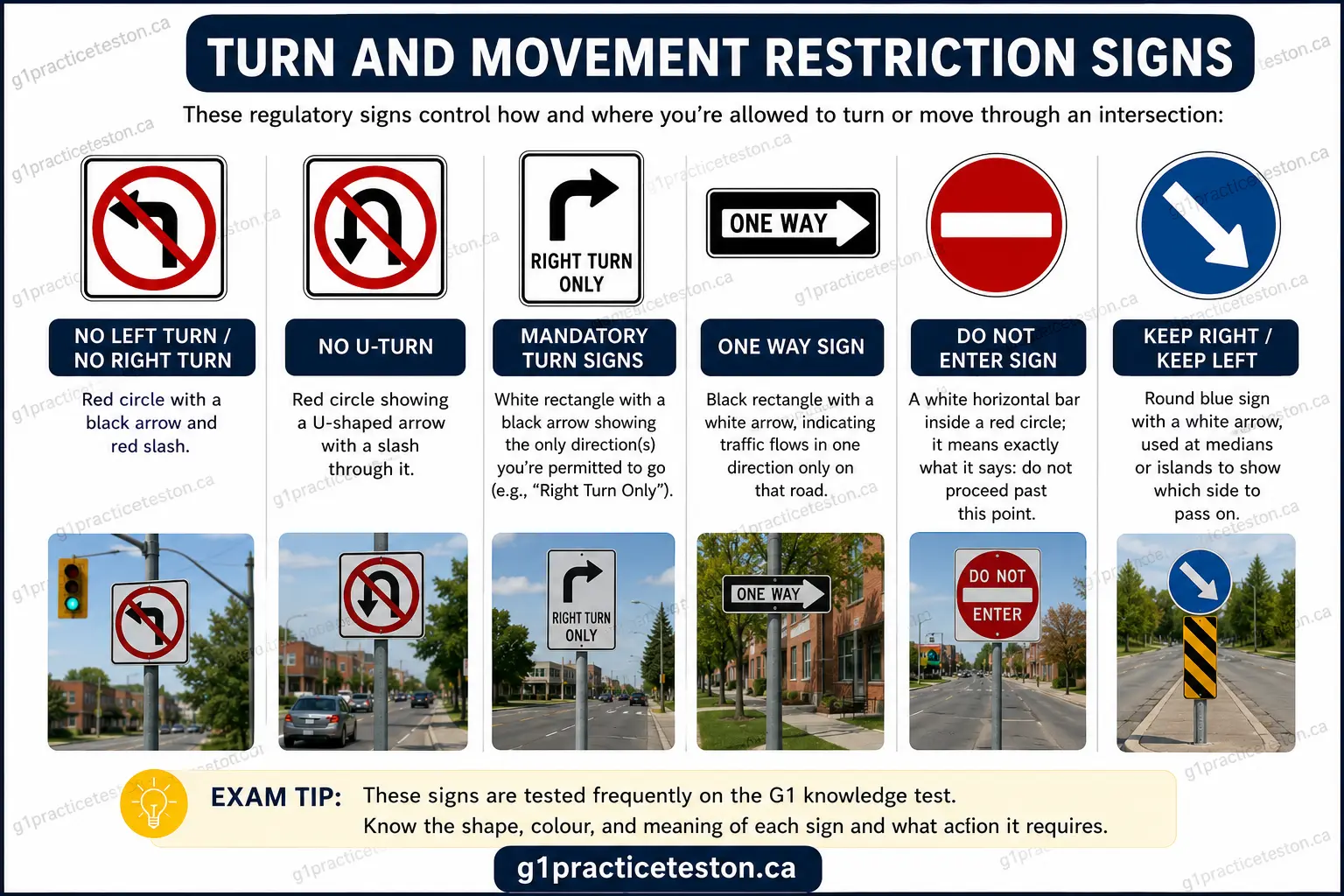
These regulatory signs control how and where you’re allowed to turn or move through an intersection:
- No Left Turn / No Right Turn — Red circle with a black arrow and red slash.
- No U-Turn — Red circle showing a U-shaped arrow with a slash through it.
- Mandatory Turn Signs — White rectangle with a black arrow showing the only direction(s) you’re permitted to go (e.g., “Right Turn Only”).
- One Way Sign — Black rectangle with a white arrow, indicating traffic flows in one direction only on that road.
- Do Not Enter Sign — A white horizontal bar inside a red circle; it means exactly what it says: do not proceed past this point.
- Keep Right / Keep Left — Round blue sign with a white arrow, used at medians or islands to show which side to pass on.
Lane Use and Movement Control Signs
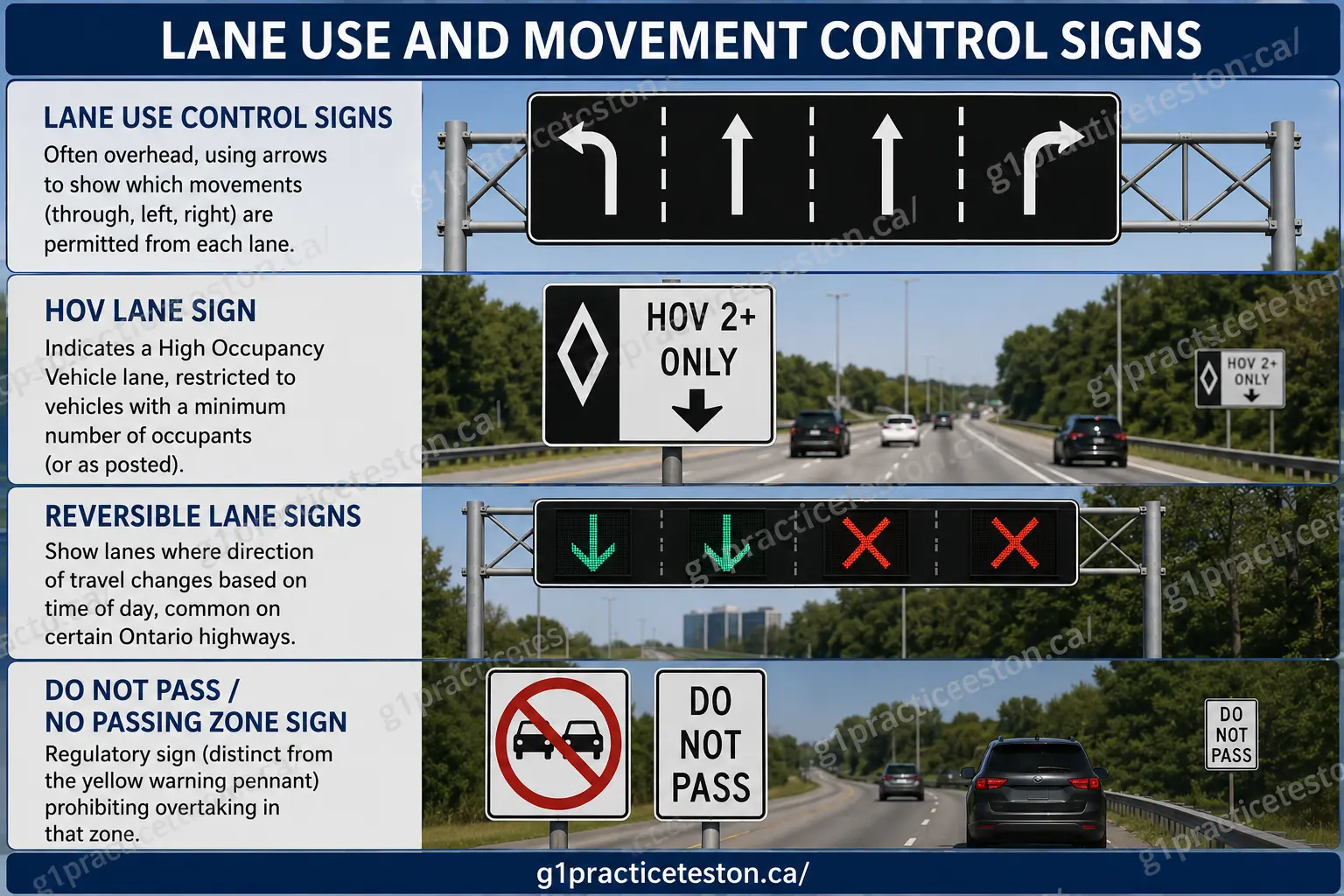
- Lane Use Control Signs — Often overhead, using arrows to show which movements (through, left, right) are permitted from each lane.
- HOV Lane Sign — Indicates a High Occupancy Vehicle lane, restricted to vehicles with a minimum number of occupants (or as posted).
- Reversible Lane Signs — Show lanes where direction of travel changes based on time of day, common on certain Ontario highways.
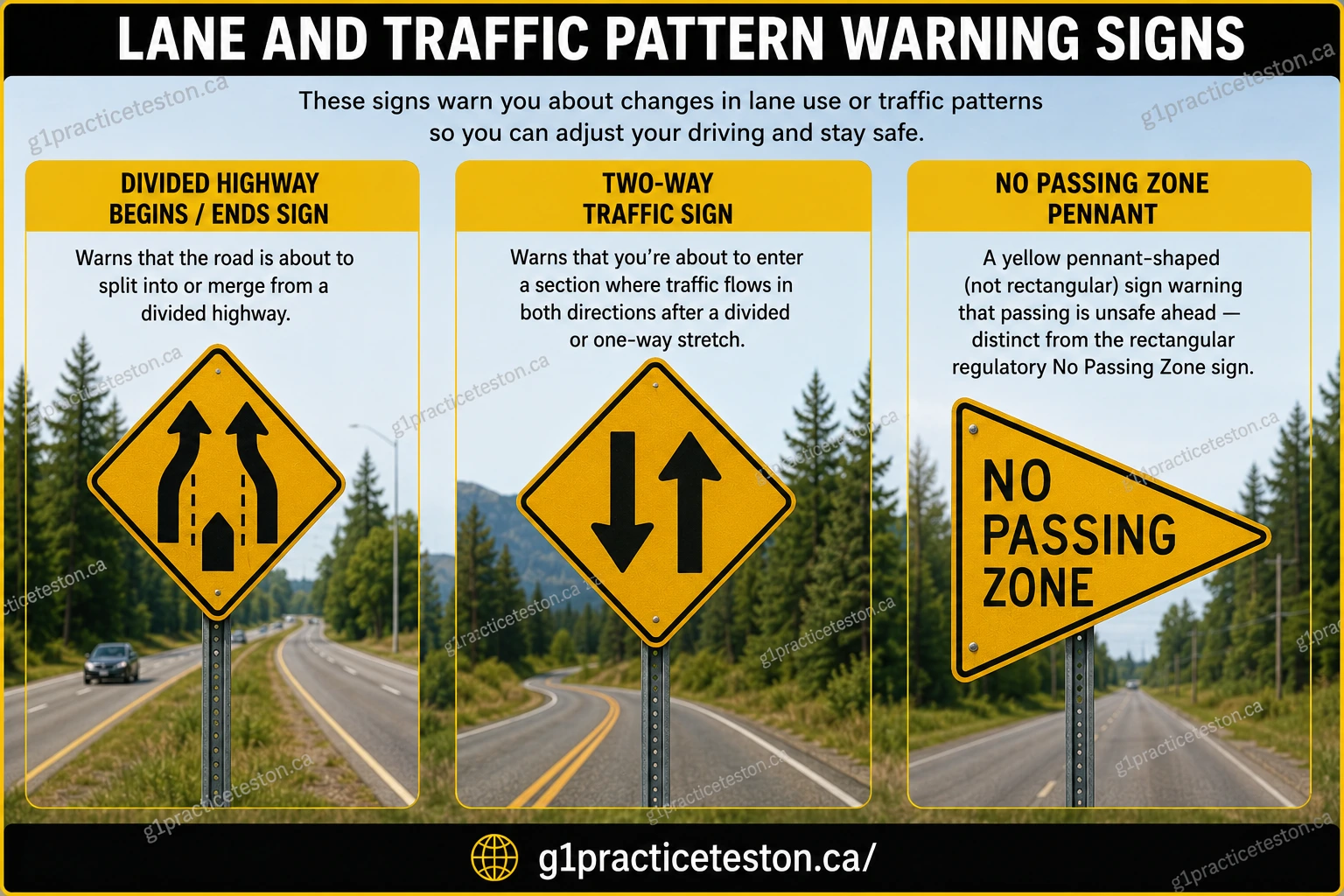
- Do Not Pass / No Passing Zone Sign — Regulatory sign (distinct from the yellow warning pennant) prohibiting overtaking in that zone.
Parking and Stopping Regulation Signs
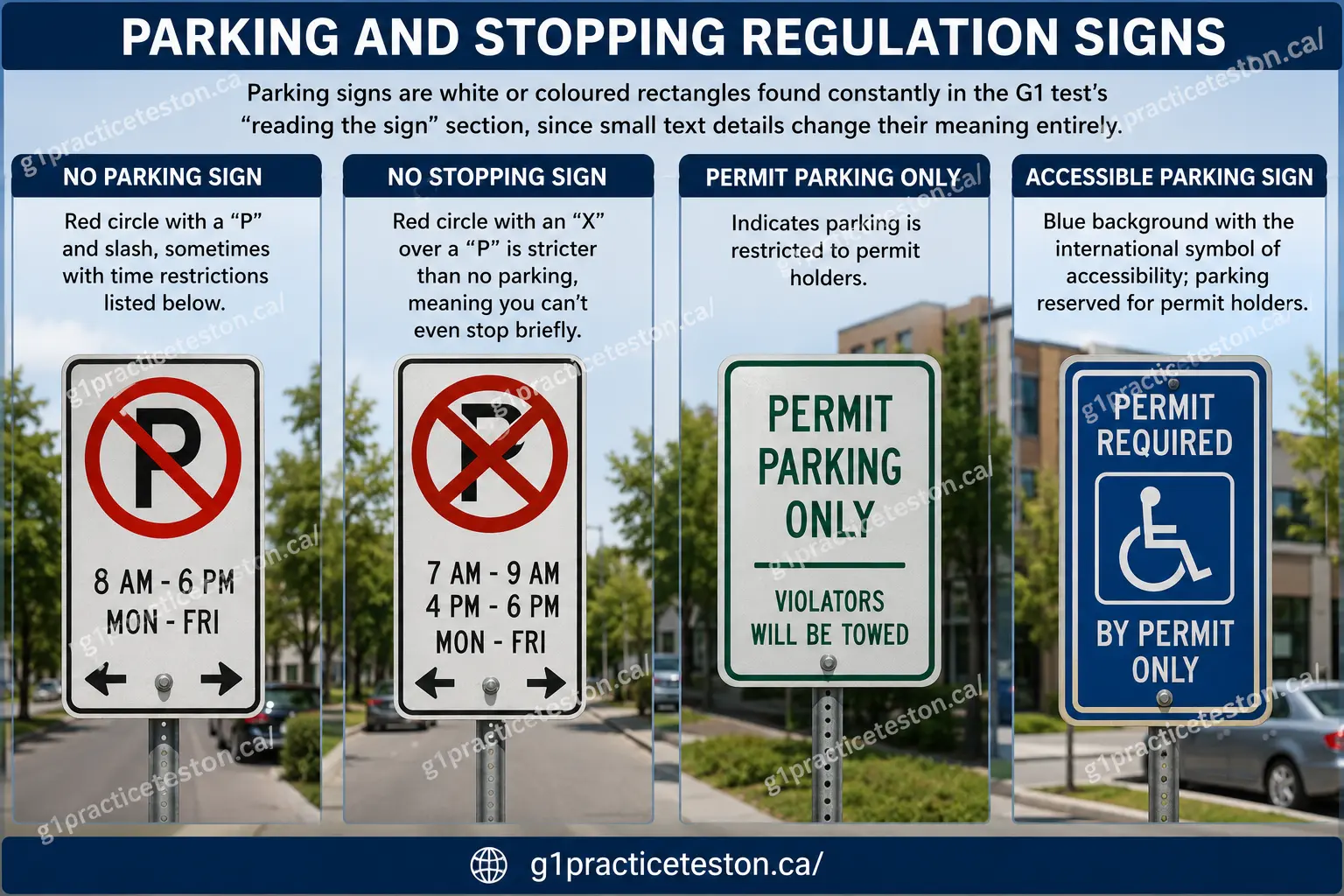
Parking signs are white or coloured rectangles found constantly in the G1 test’s “reading the sign” section, since small text details change their meaning entirely:
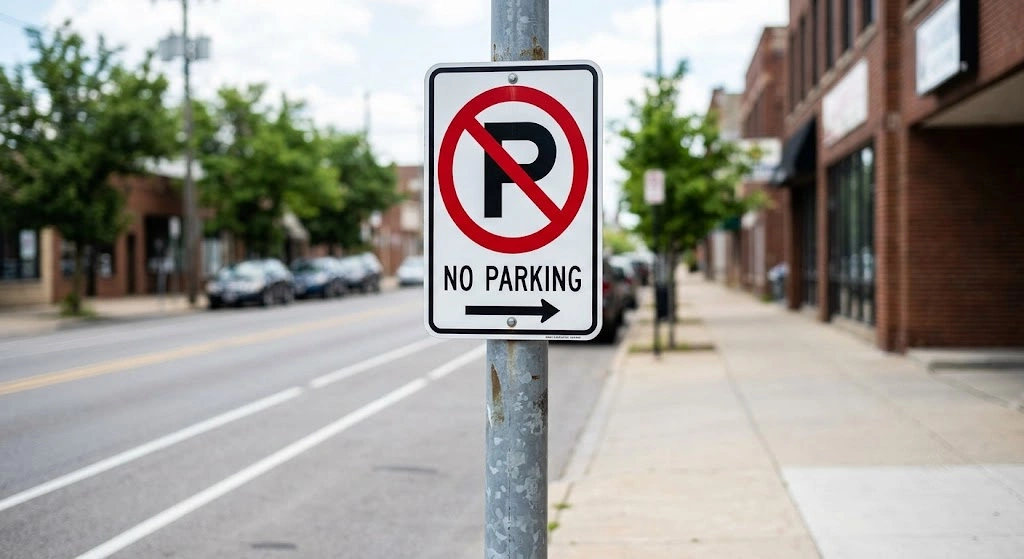
- No Parking Sign — Red circle with a “P” and slash, sometimes with time restrictions listed below.
- No Stopping Sign — Red circle with an “X” over a “P” is stricter than no parking, meaning you can’t even stop briefly.
- Permit Parking Only — Indicates parking is restricted to permit holders.
- Accessible Parking Sign — Blue background with the international symbol of accessibility; parking reserved for permit holders.
G1 tip
The test often asks you to distinguish “No Parking” from “No Stopping.” Remember, No Stopping is the stricter rule with zero exceptions, even to drop someone off.
Weight, Height, and Vehicle-Type Restriction Signs
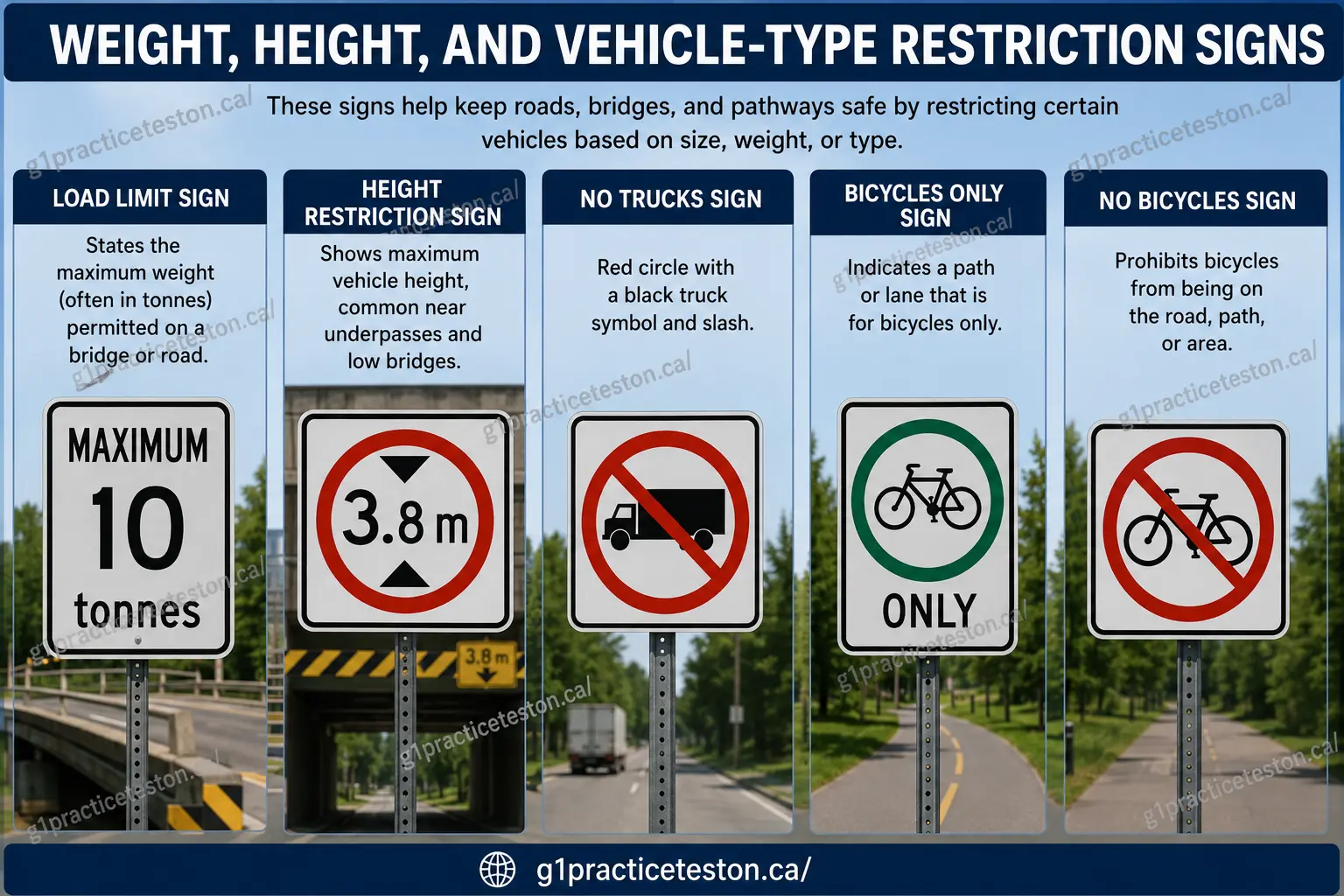
- Load Limit Sign — States the maximum weight (often in tonnes) permitted on a bridge or road.
- Height Restriction Sign — Shows maximum vehicle height, common near underpasses and low bridges.
- No Trucks Sign — Red circle with a black truck symbol and slash.
- Bicycles Only / No Bicycles Signs — Regulate where cyclists must or must not ride.
Other Common Regulatory Signs
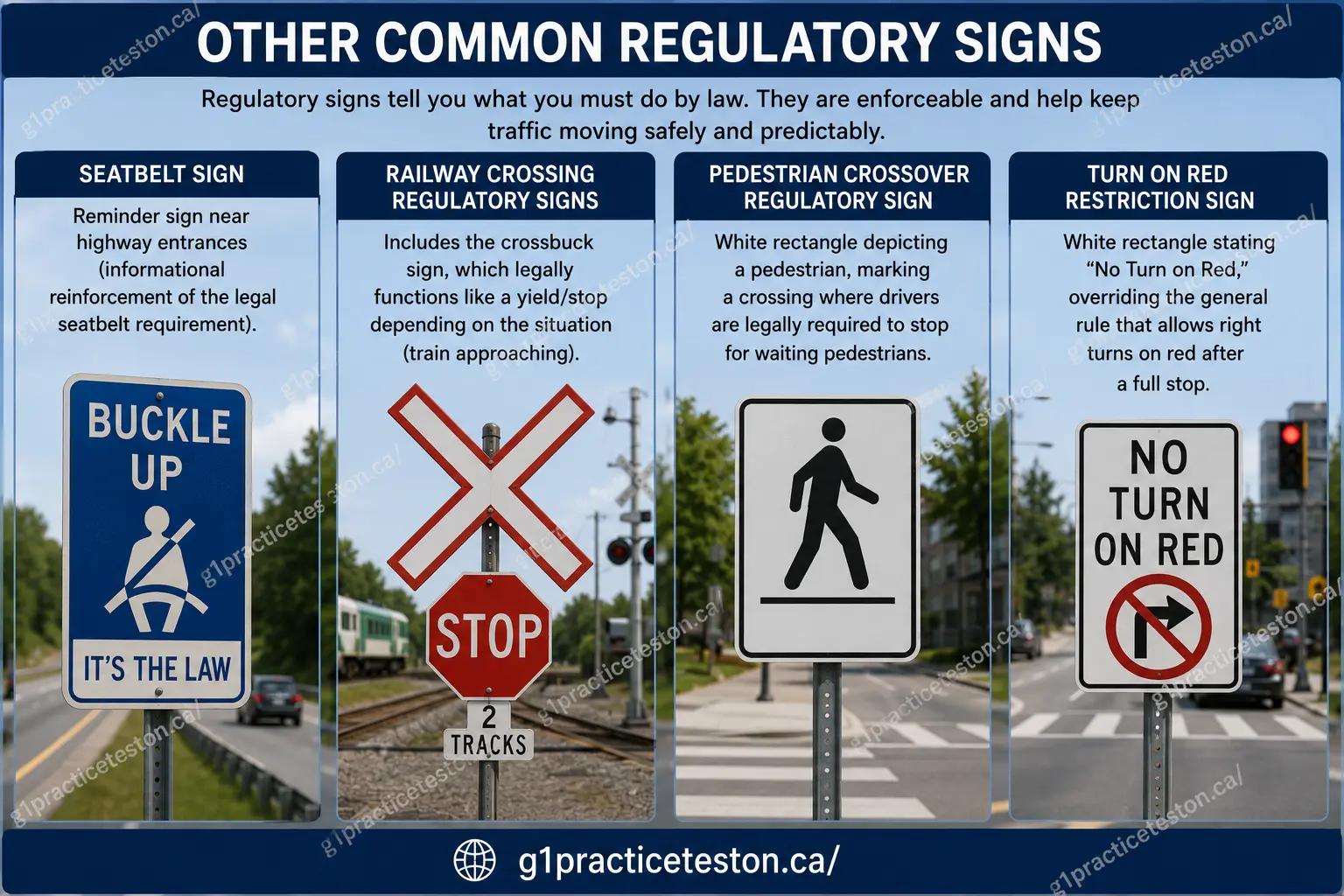
- Seatbelt Sign — Reminder sign near highway entrances (informational reinforcement of the legal seatbelt requirement).
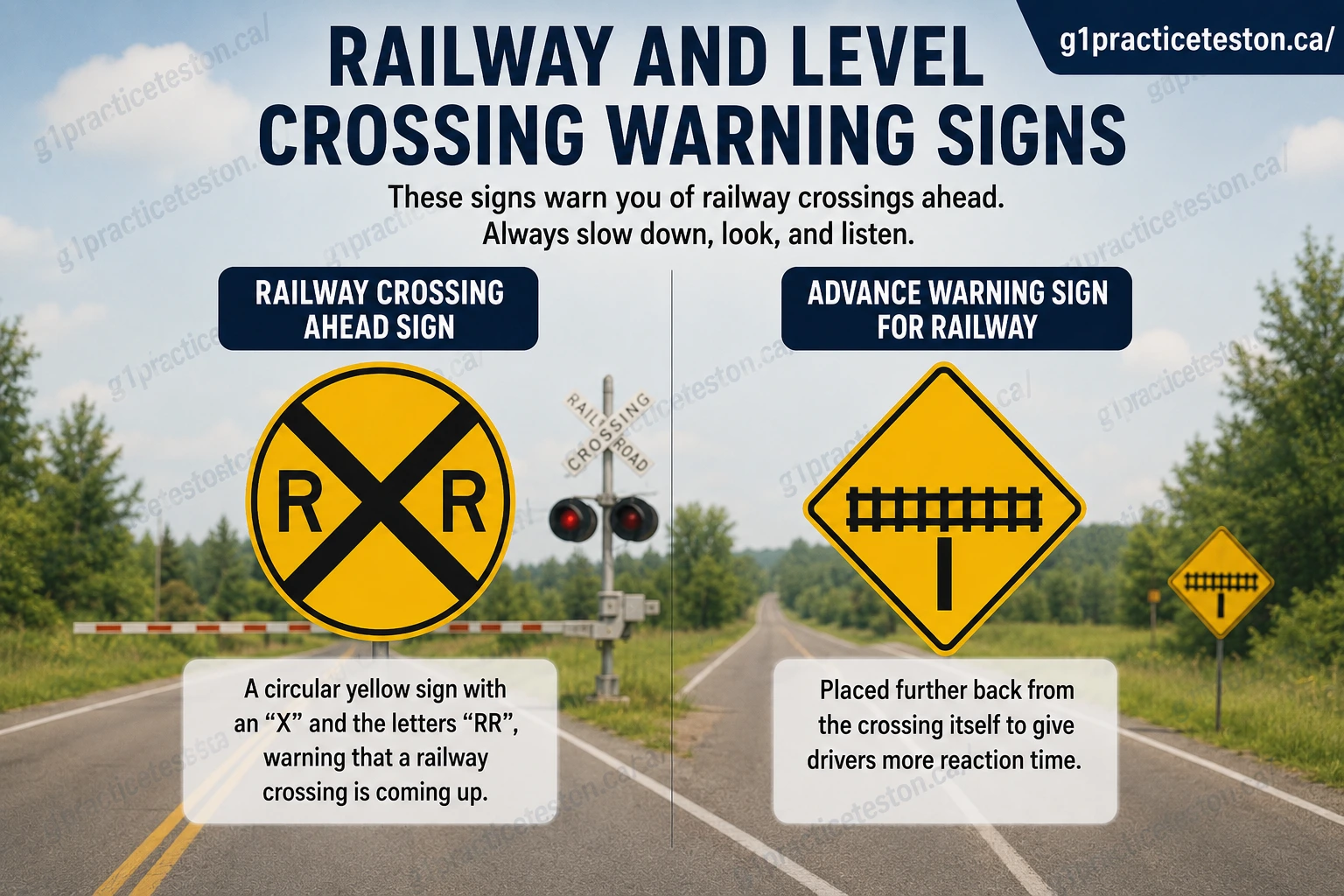
- Railway Crossing Regulatory Signs — Includes the crossbuck sign, which legally functions like a yield/stop depending on the situation (train approaching).
- Pedestrian Crossover Regulatory Sign — White rectangle depicting a pedestrian, marking a crossing where drivers are legally required to stop for waiting pedestrians.
- Turn on Red Restriction Sign — White rectangle stating “No Turn on Red,” overriding the general rule that allows right turns on red after a full stop.
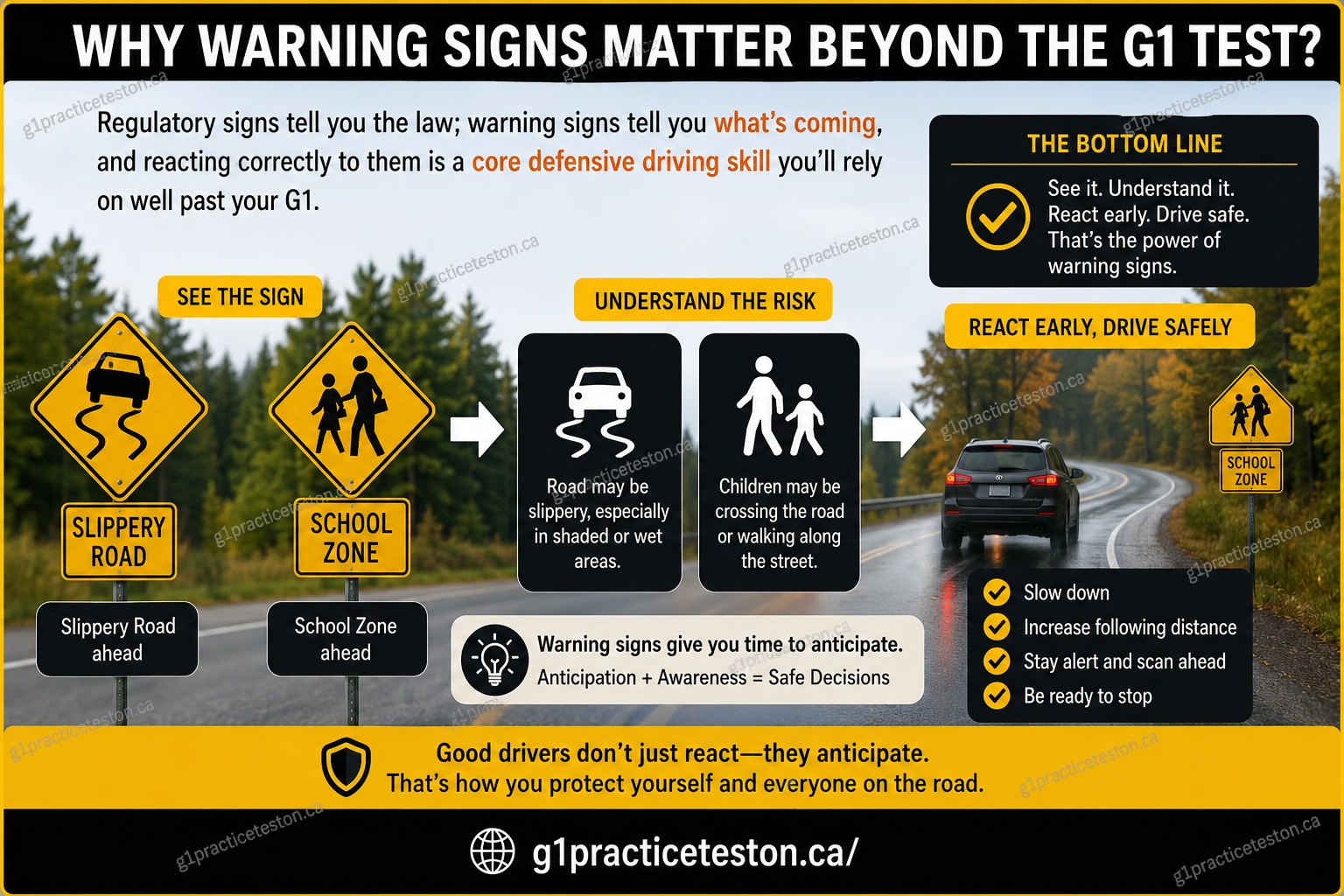
Why This Matters Beyond the G1 Test
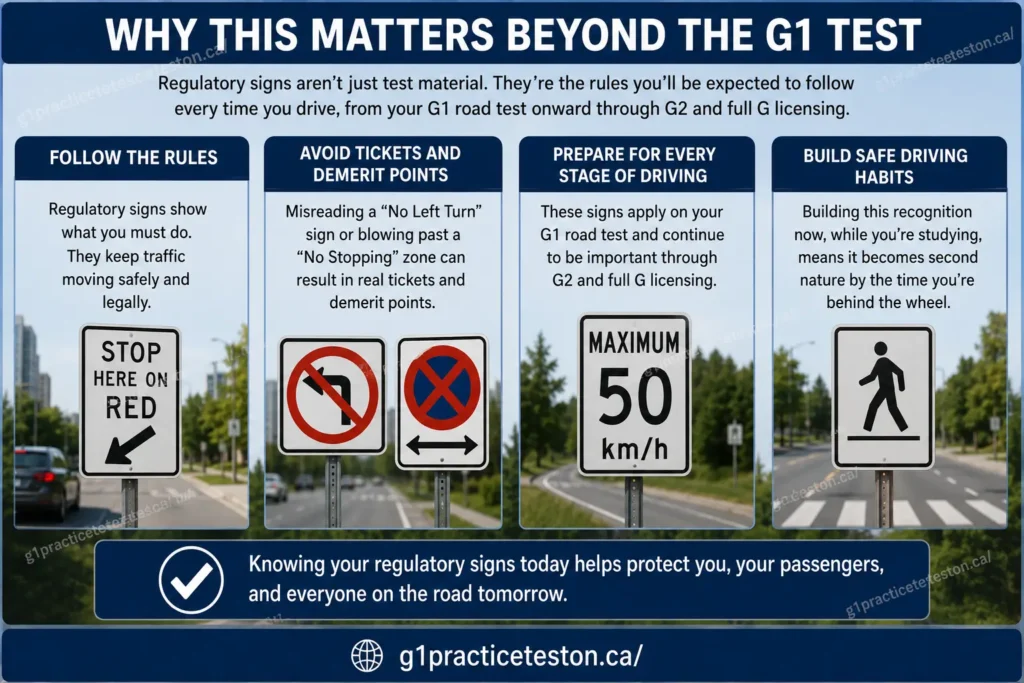
Regulatory signs aren’t just test material. They’re the rules you’ll be expected to follow every time you drive, from your G1 road test onward through G2 and full G licensing. Misreading a “No Left Turn” sign or blowing past a “No Stopping” zone doesn’t just cost test points; it can result in real tickets and demerit points later. Building this recognition now, while you’re studying, means it becomes second nature by the time you’re behind the wheel.
Frequently Asked Questions
Conclusion
Regulatory signs make up one of the most testable and most practical sections of your G1 knowledge exam. The key isn’t memorizing every sign individually, but learning to recognize the pattern: shape and colour tell you the sign’s function before you even read the text. Once that clicks, questions about stop/yield, turn restrictions, speed limits, and parking rules become quick, easy points rather than guesswork.
Related Posts:
- Ontario Road Signs — Complete Guide
- Warning Signs in Ontario — Full List & Meanings
- Information and Guide Signs in Ontario Explained
- G1 Practice Test: Road Signs Edition (coming soon)





One Comment