
An intersection is coming up — and the drivers waiting on the sideroad cannot see you coming. That is the hidden intersection ahead sign: advance warning of a junction hidden by a bend, a rise, trees, buildings or parked cars, where the other driver has no clear view of your traffic. This page explains what the sign means, what to do when you see it, and how it appears on the G1 test.
Last updated: November 24, 2026
Practise road signs: take the free Traffic Signs Practice Test (102 questions).
What this sign means
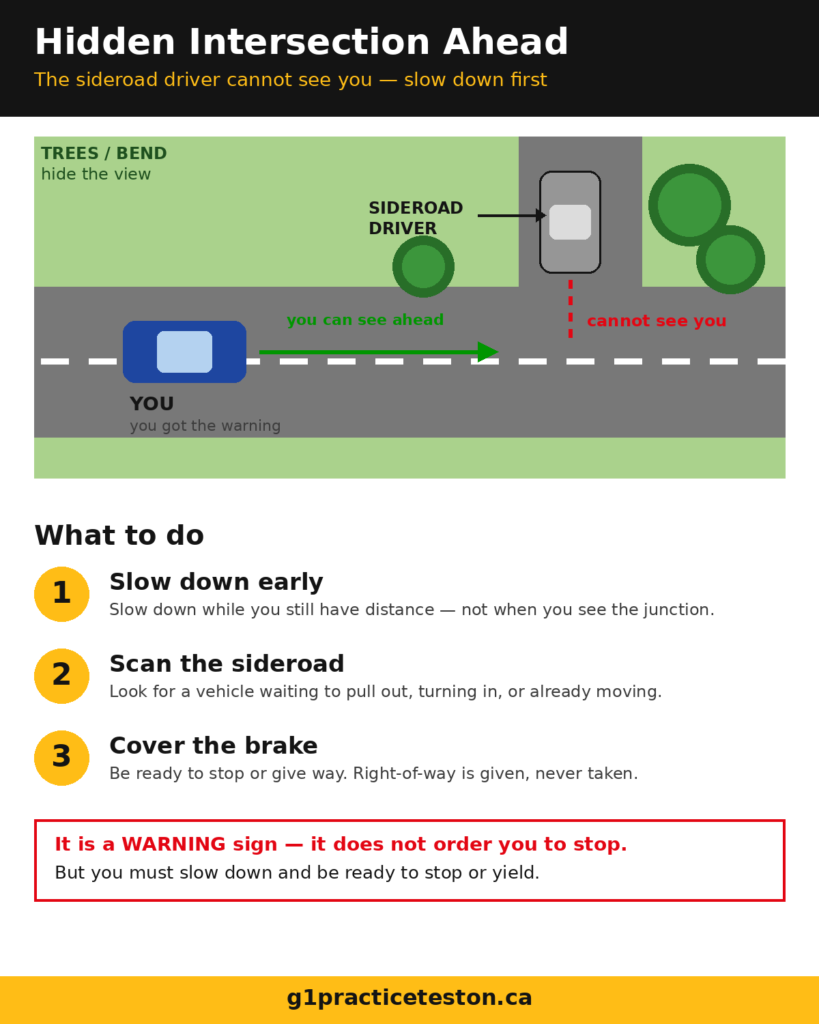
The hidden intersection ahead sign means an intersection is ahead where drivers on the sideroad don’t have a clear view of traffic on your road. It is a warning sign, not a regulatory sign: it does not itself order you to stop, and it carries no speed limit. Its job is to give you time to slow down before you reach the junction, because a driver on the sideroad may pull out in front of you — not out of carelessness, but because they genuinely cannot see you yet.
Why it matters: at a normal, visible intersection both drivers can see each other and judge the gap. At a hidden intersection only you have the warning — the sideroad driver is working blind. The sign exists precisely so you are already slow and looking before a vehicle appears from the sideroad, instead of meeting it at full speed with no time to react.
What you must do
- Slow down as soon as you see the sign, while you still have distance — do not wait until you can see the intersection or the sideroad.
- Scan the sideroad as you approach: look for a vehicle waiting to pull out, turning in, or already moving, and for pedestrians or cyclists using the junction.
- Cover the brake and be ready to stop or give way if a vehicle pulls out or turns across your path. Expect the sideroad driver to misjudge your speed or not see you at all.
- Do not assume the other driver will wait for you. Right-of-way is given, never taken — if going first would cause a collision, you wait, even if the rules say you should go first.
- Do not pass another vehicle near the intersection, and do not enter the intersection if traffic ahead is blocked — you do not want to be stuck across the junction when a sideroad vehicle pulls out.
- Stay alert through the whole junction, not just at its edge — a second vehicle may follow the first out of the sideroad.
How it appears on the G1 test
Sign-recognition questions ask what this sign means, and rules questions ask what to do at intersections where visibility is limited. The traps are reading it as a plain intersection ahead (“a crossroad is coming” — true but incomplete, the hidden part is the point), treating it as a stop or yield instruction (wrong — it is a warning, it orders nothing by itself), and assuming the sideroad driver can see you and will wait (wrong — the handbook says they don’t have a clear view). If the question shows a hidden intersection, the answer is slow down, look for traffic on the sideroad, and be ready to stop or yield.
Signs people confuse with this one
- Intersection ahead (plain) — a visible crossroad; the handbook notes the arrow shows which direction of traffic has the right-of-way. Same family, different warning: this page’s sign adds that the sideroad driver cannot see you.
- Road branching off ahead — a side road joining yours, shown as a road branching off at an angle. A branch is a road joining; a hidden intersection is a junction you (and the sideroad driver) cannot see clearly.
- T-intersection — your road ending at a through road. The stem of the T yields to the through road; a hidden intersection is about visibility, not about which road ends.
- Hidden school bus stop — also “hidden”, but a different hazard: a school bus stop you cannot see, where you must watch for children and a bus with flashing red lights — not a junction with cross traffic.
- Stop sign ahead / yield ahead — advance warnings of a CONTROL at the intersection (a stop sign or yield sign coming up). The hidden intersection sign warns about visibility, not about a control ahead.
What does the hidden intersection ahead sign mean?
It warns that an intersection is ahead where drivers on the sideroad don’t have a clear view of traffic on your road. Slow down and watch the sideroad — a vehicle may pull out because its driver cannot see you yet.
What should I do when I see the hidden intersection ahead sign?
Slow down while you still have distance, scan the sideroad, cover the brake, and be ready to stop or give way if a vehicle pulls out. Do not assume the sideroad driver will wait for you.
Is the hidden intersection ahead sign the same as the intersection ahead sign?
No. Intersection ahead warns of a visible crossroad (the handbook notes its arrow shows which direction of traffic has the right-of-way). Hidden intersection ahead adds the key danger: drivers on the sideroad cannot see your traffic clearly.
Does the hidden intersection ahead sign mean I must stop?
No — it is a warning sign, not a regulatory sign, so it does not order you to stop. But you must slow down and be ready to stop or yield if a vehicle pulls out of the sideroad, and you must still obey any stop sign, yield sign or traffic light at the intersection itself.
Does the hidden intersection ahead sign appear on the G1 test?
Yes — sign-recognition questions test it, and rules questions test what to do at intersections with limited visibility: slow down, look for traffic on the sideroad, and be ready to stop or yield rather than assuming the other driver can see you.
Jessica
Jessica took the Ontario G1 knowledge test in 2024 and passed it on the first attempt, scoring 90%. Jessica writes and checks every question and guide on this site.