Road signs

  • |

    Information and Guide Signs in Ontario Explained (2026 Guide)

    By the time most people get to the information and guide signs section while studying for their G1, they usually relax a little and honestly, that’s fair. These signs aren’t testing your reflexes for a hazard or your knowledge of a legal rule.

    They’re testing whether you can quickly find your way, locate services, or understand where you are heading to your destination. But the G1 test still includes a handful of questions from this category, and it’s often where people lose easy points simply because they never studied it seriously.
    This guide walks through every major type of information and guide sign you’ll see across Ontario, following the same structure as our other sign guides. If you haven’t already, check out our Ontario Road Signs — Complete Guide, our Regulatory Road Signs guide, and our Warning Signs guide to round out all three categories tested on the G1.

    What Makes a Sign an “Information” or “Guide” Sign?

    Unlike regulatory signs or warning signs, information and guide signs exist purely to help you navigate showing directions, distances, services, and points of interest. They’re not asking you to do anything specific; they’re simply telling you what’s around you or how to get somewhere.
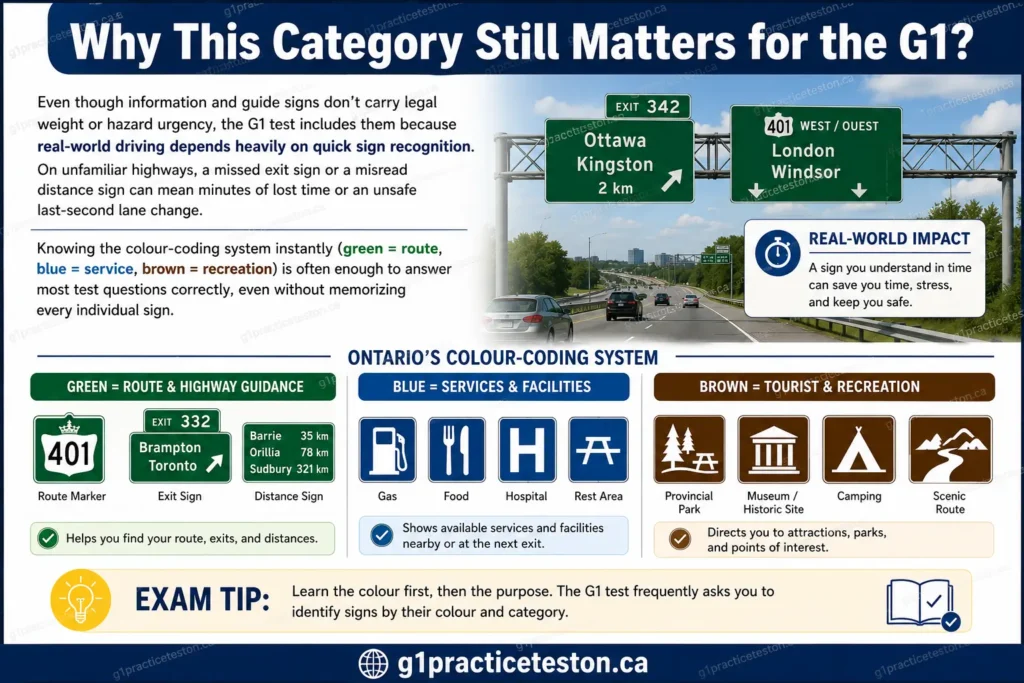
    In Ontario, these signs generally follow a consistent colour code:

    • Green — Highway and route guidance (directions, exits, distances)
    • Blue — Services (gas, food, lodging, hospitals, rest areas)
    • Brown — Tourist attractions, parks, and recreational sites
    • White or black text on a light background — General information notices

    Recognizing the colour first tells you the category of information before you even read the text.

    Information and guide signs
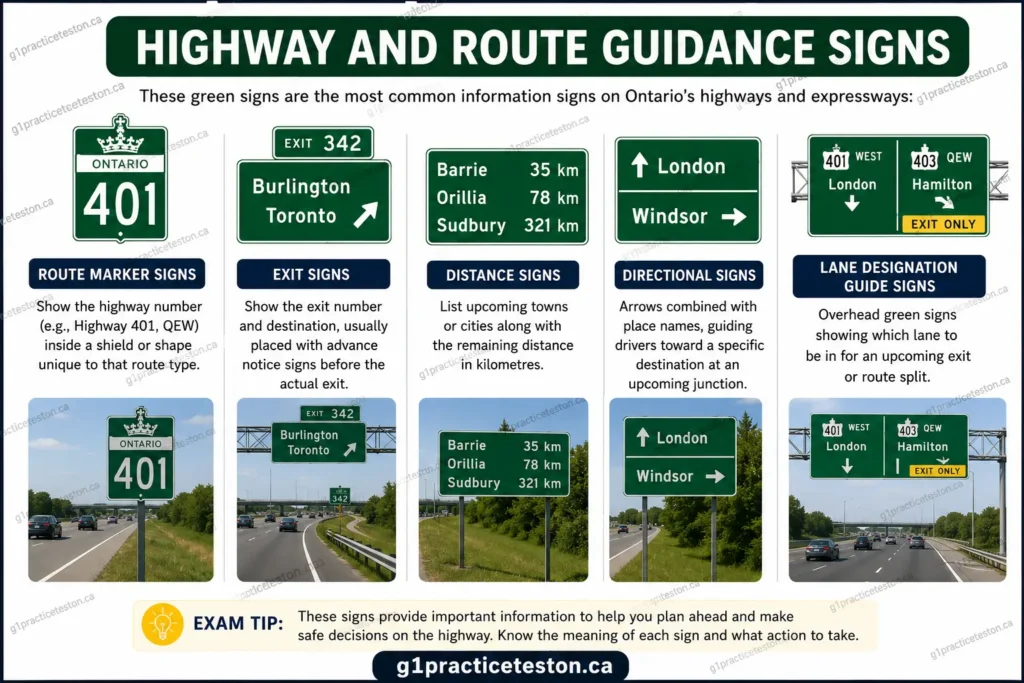
    Highway and route g1practiceteston.ca

    Highway and Route Guidance Signs

    These green signs are the most common information signs on Ontario’s highways and expressways:

    • Route Marker Signs — Show the highway number (e.g., Highway 401, QEW) inside a shield or shape unique to that route type.
    • Exit Signs — Show the exit number and destination, usually placed with advance notice signs before the actual exit.
    • Distance Signs — List upcoming towns or cities along with the remaining distance in kilometres.
    • Directional Signs — Arrows combined with place names, guiding drivers toward a specific destination at an upcoming junction.
    • Lane Designation Guide Signs — Overhead green signs showing which lane to be in for an upcoming exit or route split.

    Service Signs

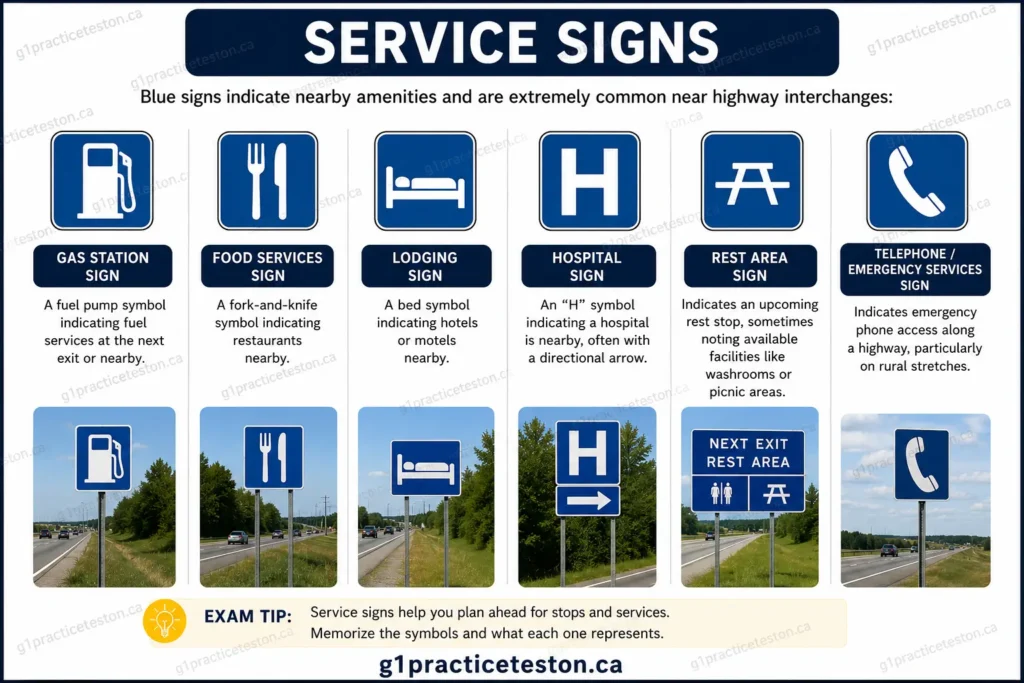
    Blue signs indicate nearby amenities and are extremely common near highway interchanges:

    • Gas Station Sign — A fuel pump symbol indicating fuel services at the next exit or nearby.
    • Food Services Sign — A fork-and-knife symbol indicating restaurants nearby.
    • Lodging Sign — A bed symbol indicating hotels or motels nearby.
    • Hospital Sign — An “H” symbol indicating a hospital is nearby, often with a directional arrow.
    • Rest Area Sign — Indicates an upcoming rest stop, sometimes noting available facilities like washrooms or picnic areas.
    • Telephone/Emergency Services Sign — Indicates emergency phone access along a highway, particularly on rural stretches.
    service sign g1practiceteston.ca
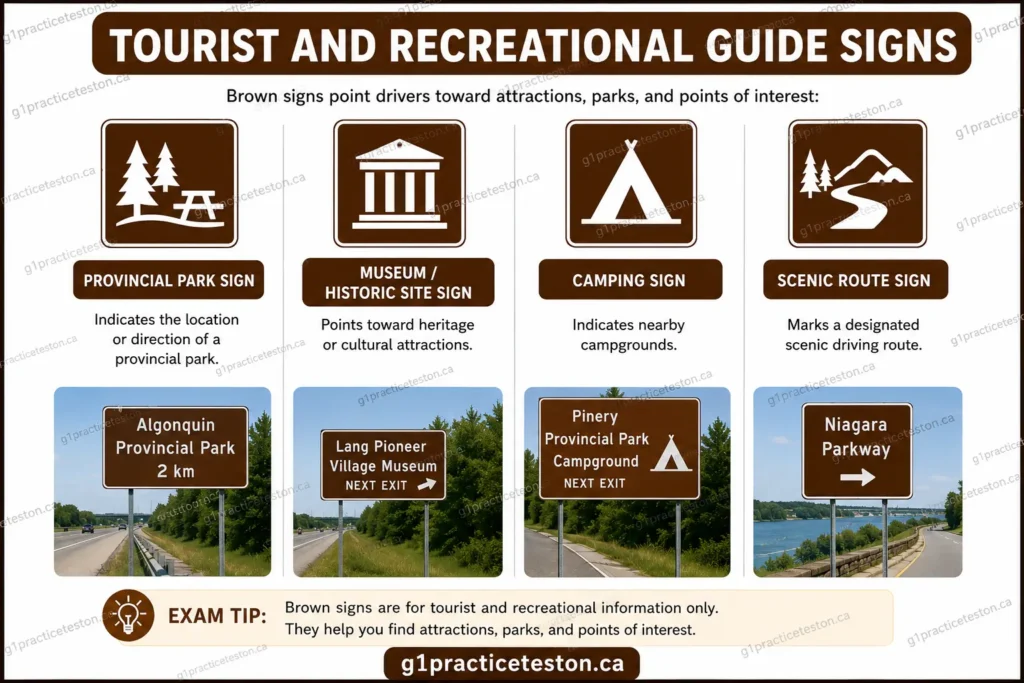
    Tourist and Recreational g1practiceteston.ca

    Tourist and Recreational Guide Signs

    Brown signs point drivers toward attractions, parks, and points of interest:

    • Provincial Park Sign — Indicates the location or direction of a provincial park.
    • Museum/Historic Site Sign — Points toward heritage or cultural attractions.
    • Camping Sign — Indicates nearby campgrounds.
    • Scenic Route Sign — Marks a designated scenic driving route.

    General Information and Notice Signs

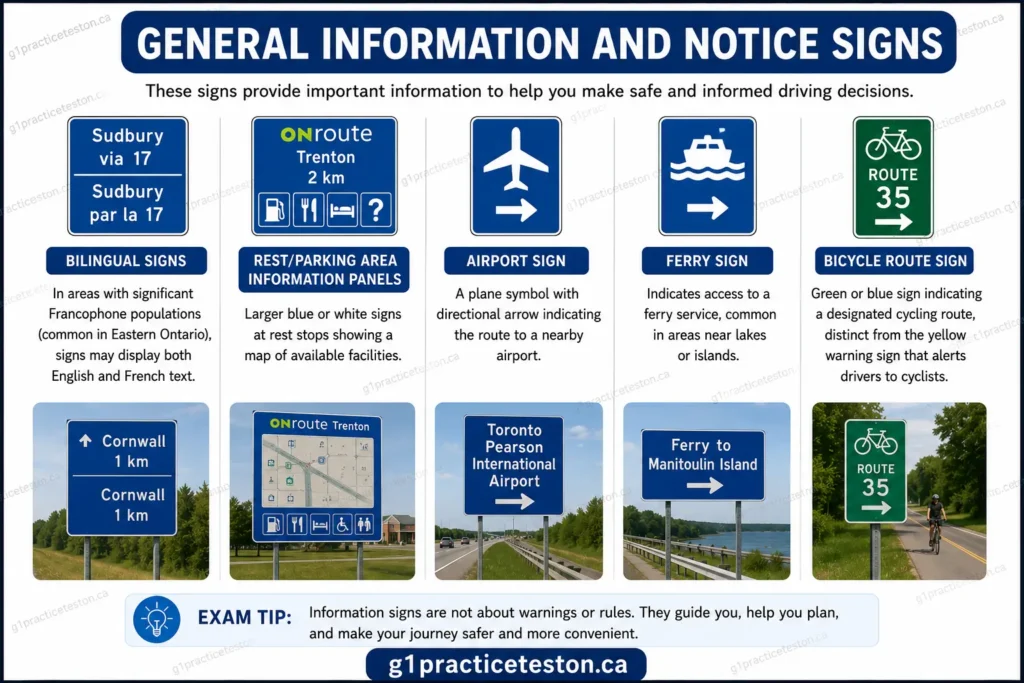
    • Bilingual Signs — In areas with significant Francophone populations (common in Eastern Ontario), signs may display both English and French text.
    • Rest/Parking Area Information Panels — Larger blue or white signs at rest stops showing a map of available facilities.
    • Airport Sign — A plane symbol with directional arrow indicating the route to a nearby airport.
    • Ferry Sign — Indicates access to a ferry service, common in areas near lakes or islands.
    • Bicycle Route Sign — Green or blue sign indicating a designated cycling route, distinct from the yellow warning sign that alerts drivers to cyclists.
    General Information g1practiceteston.ca
    Why This Category g1practiceteston.ca

    Why This Category Still Matters for the G1?

    Even though information and guide signs don’t carry legal weight or hazard urgency, the G1 test includes them because real-world driving depends heavily on quick sign recognition especially on unfamiliar highways where a missed exit sign or misread distance sign can mean minutes of lost time or an unsafe last-second lane change. Knowing the colour-coding system instantly (green = route, blue = service, brown = recreation) is often enough to answer most test questions correctly, even without memorizing every individual sign.

    Frequently Asked Questions

    Not as heavily as regulatory or warning signs, but they still appear, particularly questions about colour coding (green vs. blue vs. brown) and specific symbols like hospital, gas, or rest area signs.

    Ontario has significant Francophone communities, particularly in Eastern Ontario and parts of the North, and provincial policy requires bilingual signage in designated areas under the French Language Services Act.

    Green means route/direction, blue means service, and brown means recreation or tourism. Once that’s memorized, most individual signs become easy to interpret even without prior exposure.

    No. Unlike regulatory signs, information and guide signs are purely navigational and carry no legal obligation, though ignoring them (like missing a “Rest Area” sign) can still affect trip planning and safety on long drives.

    Conclusion

    Information and guide signs round out the third and final sign category tested on your G1 exam. They’re the easiest to master once you understand the colour-coding logic behind them green for routes, blue for services, brown for recreation and they matter just as much for real-world driving as they do for the test, especially on unfamiliar highways where quick recognition saves both time and stress.

  • |

    Warning Road Signs in Ontario — Full List & Meanings (2026 Guide)

    Out of all three sign categories on the G1 test, warning road signs are the ones I always tell new drivers to slow down and actually read carefully. They’re not asking you to follow a legal rule the way regulatory signs do; they’re telling you something is coming up that you need to be careful.

    Miss one, and it’s not just a test question you get wrong. It’s the difference between anticipating a sharp curve and being caught off guard by one.
    This guide covers every major category of warning sign you’ll encounter in Ontario, based on the official MTO Driver’s Handbook, organized the way they actually appear on the G1 exam.
    If you haven’t already gone through them, pair this with our Ontario Road Signs — Complete Guide and our Regulatory Road Signs in Ontario guide to cover all three sign categories tested on the G1.

    What Makes a Sign a “Warning” Sign?

    Warning road signs alert you to hazards, changing road conditions, or situations ahead that require caution, but unlike regulatory signs, they aren’t a legal command in themselves. You won’t get a ticket for “disobeying” a curve warning sign, but ignoring it can absolutely lead to a collision, which is exactly why the G1 test weighs this category heavily.

    In Ontario, warning road signs are almost always:

    • Yellow diamond-shaped, with black symbols or text.
    • Occasionally paired with a supplementary tab underneath (like an advisory speed plate).
    • Sometimes fluorescent yellow-green for signs involving pedestrians, cyclists, or school zones, a newer MTO standard meant to increase visibility

    This is different from regulatory signs (red/white or black/white, legally binding) and information/guide signs (green or blue, giving directions or services).

    Warning Road Signs Ontario
    Road Condition g1practiceteston.ca

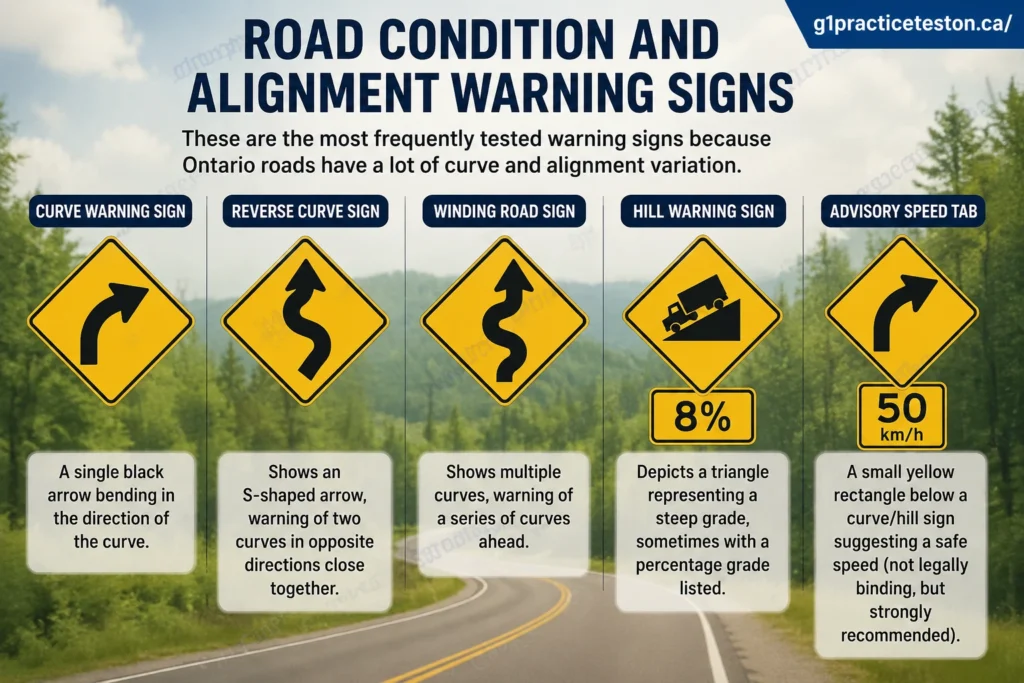
    Road Condition and Alignment Warning Signs

    These are the most frequently tested warning road signs because Ontario roads have a lot of curves and alignment variation:

    • Curve Warning Sign — A single black arrow bending in the direction of the curve.
    • Reverse Curve Sign — Shows an S-shaped arrow, warning of two curves in opposite directions close together.
    • Winding Road Sign — Shows multiple curves, warning of a series of curves ahead.
    • Hill Warning Sign — Depicts a triangle representing a steep grade, sometimes with a percentage grade listed.
    • Advisory Speed Tab — A small yellow rectangle below a curve/hill sign suggesting a safe speed (not legally binding, but strongly recommended).

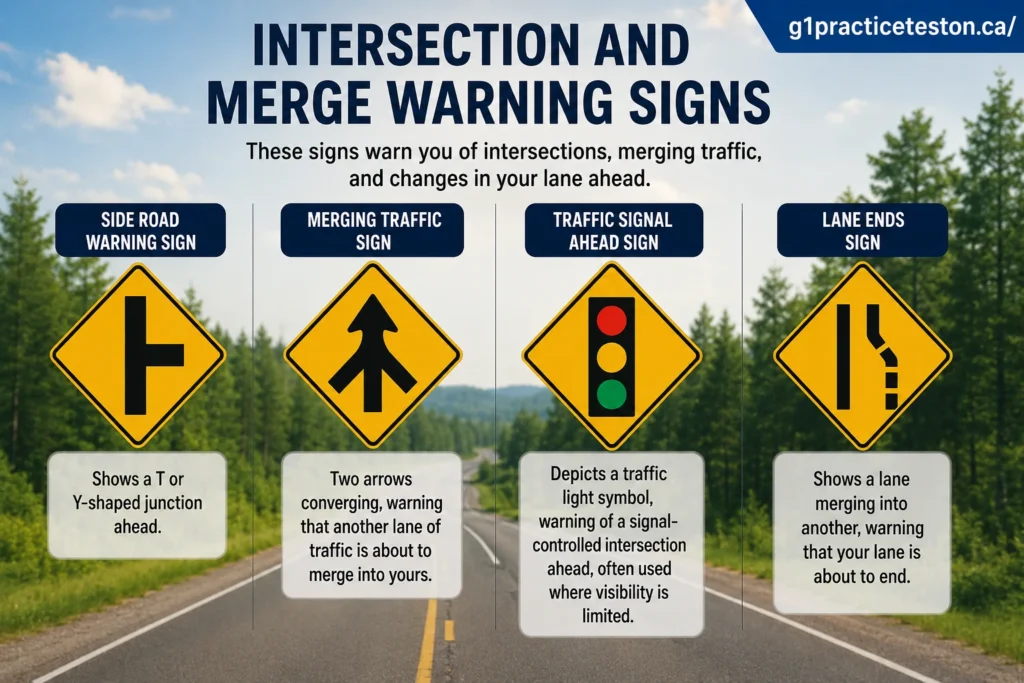
    Intersection and Merge Warning Signs

    • Side Road Warning Sign — Shows a T or Y-shaped junction ahead.
    • Merging Traffic Sign — Two arrows converging, warning that another lane of traffic is about to merge into yours.
    • Traffic Signal Ahead Sign — Depicts a traffic light symbol, warning of a signal-controlled intersection ahead, often used where visibility is limited.
    • Lane Ends Sign — Shows a lane merging into another, warning that your lane is about to end.
    Intersection and Merge g1practiceteston.ca
    Pedestrian School g1practiceteston.ca

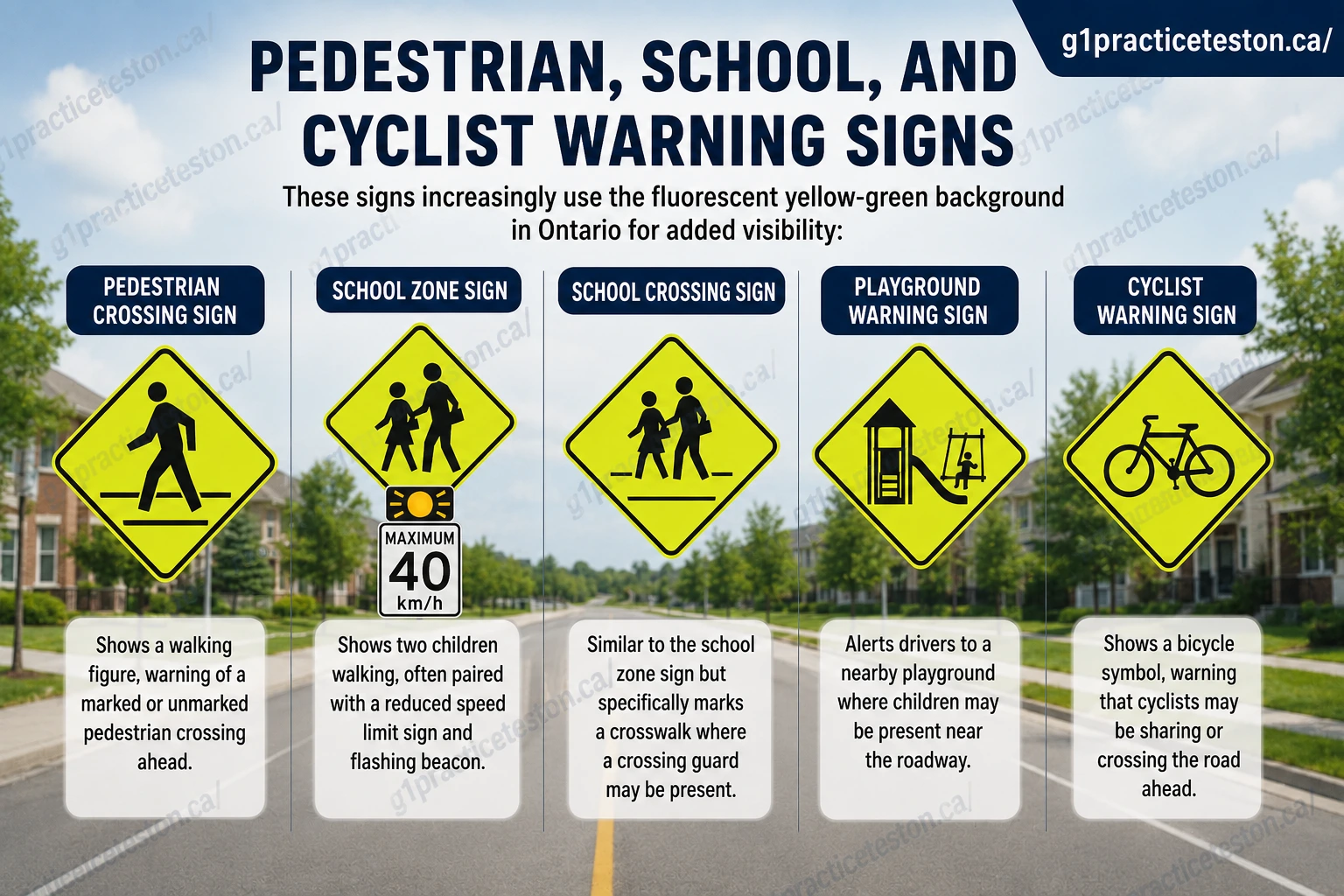
    Pedestrian, School, and Cyclist Warning Signs

    These signs increasingly use the fluorescent yellow-green background in Ontario for added visibility:

    • Pedestrian Crossing Sign — Shows a walking figure, warning of a marked or unmarked pedestrian crossing ahead.
    • School Zone Sign — Shows two children walking, often paired with a reduced-speed-limit sign and a flashing beacon.
    • School Crossing Sign — Similar to the school zone sign, but specifically marks a crosswalk where a crossing guard may be present.
    • Playground Warning Sign — Alerts drivers to a nearby playground where children may be present near the roadway.
    • Cyclist Warning Road Sign — Shows a bicycle symbol, warning that cyclists may be sharing or crossing the road ahead.
    tip g1practiceteston.ca e1783998811159

    G1 tip

    The test frequently asks you to distinguish a School Zone sign (general area) from a School Crossing sign (a specific crosswalk point), both use children symbols, but signal different things.

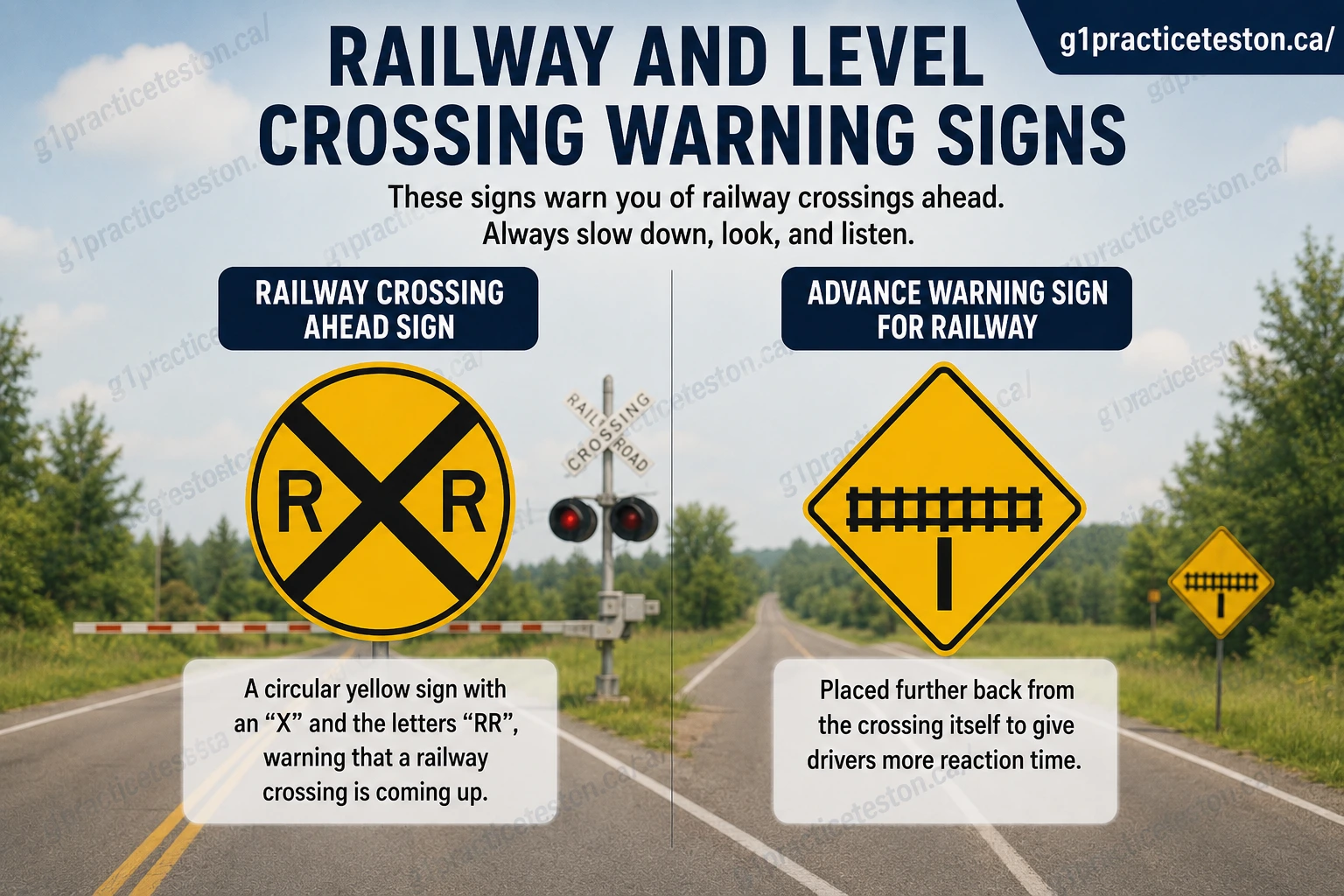
    Railway and Level Crossing Warning Signs

    • Railway Crossing Ahead Sign — A circular yellow sign with an “X” and the letters “RR,” warning that a railway crossing is coming up.
    • Advance Warning Sign for Railway — Placed further back from the crossing itself to give drivers more reaction time.
    Railway and Level Crossing g1practiceteston.ca
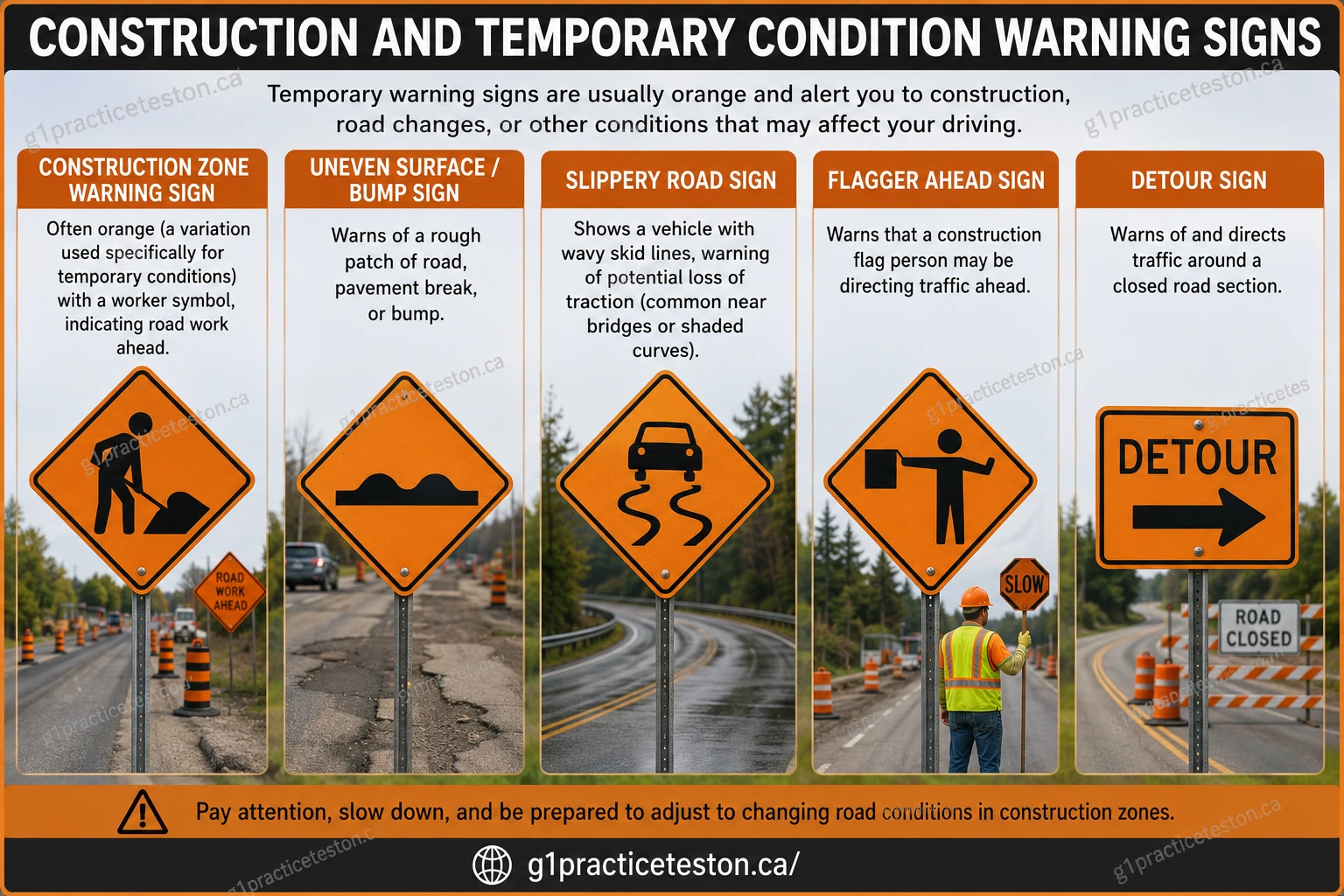
    Construction and Temporary g1practiceteston.ca

    Construction and Temporary Condition Warning Signs

    • Construction Zone Warning Sign — Often orange (a variation used specifically for temporary conditions) with a worker symbol, indicating road work ahead.
    • Uneven Surface / Bump Sign — Warns of a rough patch of road, pavement break, or bump.
    • Slippery Road Sign — Shows a vehicle with wavy skid lines, warning of potential loss of traction (common near bridges or shaded curves).
    • Flagger Ahead Sign — Warns that a construction flag person may be directing traffic ahead.
    • Detour Sign — Warns of and directs traffic around a closed road section.

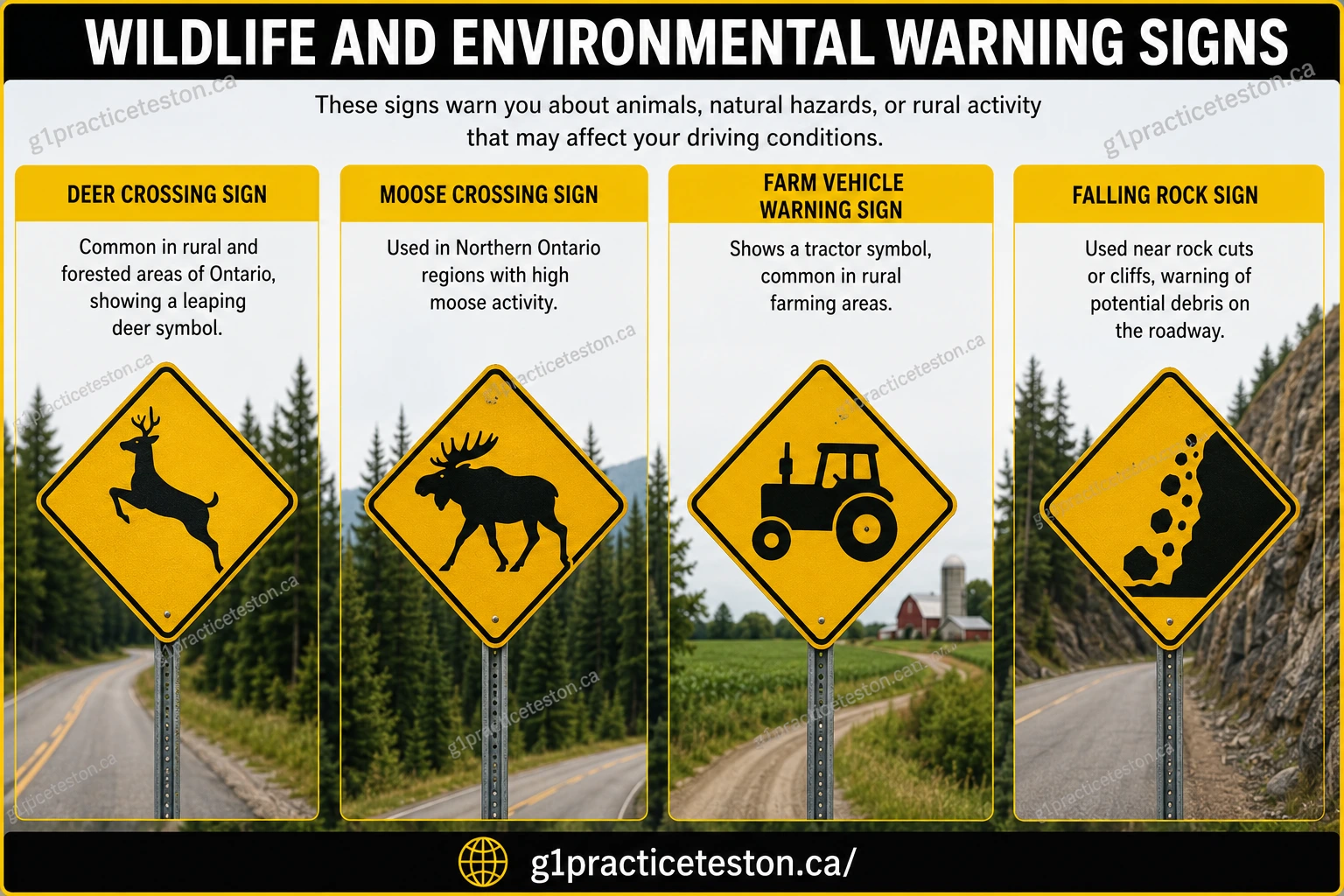
    Wildlife and Environmental Warning Signs

    • Deer Crossing Sign — Common in rural and forested areas of Ontario, showing a leaping deer symbol.
    • Moose Crossing Sign — Used in Northern Ontario regions with high moose activity.
    • Farm Vehicle Warning Sign — Shows a tractor symbol, common in rural farming areas.
    • Falling Rock Sign — Used near rock cuts or cliffs, warning of potential debris on the roadway.
    Wildlife and Environmental Warning Signs g1practiceteston.ca
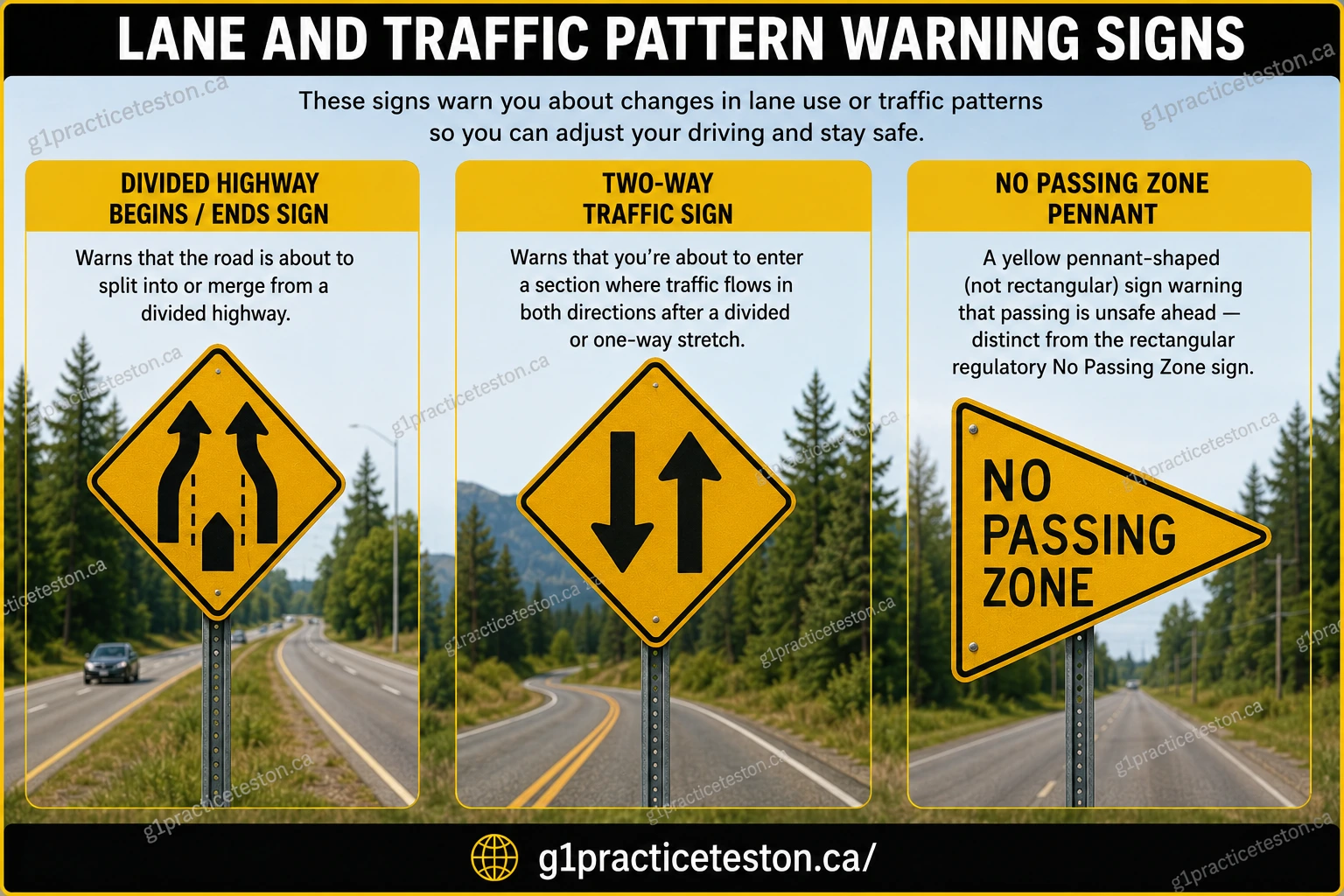
    Lane and Traffic g1practiceteston.ca

    Lane and Traffic Pattern Warning Signs

    • Divided Highway Begins/Ends Sign — Warns that the road is about to split into or merge from a divided highway.
    • Two-Way Traffic Sign — Warns that you’re about to enter a section where traffic flows in both directions after a divided or one-way stretch.
    • No Passing Zone Pennant — A yellow pennant-shaped (not rectangular) sign warning that passing is unsafe ahead — distinct from the rectangular regulatory No Passing Zone sign.

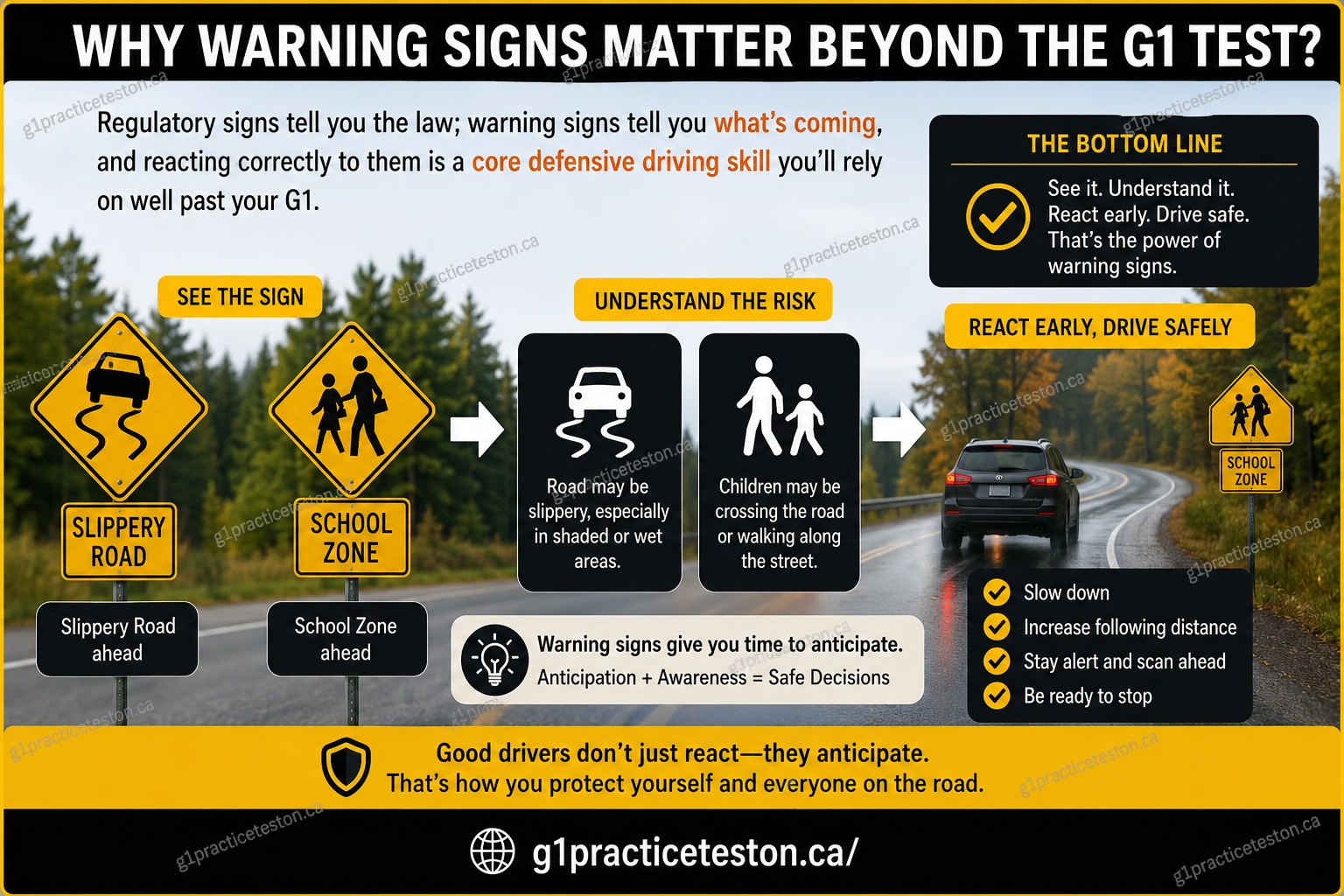
    Why Warning Signs Matter Beyond the G1 Test?

    Regulatory signs tell you the law; warning road signs tell you what’s coming, and reacting correctly to them is a core defensive driving skill you’ll rely on well past your G1. Recognizing a Slippery Road sign before a shaded curve, or a School Zone sign before a stretch with kids nearby, is exactly the kind of anticipation examiners are testing for, both on paper and later during your road test.

    why g1practiceteston.ca 1

    Frequently Asked Questions

    Most are yellow diamonds with black symbols or text, though signs involving pedestrians, cyclists, or school zones increasingly use a fluorescent yellow-green background for better visibility.

    Not directly, you won’t be ticketed simply for “ignoring” a warning sign the way you would for running a stop sign. However, failing to adjust your driving appropriately (like speeding through a curve) can lead to careless driving charges if it results in a collision.

    A School Zone sign warns of a general area near a school, often with a reduced speed limit. A School Crossing sign marks a specific crosswalk point, sometimes staffed by a crossing guard.

    The fluorescent yellow-green colour is used by the MTO for signs involving pedestrians, school zones, and cyclists, specifically because it stands out more in daylight and low-visibility conditions, improving driver reaction time.

    Conclusion

    Warning road signs are your early alert system on Ontario roads; they don’t carry the legal weight of regulatory signs, but ignoring them is often what leads to the situations that regulatory signs and traffic laws are meant to prevent in the first place. Learning to recognize them by shape, colour, and symbol rather than memorizing each one individually will make both your G1 test and your actual driving noticeably safer.

    Related Posts:

  • |

    Regulatory Road Signs in Ontario — Full List & Meanings (2026 Guide)

    When I sat down to study for my own G1 knowledge test, regulatory road signs Ontario were the section that actually made me confused, and the marks on my first try weren’t good, not because they’re complicated, but because there are so many of them and they all look similar at first.

    Round, rectangular, red circles, white backgrounds, it’s easy to mix up a “No Left Turn” with a “No U-Turn” if you’re skimming instead of studying properly.
    This guide breaks down every major category of regulatory sign you’ll see on Ontario roads and on your G1 test, based directly on the official MTO Driver’s Handbook. I’ve grouped them the way they actually show up on the exam.

    By function, not just by shape, so you can build real recognition instead of just memorizing pictures the night before your test.
    If you haven’t already, it’s worth reading our Ontario Road Signs — Complete Guide first, since this article goes deeper specifically into the regulatory category, one of the three main sign types (regulatory, warning, and information) tested on the G1.

    Practice Regulatory Signs test →

    What Makes a Sign “Regulatory”?

    Regulatory signs tell you what you must or must not do. They carry the force of law; ignoring one isn’t just bad driving etiquette. It’s a traffic violation that can get you fined or, in more serious cases, get demerit points added to your licence once you’re past the G1 stage.
    You’ll recognize most regulatory signs by their shape and colour pattern:

    • Red circle with a diagonal slash — something is prohibited
    • White rectangle with black text/symbols — a rule or requirement
    • Red octagon — Stop (always)
    • Red-and-white inverted triangle — Yield (always)

    This is different from warning signs (yellow diamonds, alerting you to hazards ahead) and information/guide signs (green or blue, giving directions or services). If you mix these three categories up on the test, it’s usually because the studying was done by shape alone rather than by purpose, which is the approach we’re using here.

    regulatory road signs ontario
ontario regulatory signs list, g1 regulatory signs, stop and yield signs ontario, speed limit signs ontario, turn restriction signs ontario
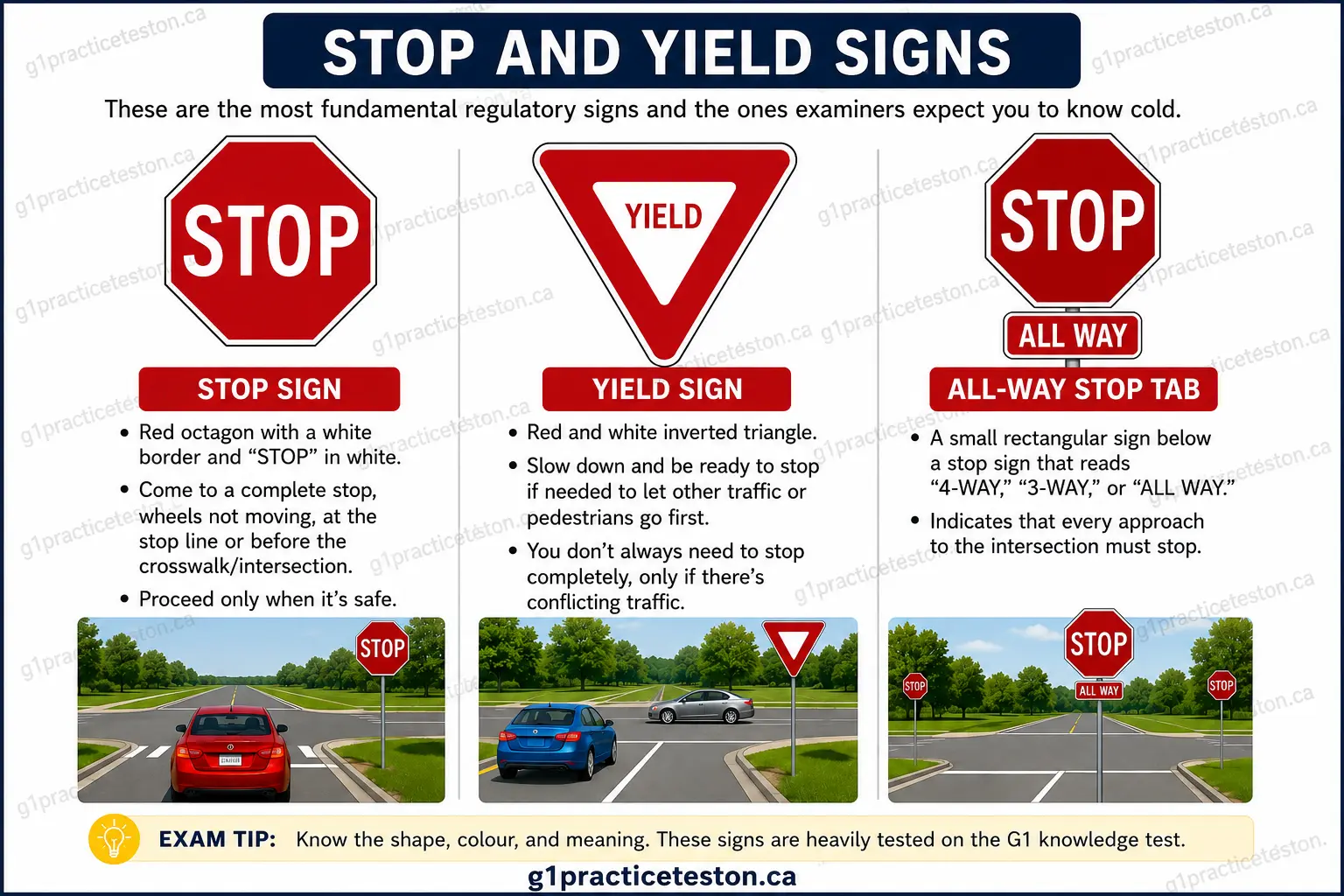
    Stop Yield g1practiceteston.ca

    Stop and Yield Signs

    These are the most fundamental regulatory signs and the ones examiners expect you to know cold.

    • Stop Sign — Red octagon with a white border and “STOP” in white. Come to a complete stop, wheels not moving, at the stop line or before the crosswalk/intersection. Proceed only when it’s safe.
    • Yield Sign — Red and white inverted triangle. Slow down and be ready to stop if needed to let other traffic or pedestrians go first. You don’t always need to stop completely, only if there’s conflicting traffic.
    • All-Way Stop Tab — A small rectangular sign below a stop sign that reads “4-WAY,” “3-WAY,” or “ALL WAY,” indicating that every approach to the intersection must stop.

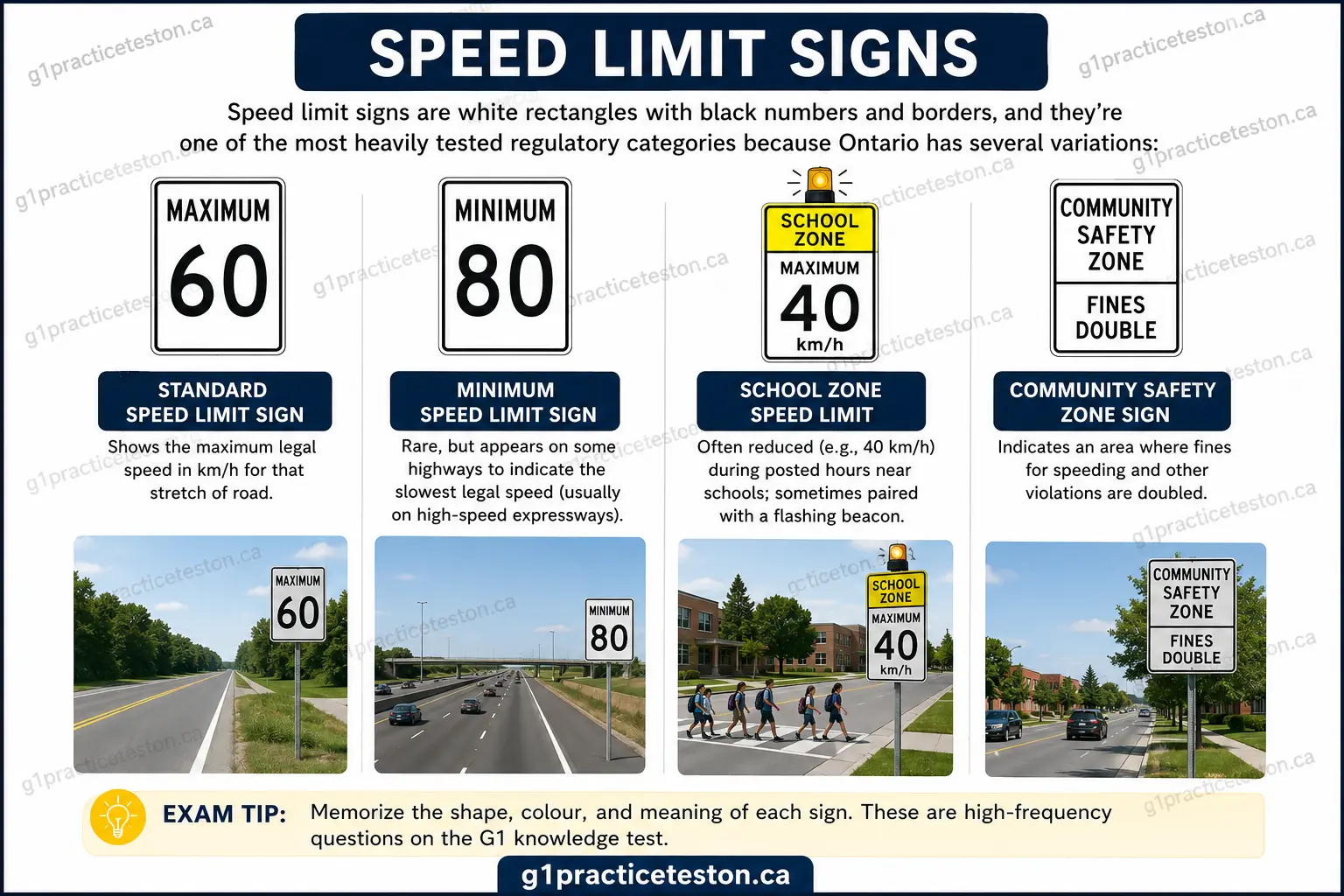
    Speed Limit Signs

    Speed limit signs are white rectangles with black numbers and borders, and they’re one of the most heavily tested regulatory categories because Ontario has several variations:

    • Standard Speed Limit Sign — Shows the maximum legal speed in km/h for that stretch of road.
    • Minimum Speed Limit Sign — Rare, but appears on some highways to indicate the slowest legal speed (usually on high-speed expressways).
    • School Zone Speed Limit — Often reduced (e.g., 40 km/h) during posted hours near schools; sometimes paired with a flashing beacon.
    • Community Safety Zone Sign — Indicates an area where fines for speeding and other violations are doubled.
    Speed Limit Signs g1practiceteston.ca
    tip g1practiceteston.ca e1783998811159

    G1 tip

    Know that the default speed limit in an Ontario municipality (if unposted) is 50 km/h, and 80 km/h on most rural roads unless otherwise signed. This is one of the most commonly tested unposted-limit questions.

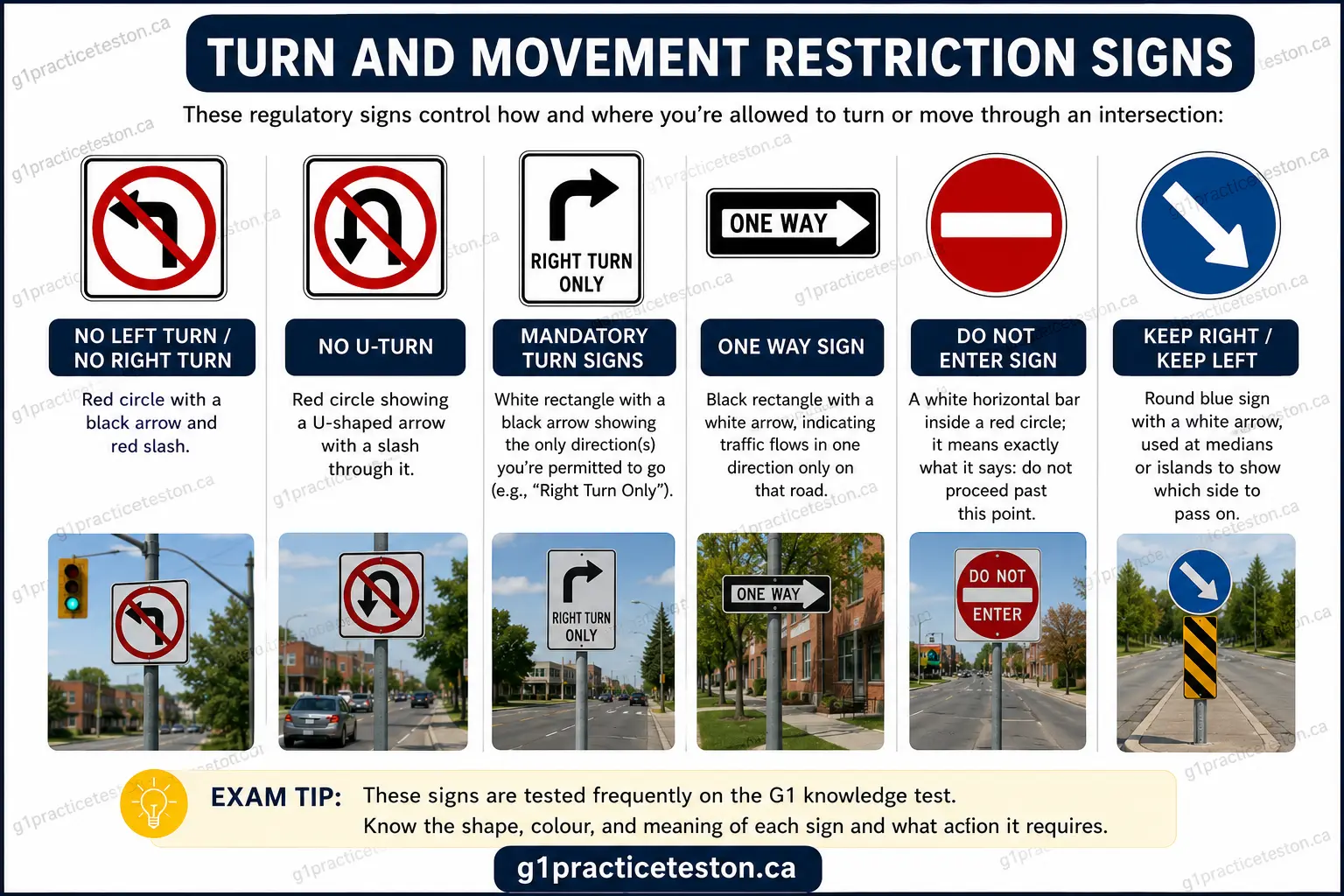
    turn g1practiceteston.ca

    Turn and Movement Restriction Signs

    These regulatory signs control how and where you’re allowed to turn or move through an intersection:

    • No Left Turn / No Right Turn — Red circle with a black arrow and red slash.
    • No U-Turn — Red circle showing a U-shaped arrow with a slash through it.
    • Mandatory Turn Signs — White rectangle with a black arrow showing the only direction(s) you’re permitted to go (e.g., “Right Turn Only”).
    • One Way Sign — Black rectangle with a white arrow, indicating traffic flows in one direction only on that road.
    • Do Not Enter Sign — A white horizontal bar inside a red circle; it means exactly what it says: do not proceed past this point.
    • Keep Right / Keep Left — Round blue sign with a white arrow, used at medians or islands to show which side to pass on.

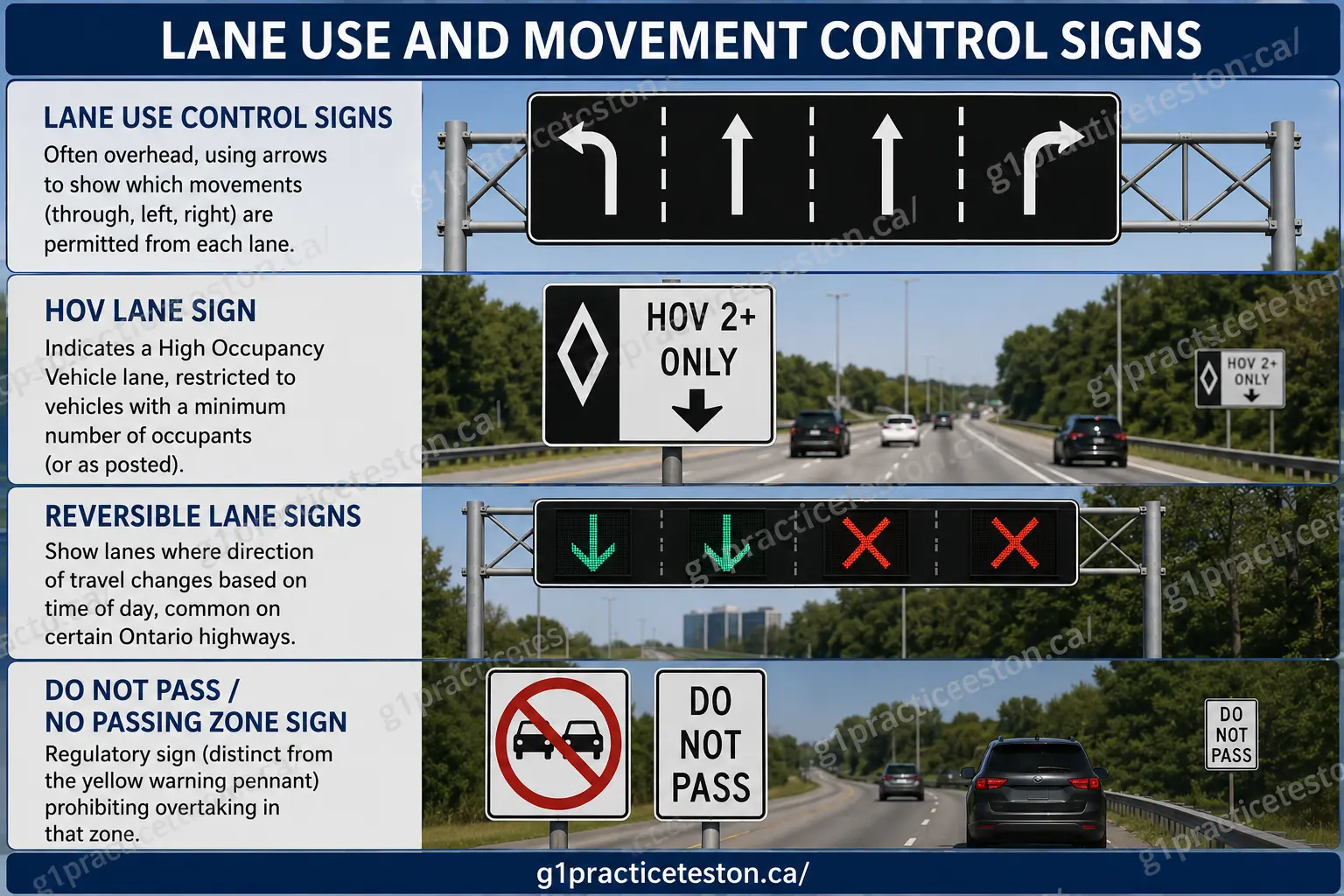
    Lane Use and Movement Control Signs

    • Lane Use Control Signs — Often overhead, using arrows to show which movements (through, left, right) are permitted from each lane.
    • HOV Lane Sign — Indicates a High Occupancy Vehicle lane, restricted to vehicles with a minimum number of occupants (or as posted).
    • Reversible Lane Signs — Show lanes where direction of travel changes based on time of day, common on certain Ontario highways.
    • Do Not Pass / No Passing Zone Sign — Regulatory sign (distinct from the yellow warning pennant) prohibiting overtaking in that zone.
    Lane use g1practiceteston.ca
    Parking g1practiceteston.ca

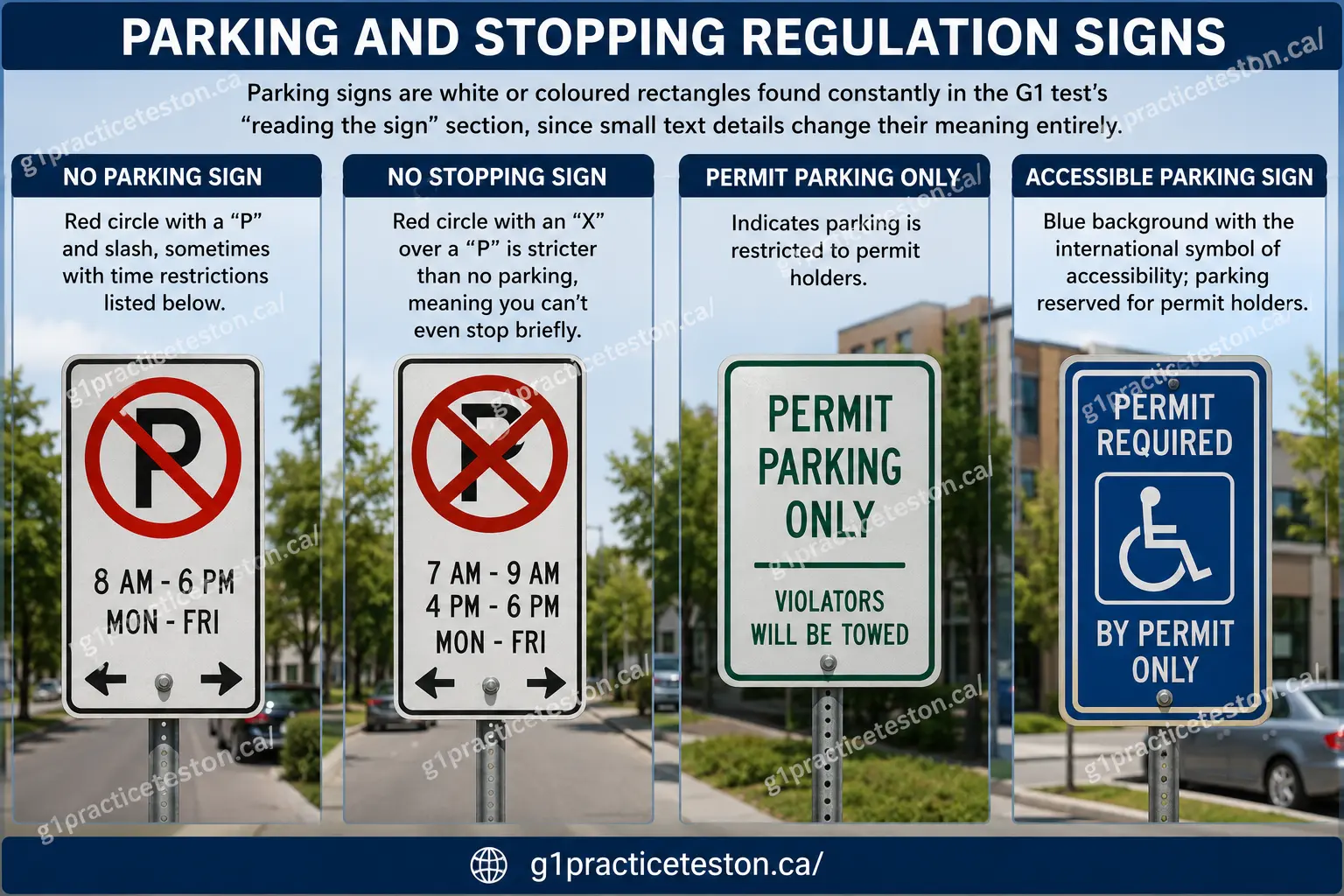
    Parking and Stopping Regulation Signs

    Parking signs are white or coloured rectangles found constantly in the G1 test’s “reading the sign” section, since small text details change their meaning entirely:

    • No Parking Sign — Red circle with a “P” and slash, sometimes with time restrictions listed below.
    • No Stopping Sign — Red circle with an “X” over a “P” is stricter than no parking, meaning you can’t even stop briefly.
    • Permit Parking Only — Indicates parking is restricted to permit holders.
    • Accessible Parking Sign — Blue background with the international symbol of accessibility; parking reserved for permit holders.
    tip g1practiceteston.ca e1783998811159

    G1 tip

    The test often asks you to distinguish “No Parking” from “No Stopping.” Remember, No Stopping is the stricter rule with zero exceptions, even to drop someone off.

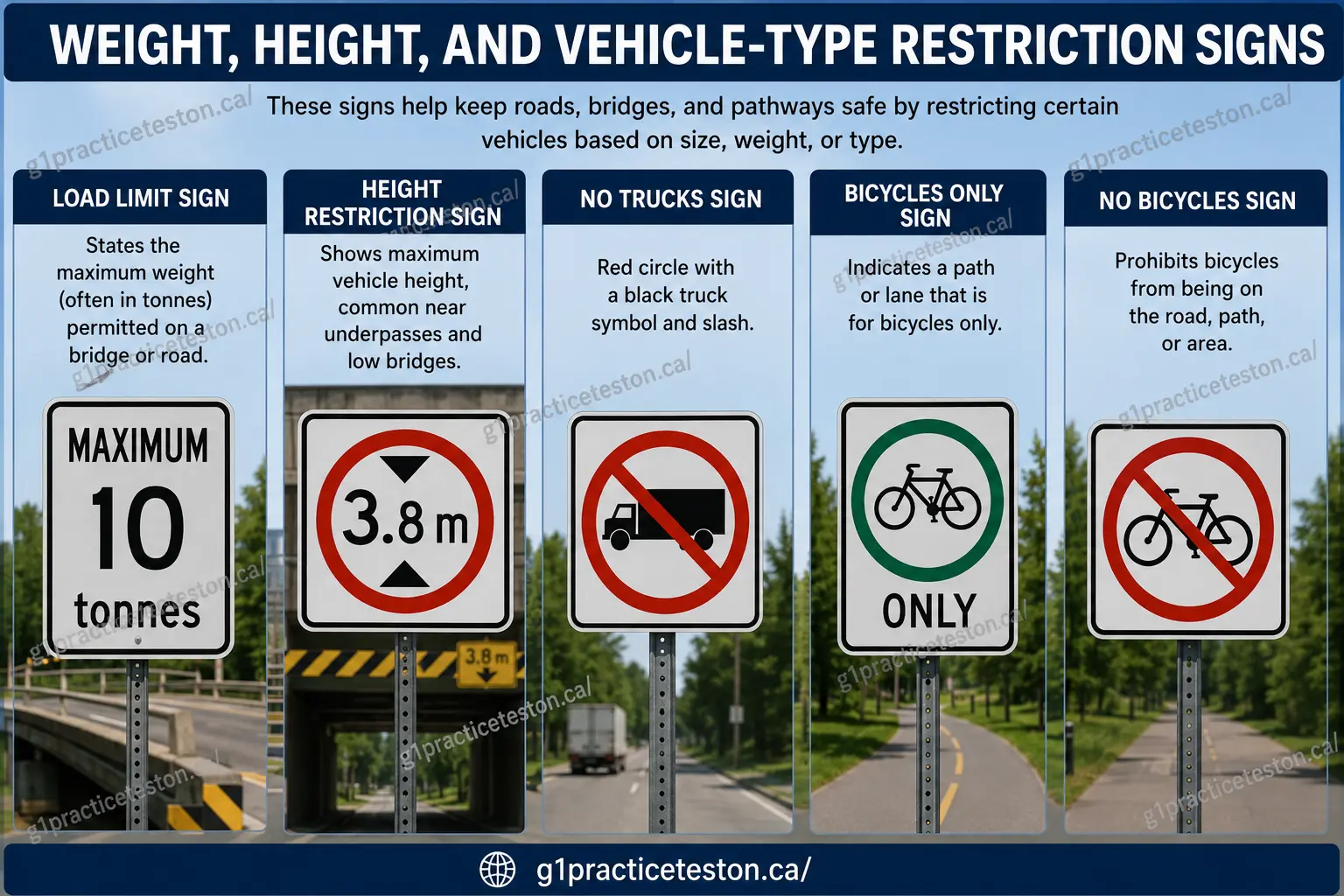
    Weight, Height, and Vehicle-Type Restriction Signs

    • Load Limit Sign — States the maximum weight (often in tonnes) permitted on a bridge or road.
    • Height Restriction Sign — Shows maximum vehicle height, common near underpasses and low bridges.
    • No Trucks Sign — Red circle with a black truck symbol and slash.
    • Bicycles Only / No Bicycles Signs — Regulate where cyclists must or must not ride.
    Weight Height g1practiceteston.ca
    Other Common Regulatory Signs g1practiceteston.ca

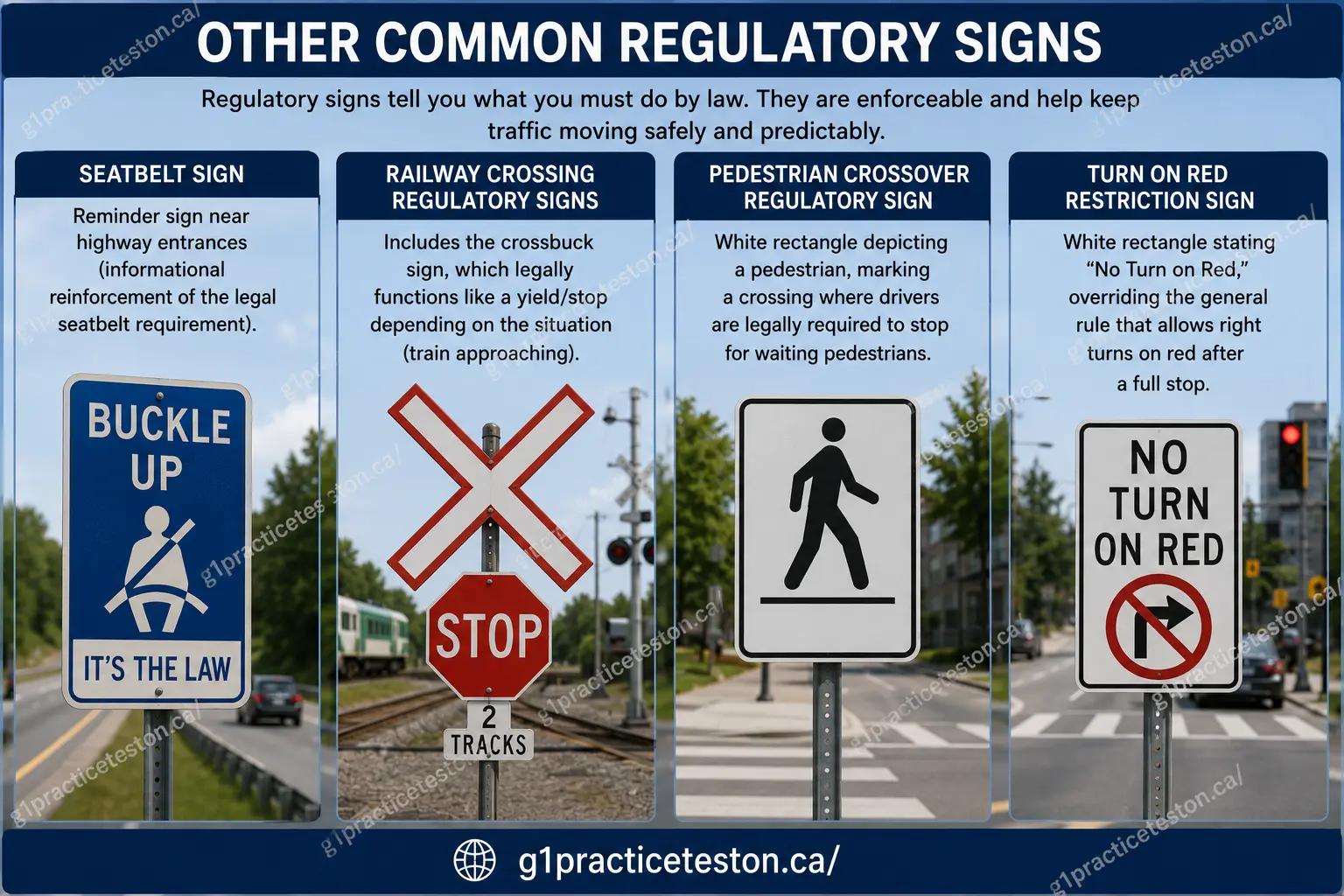
    Other Common Regulatory Signs

    • Seatbelt Sign — Reminder sign near highway entrances (informational reinforcement of the legal seatbelt requirement).
    • Railway Crossing Regulatory Signs — Includes the crossbuck sign, which legally functions like a yield/stop depending on the situation (train approaching).
    • Pedestrian Crossover Regulatory Sign — White rectangle depicting a pedestrian, marking a crossing where drivers are legally required to stop for waiting pedestrians.
    • Turn on Red Restriction Sign — White rectangle stating “No Turn on Red,” overriding the general rule that allows right turns on red after a full stop.

    Why This Matters Beyond the G1 Test

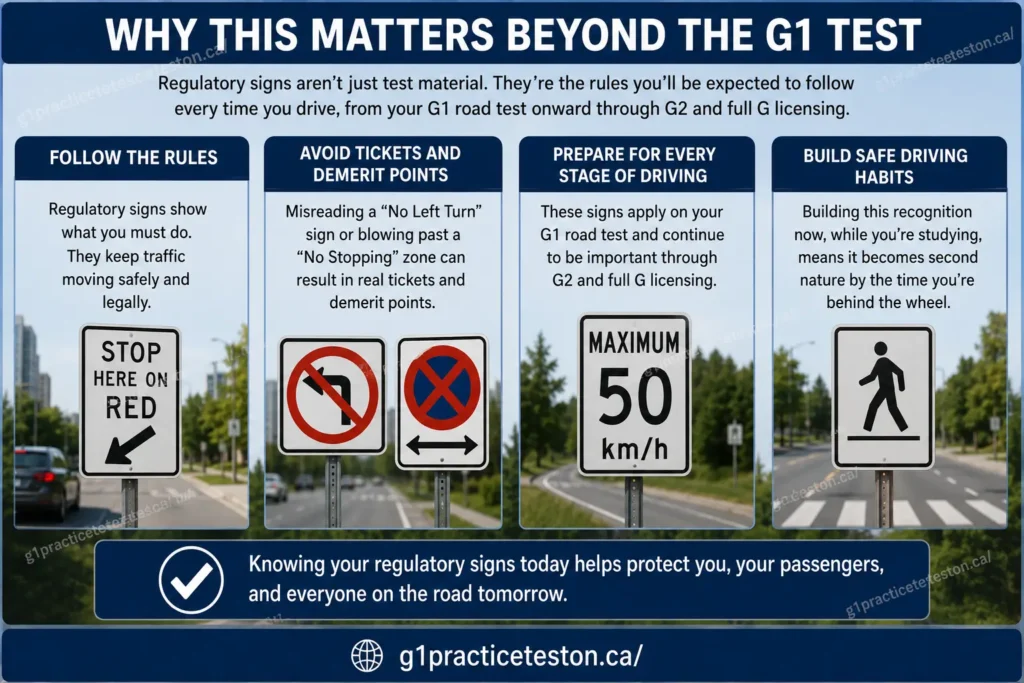
    Regulatory signs aren’t just test material. They’re the rules you’ll be expected to follow every time you drive, from your G1 road test onward through G2 and full G licensing. Misreading a “No Left Turn” sign or blowing past a “No Stopping” zone doesn’t just cost test points; it can result in real tickets and demerit points later. Building this recognition now, while you’re studying, means it becomes second nature by the time you’re behind the wheel.

    why g1practiceteston.ca

    Frequently Asked Questions

    The exact number varies by test version, but regulatory signs typically make up a meaningful portion of the road signs section, alongside warning and information signs. Expect several direct “what does this sign mean” questions.

    Regulatory signs (white/red, often circular or rectangular) tell you what’s legally required. Warning signs (yellow diamonds) alert you to hazards or conditions ahead, but aren’t legal requirements themselves.

    Yes, shape and colour are intentional and consistent across Ontario, so recognizing the pattern (red circle = prohibition, white rectangle = rule/requirement) will help you correctly guess even unfamiliar signs on the test.

    No. No Parking allows brief stops (like dropping off a passenger); No Stopping does not allow you to stop at all, except in an emergency.

    Conclusion

    Regulatory signs make up one of the most testable and most practical sections of your G1 knowledge exam. The key isn’t memorizing every sign individually, but learning to recognize the pattern: shape and colour tell you the sign’s function before you even read the text. Once that clicks, questions about stop/yield, turn restrictions, speed limits, and parking rules become quick, easy points rather than guesswork.

    Related Posts:

End of content

End of content