
The G1 knowledge test is full of numbers — how many questions, what score passes, which fees, which distances, how many points. This cheat sheet gathers all of them on one page, straight from the Official MTO Driver’s Handbook and DriveTest. Bookmark it, print it, and run through it the night before your test. When a number needs more explanation, each section links to the guide or practice quiz that covers it in depth.
Last updated: November 19, 2026
The Test at a Glance
| Questions on the real test | 40 multiple-choice |
| Sections | 2 – 20 road signs + 20 rules of the road |
| Score needed | 16 out of 20 (80%) in EACH section – the sections are scored separately, and both must be passed |
| Time limit | None – most people finish in about 20–30 minutes |
| Marking | On the spot – you know your result before you leave |
| Result validity | A passed section stays valid for 1 year; a rewrite within that year covers only the section that did not pass |
| Languages | The written test is offered in 32 languages at DriveTest centres |
Ready to rehearse the real format? Take the full G1 test simulator once you have worked through the practice quizzes.
Fees and Your Licence Timeline
| Class G1 licence package | $159.75 — covers the knowledge test, your first G2 road test and a 5-year licence |
| Each extra knowledge-test attempt | $16.00 |
| Minimum age for a G1 | 16 years |
| Vision test | Required when you apply |
| Time at G1 before the G2 road test | 12 months — or 8 months if you complete a government-approved driver education course |
| Total time to finish all stages (G1 → G2 → G) | 5 years — if the five years run out first, you start over |
The full application checklist — identification, where to go, how the visit works — is in our G1 driving test requirements guide.
G1 Rules You Must Not Break
| Rule | The number |
|---|---|
| Your blood alcohol level while driving | 0.00 — zero tolerance |
| Accompanying driver | A fully licensed (G) driver with at least 4 years of driving experience, sitting in the front seat; their blood alcohol must be below 0.05 |
| Driving hours | No driving between midnight and 5 a.m. |
| High-speed highways | No 400-series highways or high-speed expressways, unless you are with a licensed driving instructor |
| Passengers | No more passengers than there are working seat belts — and every passenger must use one |
Each of these is explained in plain language in our guide to G1 licence restrictions in Ontario.
Numbers for the Road
| Situation | The number |
|---|---|
| Speed limit where none is posted — in a city, town or village | 50 km/h |
| Speed limit where none is posted — outside built-up areas | 80 km/h |
| Safe following distance behind the vehicle ahead | At least 2 seconds — more in rain, snow or fog |
| Stopping for a school bus with flashing red lights | Stop at least 20 metres away — traffic in both directions must stop, unless the road is divided by a median |
| Stopping at a railway crossing when required | At least 5 metres from the nearest rail |
| Following a fire truck or emergency vehicle with lights or siren on | Stay back at least 150 metres |
| Parking near a fire hydrant | Not within 3 metres |
Practise these until they are automatic in the Rules of the Road practice test — the explanations cover the situation behind every number.
Demerit Points for New Drivers
As a G1 driver you are a novice driver, and the novice thresholds are stricter than for fully licensed drivers. Points stay on your record for 2 years from the offence date.
| Points on your record | What happens (novice drivers) |
|---|---|
| 2–5 points | Warning letter |
| 6–8 points | Second warning letter |
| 9 or more points | Licence suspended for 60 days |
Points for offences the test asks about most: failing to stop for a school bus — 6; careless driving — 6; speeding by 50 km/h or more — 6; speeding by 30–49 km/h — 4; following too closely — 4; using a hand-held phone — 3; failing to yield the right-of-way — 3; driver not wearing a seat belt — 2.
Sign Shapes and Colours at a Glance
| Shape or colour | Always means |
|---|---|
| Octagon (8 sides) | Stop |
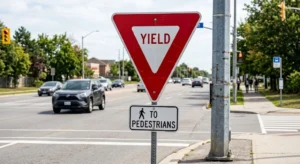
| Upside-down triangle | Yield |
| Pentagon (5 sides) | School crossing |
| Diamond | Warning of a hazard ahead |
| X shape | Railway crossing |
| Orange | Temporary condition — construction, detours |
| Green circle on a regulatory sign | The action shown is permitted |
| Red circle with a slash | The action shown is prohibited |


Ontario signs fall into four families — regulatory, warning, temporary, and information and direction signs. See them all in the Ontario road signs guide, then drill them in the Traffic Signs practice test and the Regulatory Road Signs practice test. The orange diamond in the photo above is a flying stones sign — see what it means and how it shows up on the G1 test.
What to Bring on Test Day
- Two pieces of identification (originals — one showing your legal name and date of birth, one with your signature)
- Glasses or contact lenses if you need them to drive (you will take a vision test)
- Payment for the $159.75 licence package
Details and the step-by-step visit walkthrough are in the G1 driving test requirements guide. For a minute-by-minute test-day checklist, see our G1 test-day checklist.
G1 Cheat Sheet — Frequently Asked Questions
How many questions are on the G1 test?
There are 40 multiple-choice questions: 20 about road signs and 20 about the rules of the road. Each section is scored on its own, so you are really writing two short tests in one sitting.
What is the G1 passing score?
You need at least 16 out of 20 — 80% — in the signs section AND at least 16 out of 20 in the rules section. A high score in one section cannot make up for a low score in the other.
How long is a G1 licence valid?
You have five years from getting your G1 to complete the whole graduated licensing process (G1, then G2, then the full G licence). Most drivers spend 12 months at the G1 stage before taking the G2 road test — 8 months if they finish a government-approved driver education course.
How many passengers can a G1 driver have?
As many as there are working seat belts in the vehicle — no more. The front seat is reserved for your accompanying driver, who must hold a full G licence with at least four years of driving experience.
How many types of road signs are there in Ontario?
Ontario’s signs fall into four families: regulatory signs that state the law, warning signs for hazards ahead, orange temporary signs for construction and detours, and information and direction signs. Shape and colour tell you the family before you even read the sign — the table above is the fastest way to learn them.
This cheat sheet is an independent study aid based on the Official MTO Driver’s Handbook and DriveTest. It is not affiliated with the Ministry of Transportation or DriveTest. Fees and rules can change — confirm the latest figures at drivetest.ca before you apply.
