
Not every Ontario sign shows a picture you have to memorise on its own. Some signs use a code, and once you know the code you can read any sign that uses it. The green circle is one of those codes. It appears on regulatory signs, and it tells you that the activity shown inside the ring is permitted — or, in some cases, something you must do. This page explains the code, how it differs from the red circle, and how the G1 test asks about it.
Last updated: November 20, 2026
Test yourself: try this sign in the free Traffic Signs Practice Test.
What this sign means
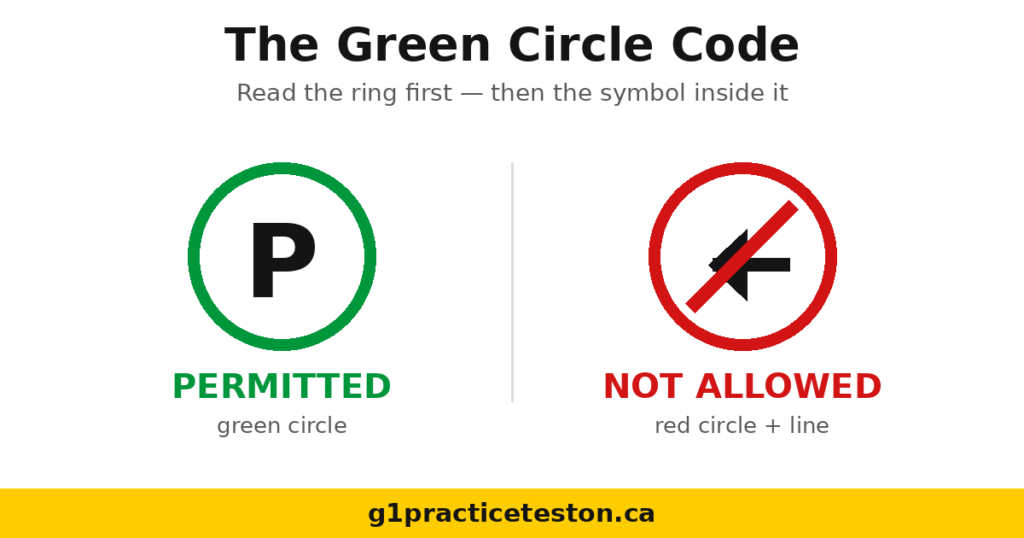
A green circle on an Ontario regulatory sign means the activity shown inside the ring is allowed, or is something you must do. The symbol inside the ring is what changes from sign to sign — the circle is the part that tells you the direction of the rule. Two examples from the site’s own question bank show how the same code works with different symbols: A white sign with the letter “P” inside a green circle, with a double-headed arrow and a times-of-day tab, means parking is permitted — only in the area between this sign and the next one, and only during the times shown. A white sign with a black snowmobile symbol inside a green circle means snowmobiles may legally share the road — so other drivers should watch for them, especially in winter. The key reading skill is therefore two-part: first read the circle (green = permitted), then read the symbol inside it (what, exactly, is permitted, and for whom).
What you must do
- When you see a green circle, do not treat it as a warning or a prohibition — it is the opposite of the red-circle prohibition.
- Read the symbol inside the ring before acting: the permission covers only the activity and, where shown, only the vehicle type in the symbol. A permission for buses, for parking, or for snowmobiles does not transfer to other vehicles or activities.
- Obey any conditions shown with the sign, such as a times-of-day tab or a “between these signs” area — the permission ends where its conditions end.
- A green circle does not remove the normal rules of the road: a permitted turn still needs a signal and a yield to oncoming traffic and pedestrians, and permitted parking still has to be done legally and safely.
- If you are unsure whether the circle is green (permitted) or red with a line through it (not allowed), slow down and re-read it — confusing the two reverses the meaning of the sign entirely.
How it appears on the G1 test
The G1 tests sign recognition, and the green-circle code is one of the most testable colour rules in the bank: a green circle means the action pictured is permitted or mandatory, while a red circle with a line through it means it is prohibited. Test questions turn on that contrast and on the symbol inside the ring — for example, a P in a green circle (parking permitted, with times) versus a pedestrian symbol in a red circle with a line (pedestrians not permitted). Learn the code, not just one sign, and every green-circle question becomes readable.
Signs people confuse with this one
- Red circle with a line through it (prohibitory) — the exact opposite: the activity shown is not allowed. Examples in the bank: no left turn, no straight-through, no pedestrians.
- Buses may turn left (live B1 page, sign 5) — one specific application of the green-circle code: the permission is for buses turning left, not for every vehicle.
- Mandatory turn signs — regulatory signs that order a turn in the shown direction. The green-circle “may or must” wording overlaps here, so read the symbol: a permission and an order are not the same instruction, even when both use a circle. (Page not live yet — name only, no link.)
- Warning signs (yellow diamond) — a different family entirely: warnings tell you about a hazard ahead, they do not permit or prohibit an action. (Pages live for some warning signs — link “Warning signs” to /warning-road-signs-ontario/.)
- Information signs — these give guidance, not a regulatory permission or prohibition. Lane Start is one:
What does a green circle on an Ontario road sign mean?
It means the activity shown inside the ring is permitted, or is something you must do. The symbol inside the ring says what activity that is.
What is the difference between a green circle sign and a red circle sign?
A green circle means you may or must do the activity shown inside the ring. A red circle with a line through it means the activity shown is not allowed.
Does a green circle mean I can do anything?
No. The permission covers only the activity and vehicle type shown inside the ring, and only under any conditions shown with the sign, such as times of day.
What does a P inside a green circle mean?
Parking is permitted — only in the area between this sign and the next one, and only during the times shown on the sign.
Does the green circle code appear on the G1 test?
Yes. The G1 tests sign recognition, including regulatory signs, and the green-circle-versus-red-circle contrast is a standard testable point: green = permitted, red with a line = prohibited.
Jessica
Jessica took the Ontario G1 knowledge test in 2024 and passed it on the first attempt, scoring 90%. Jessica writes and checks every question and guide on this site.