
Right-of-way is the single most-tested rules area on the Ontario G1 test — and the most misunderstood. The core idea is simple, and it is also the trap: right-of-way is given, never taken. Nobody ‘has’ it as a possession you can insist on. The rules below tell you who should go first, but if going first would cause a collision, you wait. That one sentence explains half the test questions on this topic. A second trap sits in the same paragraph of the handbook: signalling does not give you the right-of-way. Turning your indicator on tells other drivers what you intend to do. It does not make the way yours. You still go only when the way is clear.
Last updated: November 19, 2026
Two kinds of intersection
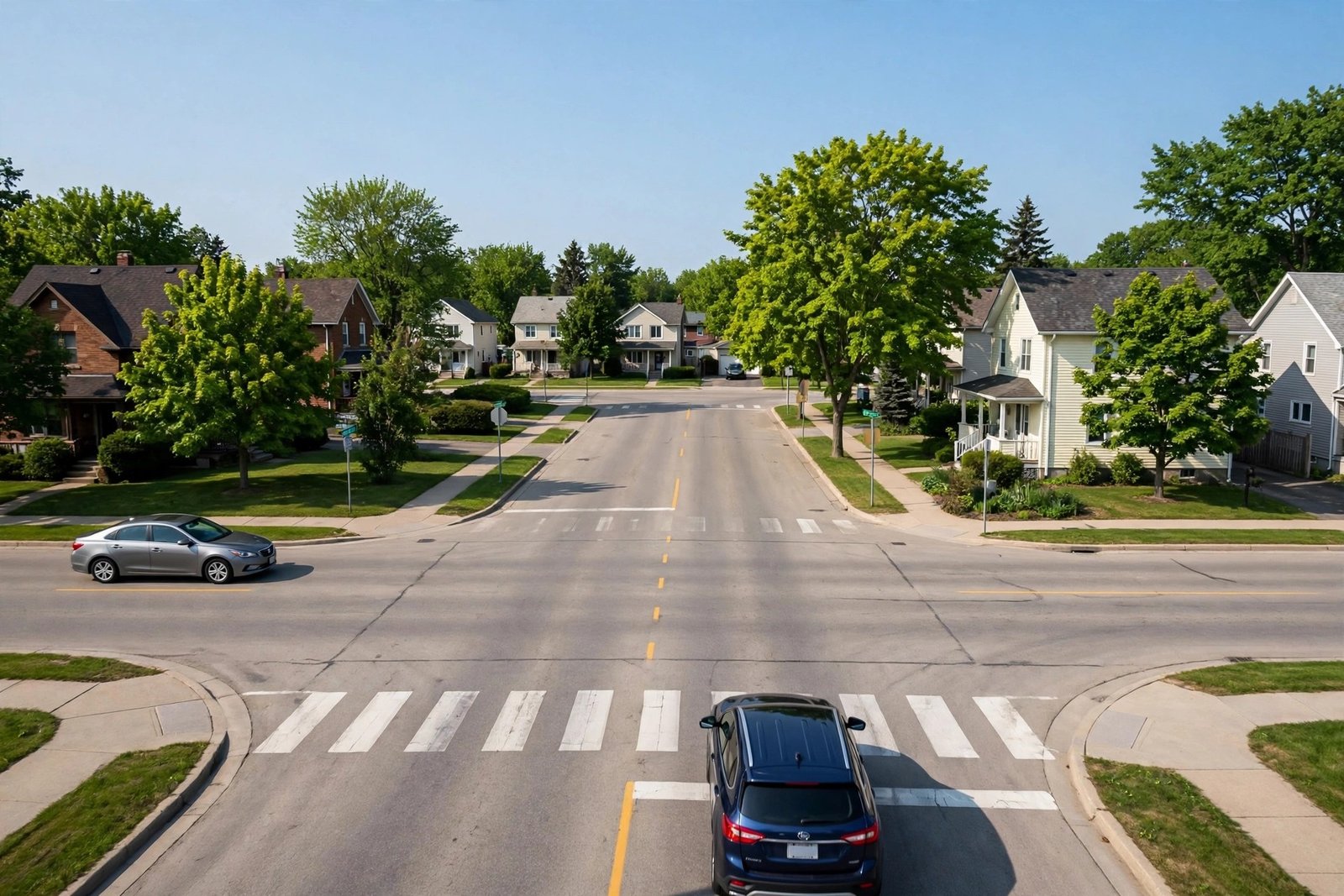
Controlled intersections have traffic lights, yield signs or stop signs controlling traffic. The control tells you what to do — stop, slow and yield, or go — and you still check for pedestrians, cyclists and vehicles already in the intersection. Uncontrolled intersections have no signs or traffic lights at all. They are usually found where traffic is light — quiet residential streets, rural crossroads. There is nothing to tell you who goes first, so the yield rules below do all the work, and you must be extra careful: slow down, look both ways, and be ready to stop even though no sign told you to.
Who goes first — the quick table
| Situation | Who goes first |
|---|---|
| Uncontrolled, you arrive first | You — but only after checking the intersection is clear. |
| Uncontrolled, same time | The vehicle on the right (the driver on the left yields). |
| All-way stop, you stop first | You — first to come to a complete stop goes first. |
| All-way stop, same time | The vehicle on the right. |
| You are turning left | Oncoming traffic and pedestrians in your path go first. |
| You are turning right | Pedestrians in or approaching your path go first; check the blind spot for cyclists. |
| You face a yield sign | Traffic already in the intersection or on the intersecting road. |
| You face a stop sign | You stop fully, then go only when the way is clear. |
| You are leaving a driveway or private road | All vehicles on the road, plus pedestrians on the sidewalk. |
| Roundabout | Traffic already circulating in the roundabout. |
| Pedestrian crossover / school crossing with a guard | Pedestrians — wait until they have completely crossed. |
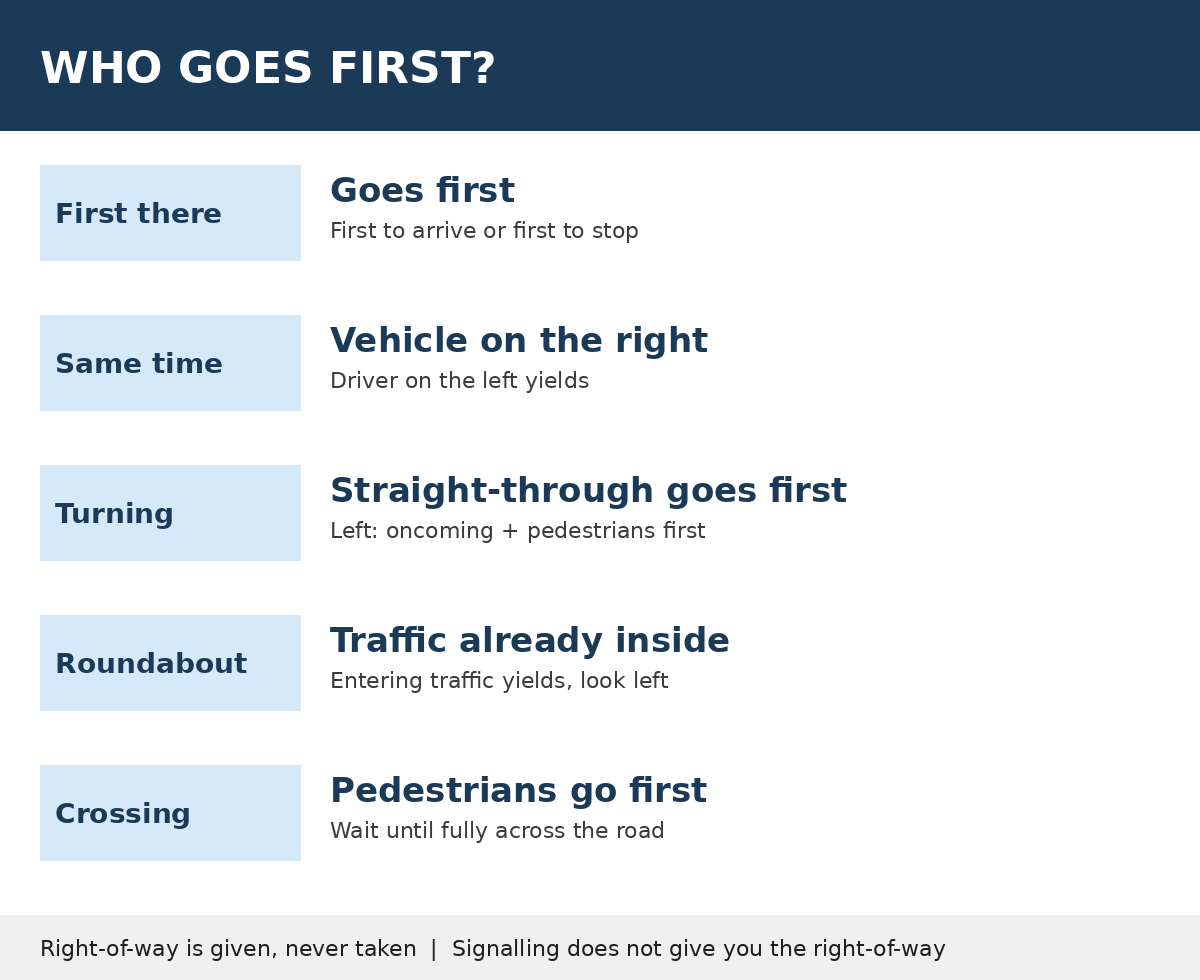
If you remember nothing else, remember the pattern: first there goes first, same time the right goes first, turning yields to straight-through, and pedestrians beat everyone at a crossing.
Uncontrolled intersections, in full
HTA s. 135 and the handbook agree on two rules, in this order: 1. Yield to a vehicle already in the intersection. If another vehicle entered from an intersecting road before you, it goes first — even if it is on your left. 2. Same time? Yield to the right. If two vehicles enter from intersecting roads at approximately the same time, the driver on the left yields to the vehicle on the right.
Worked example: you and another car reach a quiet crossroads together. The other car is on your right. You wait, even if you feel you ‘got there first’ by a split second — ‘approximately the same time’ is the test, not a photo finish. Reverse it: the other car is on your left, you go — but slowly, watching in case the other driver does not know the rule. That is the ‘given, never taken’ principle in action.
What uncontrolled is NOT: it is not a four-way stop. With no other traffic present, you are not required to stop at an uncontrolled intersection — you slow, look, and proceed when clear. Stopping for no reason in the middle of a test answer is how marks are lost, and on a real road it confuses everyone behind you.
All-way stops
At an intersection with stop signs at all corners, the rule mirrors the uncontrolled one, with stopping added: First to come to a complete stop goes first. Same time? The vehicle on the left yields to the vehicle on the right. ‘Complete stop’ means the wheels stop turning — a slow roll (a ‘rolling stop’) is not a stop, and it does not earn you first place. Where do you stop? The handbook’s fixed order, which the test loves to ask: stop line first; if there is no stop line, at the crosswalk (marked or not); if there is no crosswalk, at the edge of the sidewalk; if there is no sidewalk, at the edge of the intersection. Never stop ON the crosswalk or in the intersection itself.
Traffic lights
Green: you may go straight, turn left or turn right — after yielding to vehicles and pedestrians already in the intersection. Turning left or right, you must yield to pedestrians crossing the intersection. Yellow (amber): the red is about to appear. Stop if you can do so safely; otherwise, go through with caution. If you are already so close you cannot stop safely, do not brake hard in the intersection — proceed with caution. Red: come to a complete stop (same stop-position order as above) and wait until the light turns green and the intersection is clear. Right turn on red: allowed unless a sign says otherwise — but only after a complete stop, and only when the way is clear (including pedestrians). Left turn on red: allowed only from a one-way road onto a one-way road, again only after a complete stop and when the way is clear. Flashing red: come to a complete stop, then go only when it is safe — it works like a stop sign. Flashing yellow: proceed with caution. Flashing green or a green arrow (advance green): you may turn left, go straight or turn right from the proper lane; oncoming traffic still faces red — but you can still only turn left when the way is clear of traffic and pedestrians, and if the light turns red while you are already in the intersection, complete your turn when it is safe. Blocked intersection: if you are on a main road and the intersection ahead is blocked with traffic, stop before entering and wait until traffic ahead moves on. You do not creep into the box and get stuck across the crosswalk. This rule does not apply if you are turning left or right.
Turning — where most right-of-way mistakes happen
Turning left: you yield to everything coming at you — oncoming traffic, and pedestrians in or approaching your path. Wait in the intersection only where it is legal and safe to do so, keep your wheels straight while waiting (so a rear-end push does not throw you into oncoming traffic), and complete the turn when the way is clear. Turning right: you yield to pedestrians in or approaching your path, and you check your blind spot for cyclists approaching from behind — particularly in a bike lane to your right, or on a sidewalk or trail. The most common real-world right-of-way collision is a right-turning driver cutting off a cyclist going straight. On the test, ‘check the blind spot’ is almost always part of the correct answer for a right turn.
Driveways, private roads and T-intersections
Leaving a driveway or private road: you must yield to vehicles on the road and pedestrians on the sidewalk. You are joining their road; they do not yield to you. This is a favourite test question because it feels backwards to new drivers — you are the one moving, but you are the one who waits. T-intersections: the road that ends (the stem of the T) yields to the through road. Traffic on the through road does not stop for you. If you are on the through road turning left into the stem, you still yield to oncoming traffic first.
Pedestrians — the absolute rule
At pedestrian crossovers (marked crossings, often with overhead yellow lights) and school crossings with a crossing guard, you must yield and wait for pedestrians to completely cross the road — not just clear your lane — before proceeding. The same applies to a pedestrian already in a crosswalk at an intersection: they have the right-of-way over turning vehicles.
Roundabouts
Roundabouts reverse the instinct most new drivers bring from uncontrolled intersections: Traffic already in the roundabout has the right-of-way. You, entering, yield — look left, wait for an adequate gap, and do not enter directly beside a vehicle that may exit at the next exit. Choose your lane before entering: left lane to turn left or go straight; right lane to turn right or go straight. Never enter from the right lane if you want to turn left. Travel counter-clockwise, stay in your lane, do not stop once inside unless you must to avoid a collision, and signal your exit. If you miss your exit, go around again — stopping in the circle is far more dangerous than one extra loop. The trap: ‘the vehicle on the right goes first’ does NOT apply here. A vehicle entering from your right must still yield to you once you are circulating.
The five test traps
- ‘I signalled, so I have the right-of-way.’ No — signalling never grants it.
- ‘I arrived first, so I go, no matter what.’ Only if the way is actually clear. Right-of-way is given, never taken.
- ‘Green light means go, full stop.’ Green means go after yielding to what is already in the intersection.
- ‘Uncontrolled means stop like a four-way stop.’ No — slow, look, yield to the right/earlier vehicle, proceed when clear.
- ‘Turning right is always the easy turn.’ It is the turn where cyclists in your blind spot and pedestrians in your path are most often missed.
Quick decision checklist (use this at every intersection)
- What controls this intersection — lights, stop, yield, or nothing?
- Who is already in it, or got here first?
- Am I turning? If yes, who do I yield to?
- Are there pedestrians or cyclists in my path or blind spot?
- Is the way actually clear — not just legally mine?
Who goes first at an uncontrolled intersection in Ontario?
The vehicle that arrives first, if it is already in the intersection. If two vehicles arrive at approximately the same time, the vehicle on the right goes first and the driver on the left yields. (HTA s. 135.)
At a four-way stop, who goes first if two cars stop at the same time?
The same rule as uncontrolled: the vehicle on the left yields to the vehicle on the right. First to come to a complete stop otherwise goes first.
Can you turn right on a red light in Ontario?
Yes, unless a sign says otherwise — but only after a complete stop, and only when the way is clear, including pedestrians. You may also turn left on red only from a one-way road onto a one-way road, after a complete stop.
Do you have to stop at an uncontrolled intersection?
No — there is no sign or light telling you to stop. You slow down, look, yield to a vehicle already in the intersection or on your right if you arrive together, and proceed when clear.
Who has the right-of-way in a roundabout?
Traffic already circulating in the roundabout. Vehicles entering must yield, look left, and wait for a safe gap. The “vehicle on the right” rule does not apply inside a roundabout.
What if the traffic lights are not working?
Come to a complete stop and treat the intersection like an all-way stop: yield to vehicles already in the intersection and to vehicles entering from your right, and proceed only when the way is completely clear — and never assume other drivers are following the same rule.
