
You start at zero — points are added, not lost.
Ontario drivers do not “lose” points. You start with a clean record at zero, and demerit points are added only when you are convicted of certain offences under the Highway Traffic Act. A ticket alone does not add points; a conviction does. That distinction matters for new drivers: paying a ticket is accepting the conviction, and the points that come with it.
Last updated: November 19, 2026

How long points stay.
Demerit points stay on your driving record for two years from the date of the offence, then drop off automatically. The conviction itself stays visible longer — insurers generally look at convictions for three years — so a ticket can keep costing you after its points have expired. Points cannot be removed early; the only way to avoid them is to not be convicted in the first place.
The points table — common offences.
| Points | Common offences |
|---|---|
| 7 points | Failing to remain at the scene of a collision; failing to stop when signalled by a police officer. |
| 6 points | Careless driving; failing to stop for a school bus; racing; speeding 50 km/h or more over the limit. |
| 4 points | Speeding 30–49 km/h over the limit; following too closely; failing to stop at a pedestrian crossover. |
| 3 points | Speeding 16–29 km/h over the limit; running a red light; failing to stop at a stop sign; failing to yield right of way; driving while holding or using a hand-held device (full G drivers — for novice drivers, hand-held device use follows the stricter novice suspension route, not points; see the distracted section). |
| 2 points | Failing to wear a seatbelt; failing to signal; improper turn; unnecessary slow driving; failing to lower high beams. |
| 0 points | Speeding 1–15 km/h over the limit — still a fine, just no demerit points. |
Read the charge, not just the fine: two tickets that look similar can carry different points, and it is the offence wording and the conviction — not the dollar amount — that decides how many points are added.
Why G1 and G2 drivers face stricter consequences.
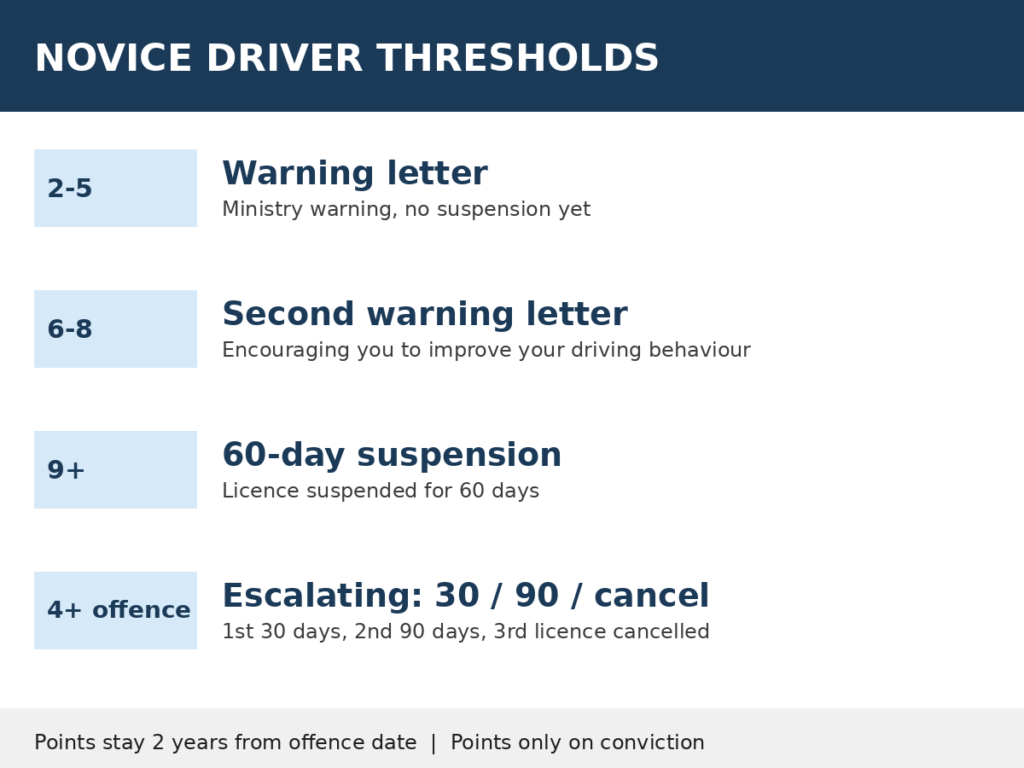
There are two layers and they are easy to mix up. Layer 1 — the general demerit ladder. For fully licensed (G) drivers: 6–8 points = warning letter, 9–14 = a second warning letter encouraging you to improve your driving behaviour, 15+ = 30-day suspension. For novice drivers (G1/G2): 2–5 points = warning letter, 6–8 = a second warning letter encouraging you to improve your driving behaviour, 9 or more points = 60-day suspension. Layer 2 — novice escalating sanctions. On top of that ladder, novice drivers face an extra, much earlier trigger: a conviction for breaking a graduated-licensing condition, or for an HTA offence worth 4 or more points (or a court-ordered suspension for an offence that would have been 4+ points). Penalties: 30-day suspension (first), 90-day (second), licence cancellation (third — you must restart the graduated licensing system). That is why one 30–49 km/h-over speeding ticket (4 points) can suspend a G1 or G2 driver, while the same ticket would only be a step on the ladder for a full G driver.
Fines are only the first cost.
A fine is what you pay on the day. The longer costs are the points above, a possible suspension, and the insurance consequence of the conviction — which is why a “small” ticket is rarely small in total. This page does not give legal advice: if you receive a ticket, check the exact offence wording and offence date, and confirm the point value through official Ontario information rather than estimating it from the fine.
Distracted and impaired driving — the short version.
Distracted driving (hand-held device) for a fully licensed driver carries 3 demerit points plus fines and suspensions that escalate with repeat offences (ontario.ca: $615 set fine settled out of court; first conviction also gets a 3-day suspension, second 7-day, third+ 30-day, with 6 points from the second conviction on). For novice drivers, distracted driving carries NO demerit points — same $615 fine, but instead 30-day suspension (first), 90-day (second), licence cancellation (third). Impaired driving — including the zero blood-alcohol rule for G1/G2 drivers — sits outside the ordinary points table altogether and carries its own suspensions and penalties.
What to do if you get a ticket.
- Read the exact offence wording — that wording decides the points.
- Note the offence date — the two-year clock runs from that date, not from the court date.
- Do not assume the fine tells you the points, and do not assume a first ticket is harmless for a G1/G2 driver — the 4-point novice trigger above is the check that matters.
- If you are unsure, get advice before paying: paying accepts the conviction and its points.
How many demerit points suspend a G1 or G2 driver in Ontario?
Two layers apply: the novice demerit ladder reaches a 60-day suspension at 9 points, but novice escalating sanctions can suspend a G1/G2 licence for 30 days much earlier — a conviction for breaking a graduated-licensing condition or for a 4+ point offence (30 days first, 90 days second, cancellation third).
How long do demerit points stay on your record in Ontario?
Two years from the date of the offence, then they drop off automatically. The conviction itself remains visible to insurers for about three years.
Does a speeding ticket always add demerit points?
No. Speeding 1–15 km/h over the limit carries a fine but 0 points; 16–29 km/h over is 3 points; 30–49 km/h over is 4 points; 50 km/h or more over is 6 points.
Do demerit points raise insurance directly?
Insurers look at the conviction behind the points, not the point total alone — the type and severity of the conviction, and how many recent convictions you have, drive the increase.
Can demerit points be removed early?
No. They stay for two years from the offence date. Avoiding a conviction is the only way to avoid the points.
What is the difference between a warning letter and a suspension?
Warning letters are early steps on the ladder — a first warning letter, then a second warning letter encouraging you to improve your driving behaviour; a suspension removes your licence for a set period. For novice drivers, the escalating-sanction suspension can arrive before the ladder’s own suspension point.
