Road Signs · Temporary Conditions
Construction Signs Ontario
The complete guide to meanings, types, and the exact rules G1 examiners test.
If you’ve driven or studied for your G1 anywhere in Ontario during the warmer months, you already know construction signs are impossible to avoid. Every spring, orange diamonds start popping up on highways, side streets, and school routes across the province, and every year candidates make the same mistake.
They can spot a construction sign from a mile away, but freeze the moment they’re asked what it actually means.
This guide closes that gap: every temporary condition sign the MTO expects you to know, exactly what each one is telling you to do, and the specific details examiners love to test.
Quick Answer
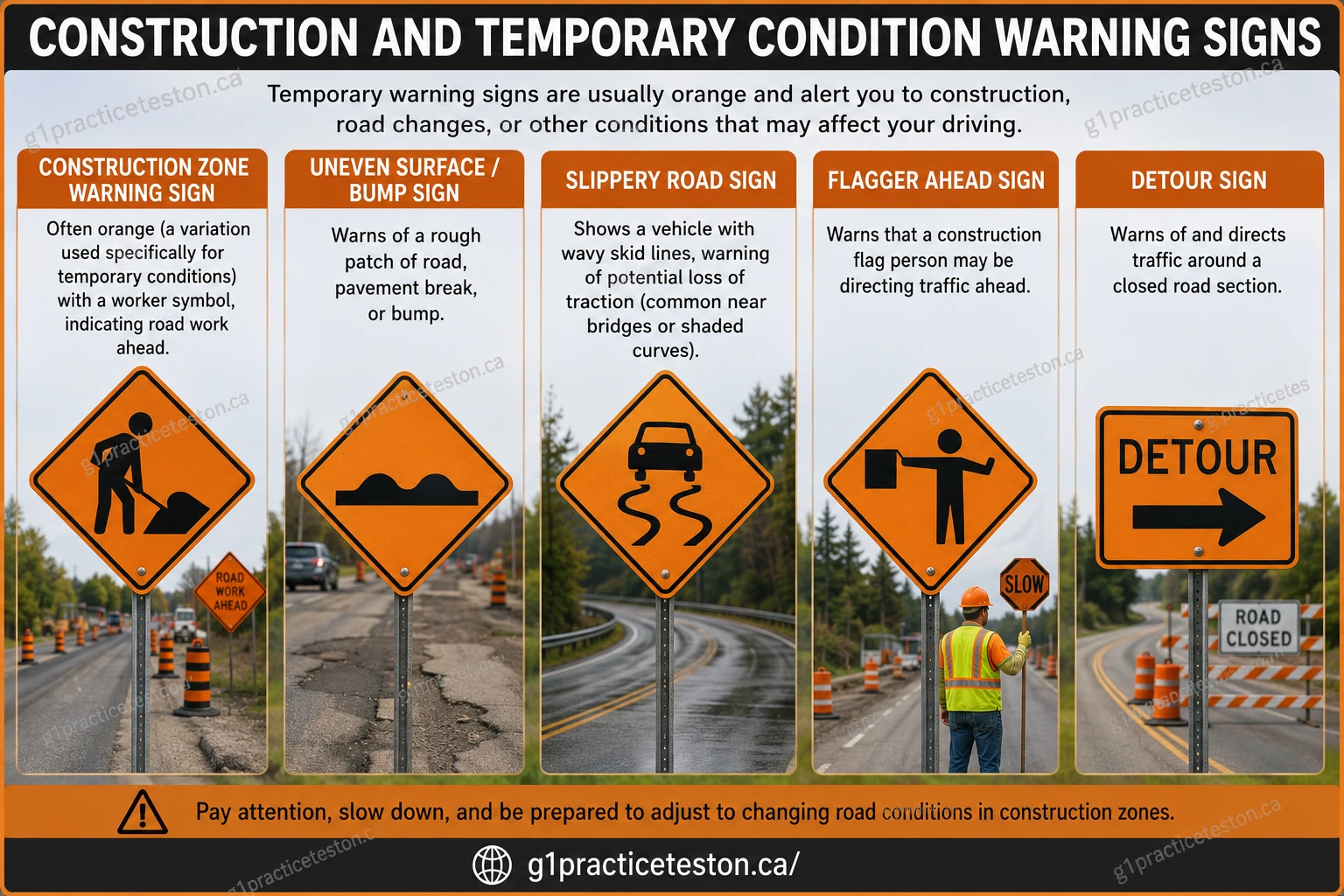
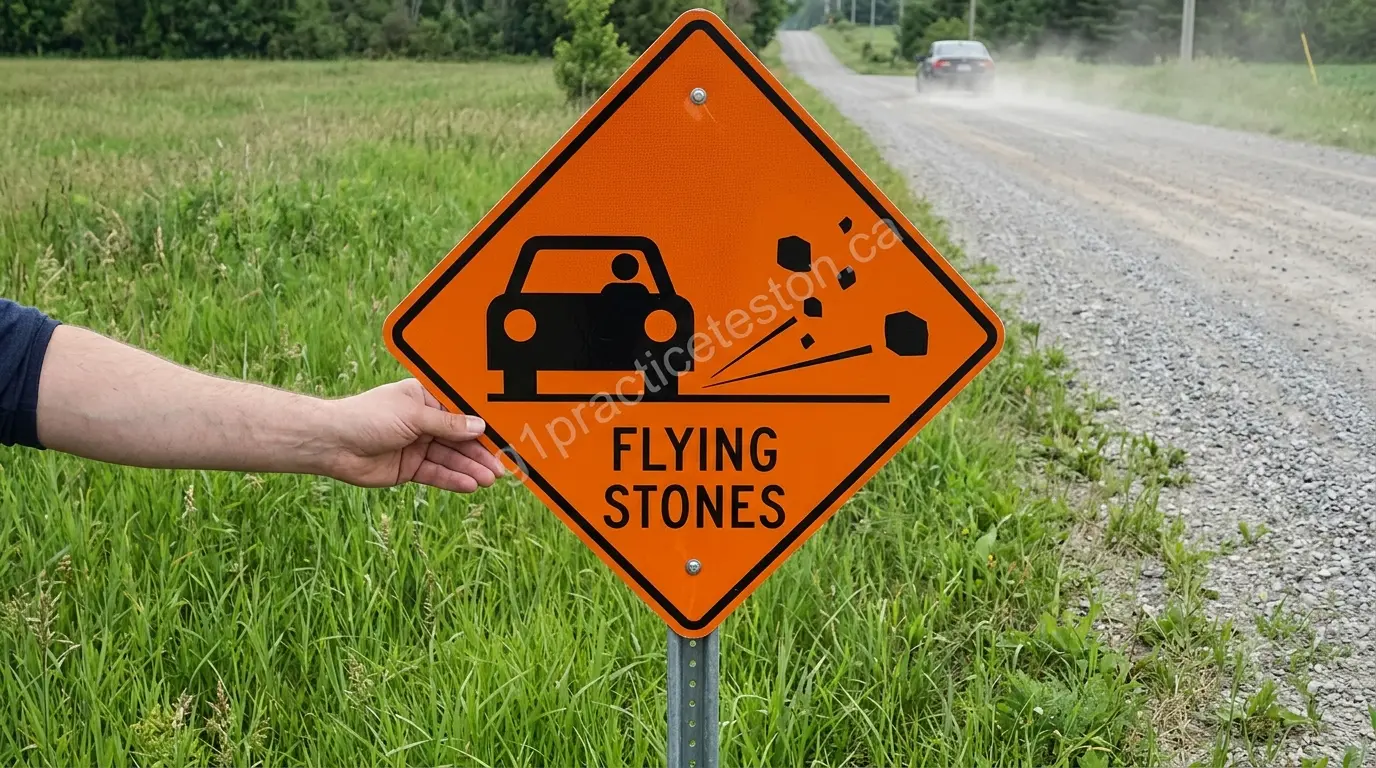
Construction signs Ontario, officially temporary condition signs in the Ontario Driver’s Handbook, are the orange, diamond-shaped signs that warn you about short-term hazards: road work, detours, lane closures, or crews working near traffic. They’re orange rather than yellow because orange is reserved specifically for temporary, changing conditions, not fixed road features.
Why Construction Signs Ontario Matter More Than Most Drivers Realize
It’s tempting to treat construction signs Ontario as background noise. But mixing up “lane ends, merge now” with “reduce speed, prepare to stop,” or missing a flagger’s signal because you assumed the sign was decorative, is exactly the kind of mistake that causes real collisions in active work zones. A flagger may be standing a few metres from moving traffic with nothing but a sign or a hand signal protecting them, which is also why this topic shows up consistently on G1 knowledge tests.
The Colour & Shape System – Construction Signs and Meanings
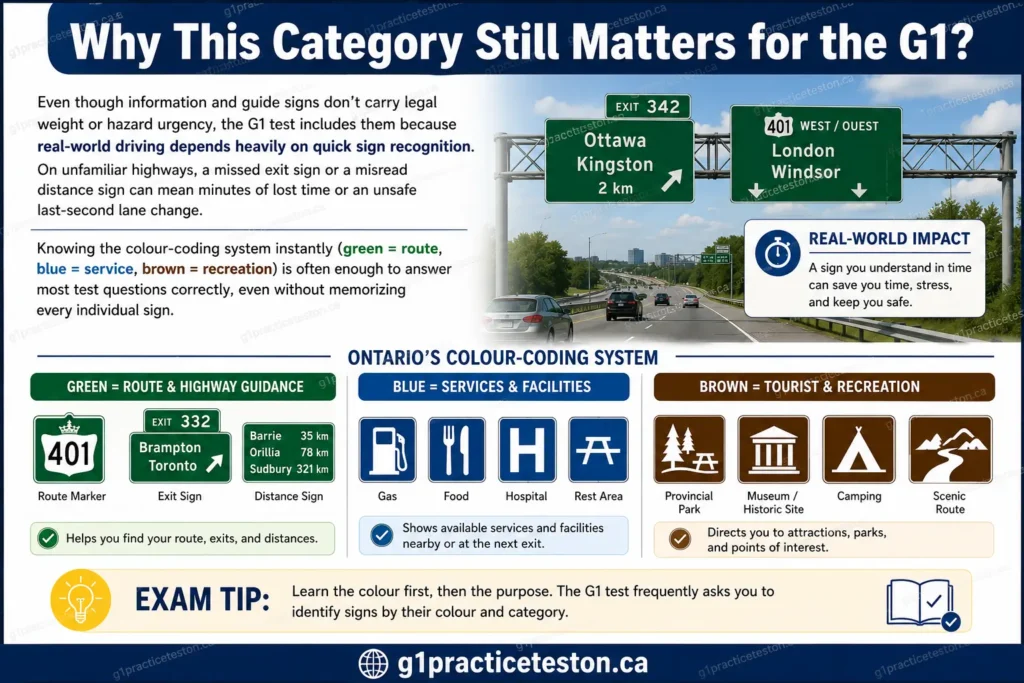
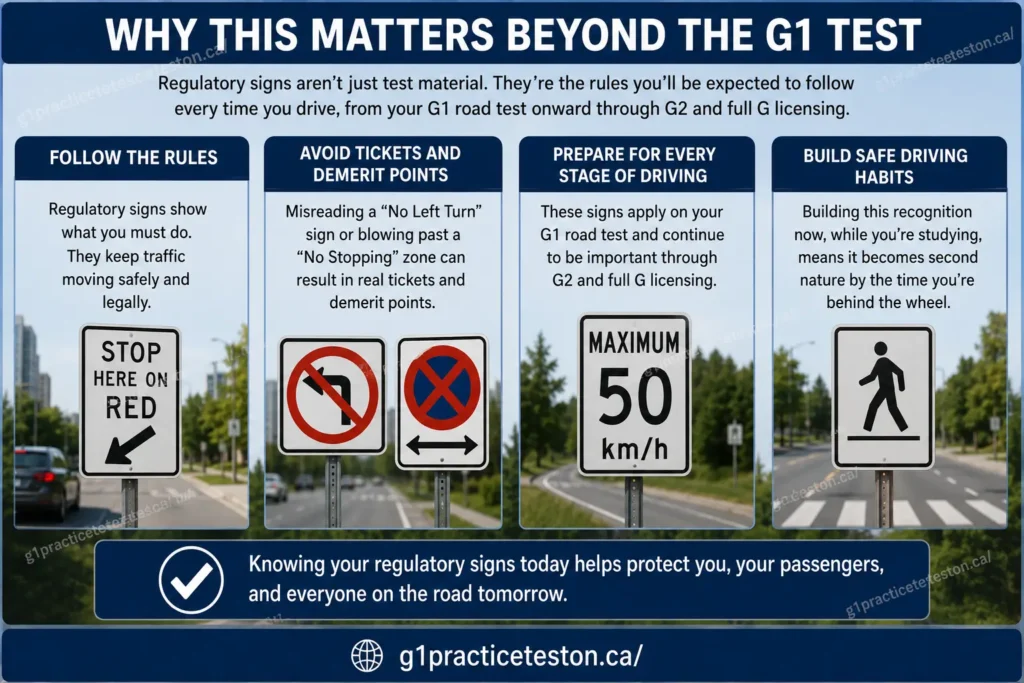
Ontario’s road signs follow a strict, predictable code. Knowing it lets you correctly guess a sign’s category the instant you see it, a skill G1 examiners specifically test for.
|
Sign Type |
Shape |
Colour |
What It Tells You |
|---|---|---|---|
|
Temporary Condition Signs |
Diamond |
Orange/black |
Short-term hazard: work zones, detours, closures |
|
Diamond |
Yellow/black |
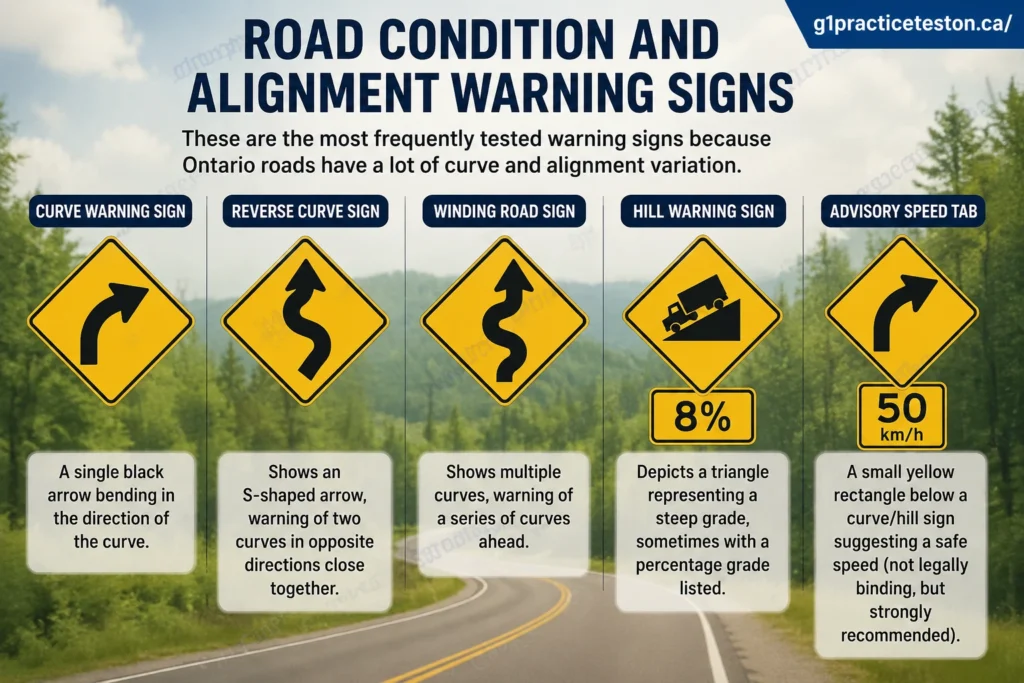
Permanent, unusual condition: curves, crossings, hills |
|
|
Rectangle |
White or black |
A rule you must legally obey |
|
|
Rectangle |
Green (mostly) |
Distances, exits, and destinations |
If you remember one rule from this table, remember this: orange means temporary.
Complete List of Construction Signs Ontario
Grouped the way you’ll actually meet them, in order, as you approach a work zone.
Advance Warning Signs
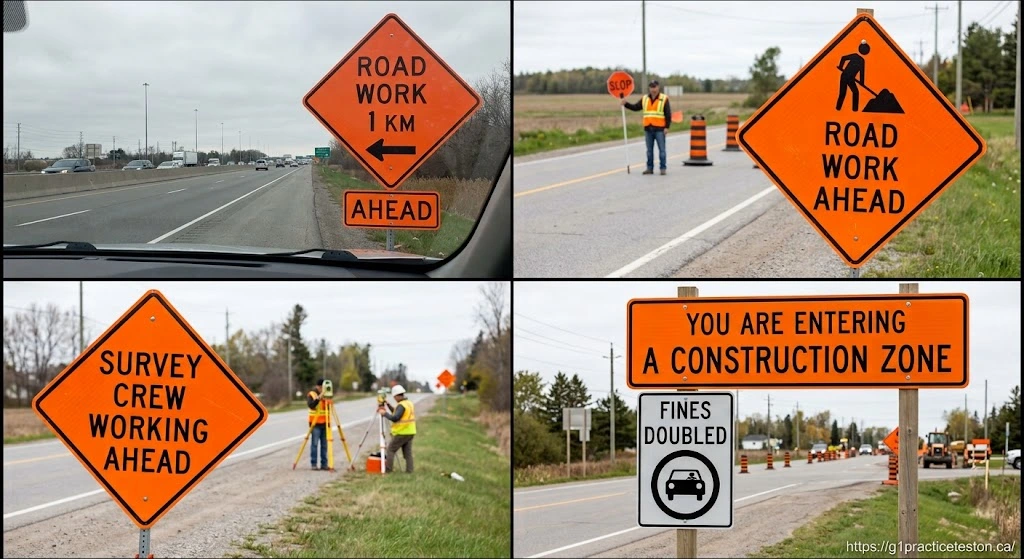
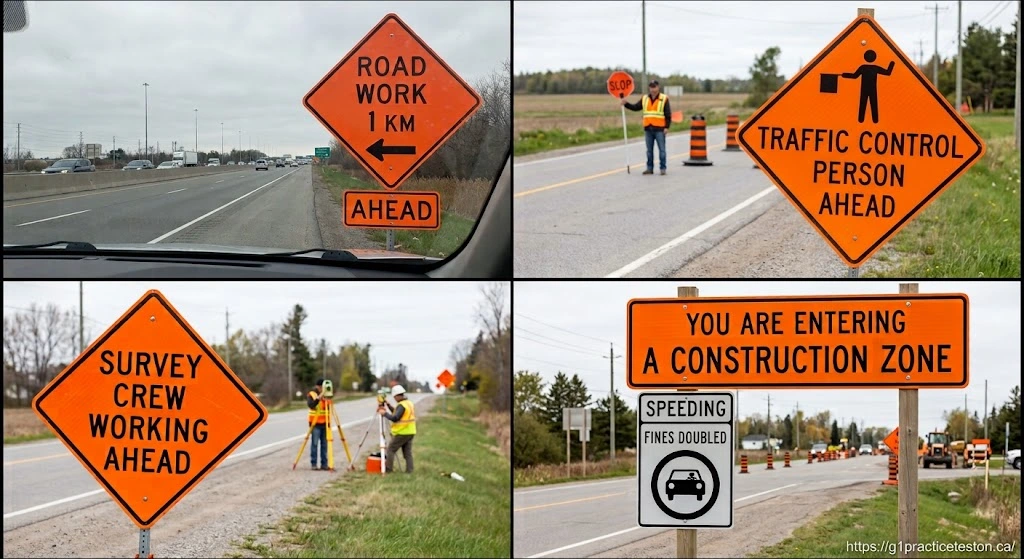
- Construction Work One Kilometre Ahead — tells you exactly how far you are from the work zone. Ease off the accelerator now.
- Road Work Ahead — a general warning; distance isn’t specified, so treat it as “any moment now.”
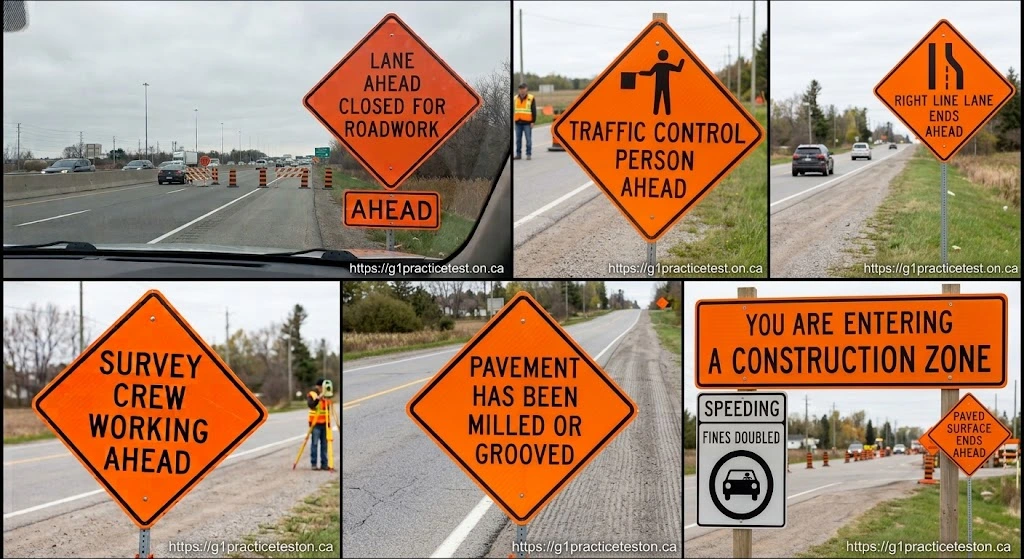
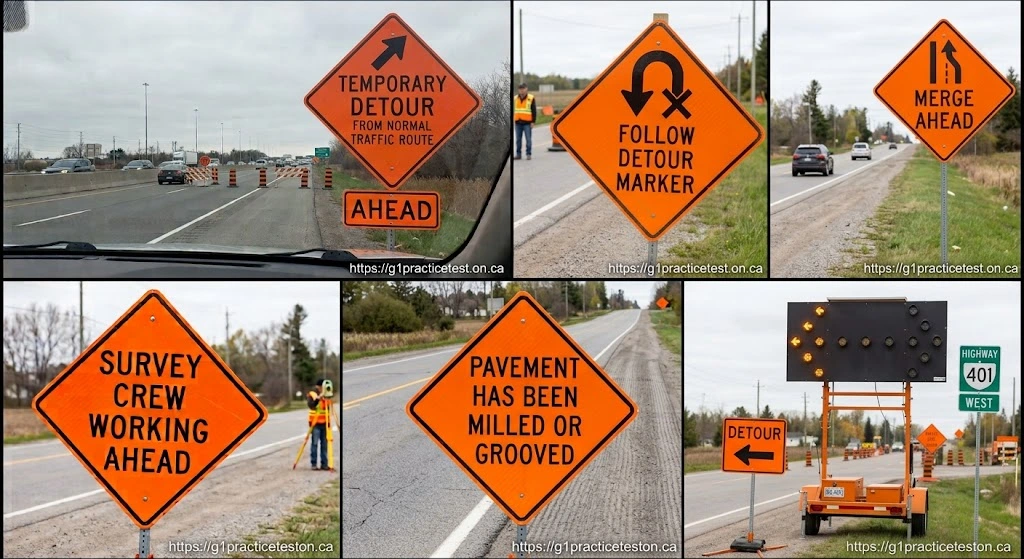
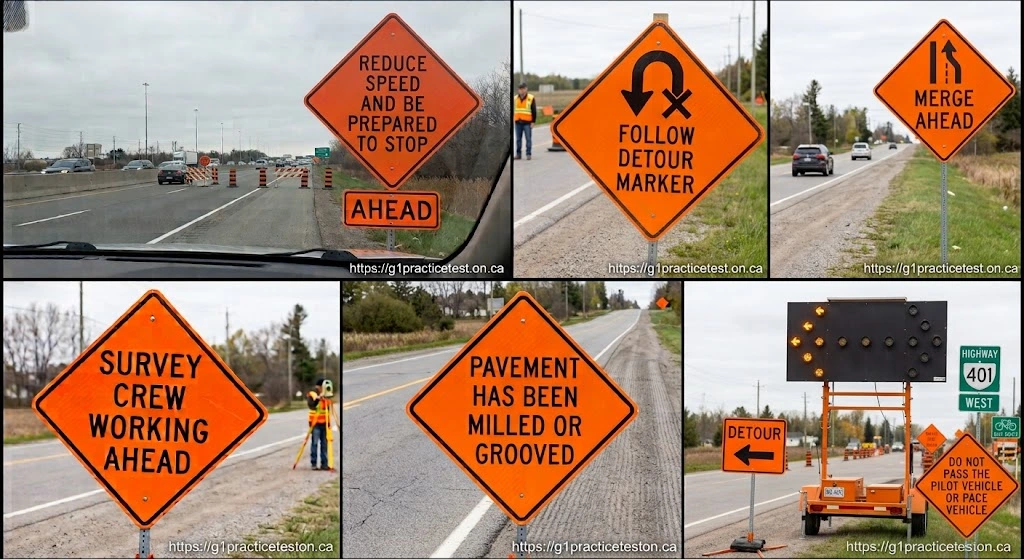
- Survey Crew Working on the Road Ahead — workers taking measurements, often with equipment on the shoulder.
- You Are Entering a Construction Zone — the formal boundary marker; doubled fines apply from here.
Worker & Traffic Control Signs
- Traffic Control Person Ahead — a flagger will direct traffic manually. Their signals override the posted speed limit and most other signage in that moment.
- Doubled Fines for Speeding in a Designated Construction Zone — HTA fines double when workers are present. One of the most commonly tested facts on the G1.
Lane, Merge & Pavement Signs
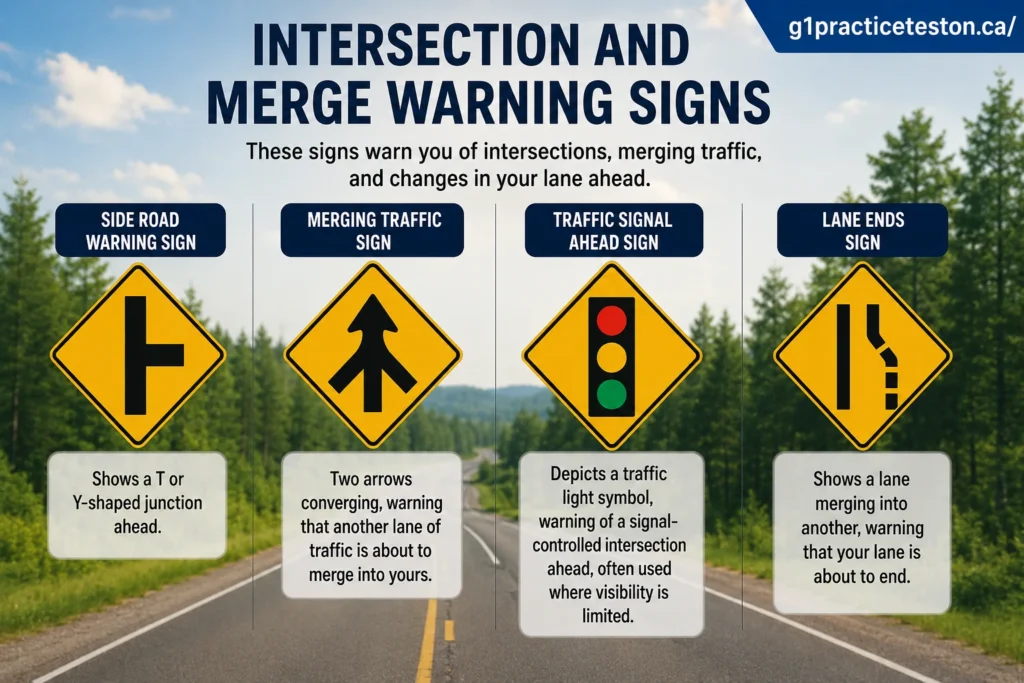
- Lane Ahead Is Closed for Roadwork — merge into the open lane well before the closure, not at the last second.
- Closed Lane — Merge Arrow — a directional arrow shows exactly which lane to merge into.
- Right Lane Ends Ahead — you’re legally required to merge safely into the lane to the left.
- Pavement Has Been Milled or Grooved — reduced tire grip; motorcyclists especially should expect less traction.
- Paved Surface Ends Ahead — smooth pavement is about to become gravel or an unfinished surface.
Detour & Route Signs
- Temporary Detour From Normal Traffic Route — the road ahead is closed; follow posted markers.
- Follow Detour Marker Until You Return to Regular Route — confirms you’re still on the correct detour path.
- Flashing Arrow Board — flashing lights show which direction to move; treat like a lane-merge instruction.
Speed & Behaviour Signs
- Reduce Speed and Be Prepared to Stop — often placed right before a flagger; stopping may be required imminently.
- Do Not Pass the Pilot Vehicle or Pace Vehicle — stay behind it through single-lane work zones, even if there appears to be room.
Construction Site Signage Requirements in Ontario
Temporary traffic control on active work sites is governed primarily by the Ontario Traffic Manual (OTM), Book 7 – Temporary Conditions, published by the Ministry of Transportation. Book 7 sets the official standards for how construction signs must be sized, placed, spaced, and removed once work is complete.
It applies to municipal roads and provincial highways alike. Contractors typically work under a road-occupancy permit and an approved traffic control plan based on Book 7; municipalities may add local bylaw requirements on top.
For everyday drivers, the takeaway is simple: any sign in a work zone was placed under a specific regulatory framework, not at random — which is exactly why misreading it carries real legal and safety consequences.