|

Warning Road Signs in Ontario — Full List & Meanings (2026 Guide)

Out of all three sign categories on the G1 test, warning road signs are the ones I always tell new drivers to slow down and actually read carefully. They’re not asking you to follow a legal rule the way regulatory signs do; they’re telling you something is coming up that you need to be careful.

Miss one, and it’s not just a test question you get wrong. It’s the difference between anticipating a sharp curve and being caught off guard by one.
This guide covers every major category of warning sign you’ll encounter in Ontario, based on the official MTO Driver’s Handbook, organized the way they actually appear on the G1 exam.
If you haven’t already gone through them, pair this with our Ontario Road Signs — Complete Guide and our Regulatory Road Signs in Ontario guide to cover all three sign categories tested on the G1.

What Makes a Sign a “Warning” Sign?

Warning road signs alert you to hazards, changing road conditions, or situations ahead that require caution, but unlike regulatory signs, they aren’t a legal command in themselves. You won’t get a ticket for “disobeying” a curve warning sign, but ignoring it can absolutely lead to a collision, which is exactly why the G1 test weighs this category heavily.

In Ontario, warning road signs are almost always:

  • Yellow diamond-shaped, with black symbols or text.
  • Occasionally paired with a supplementary tab underneath (like an advisory speed plate).
  • Sometimes fluorescent yellow-green for signs involving pedestrians, cyclists, or school zones, a newer MTO standard meant to increase visibility

This is different from regulatory signs (red/white or black/white, legally binding) and information/guide signs (green or blue, giving directions or services).
Warning Road Signs Ontario
Road Condition g1practiceteston.ca

Road Condition and Alignment Warning Signs

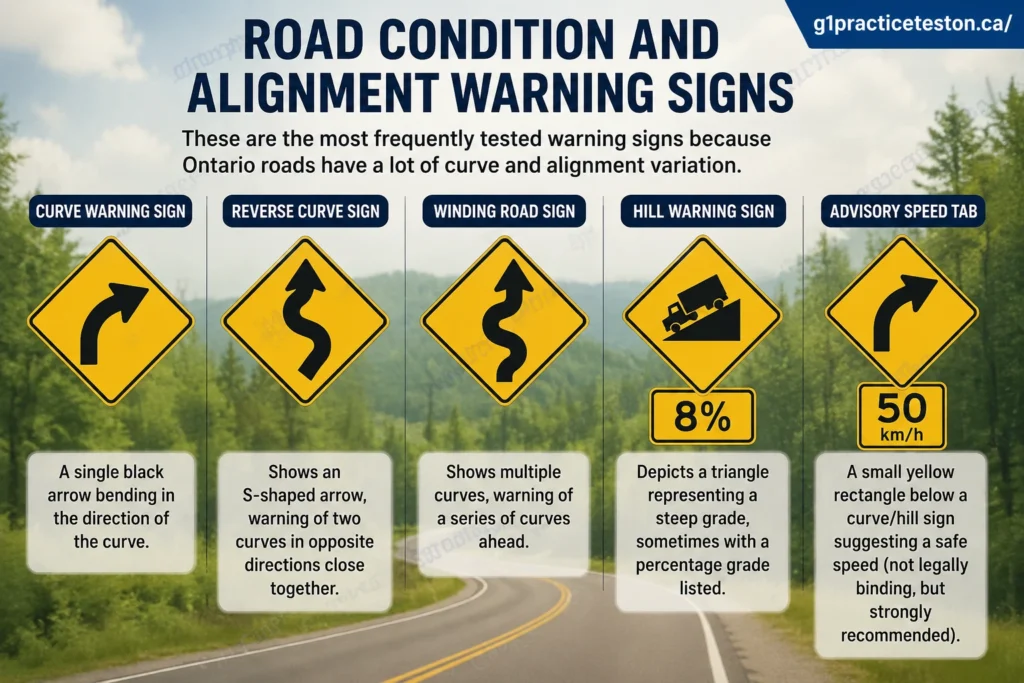
These are the most frequently tested warning road signs because Ontario roads have a lot of curves and alignment variation:

  • Curve Warning Sign — A single black arrow bending in the direction of the curve.
  • Reverse Curve Sign — Shows an S-shaped arrow, warning of two curves in opposite directions close together.
  • Winding Road Sign — Shows multiple curves, warning of a series of curves ahead.
  • Hill Warning Sign — Depicts a triangle representing a steep grade, sometimes with a percentage grade listed.
  • Advisory Speed Tab — A small yellow rectangle below a curve/hill sign suggesting a safe speed (not legally binding, but strongly recommended).

Intersection and Merge Warning Signs

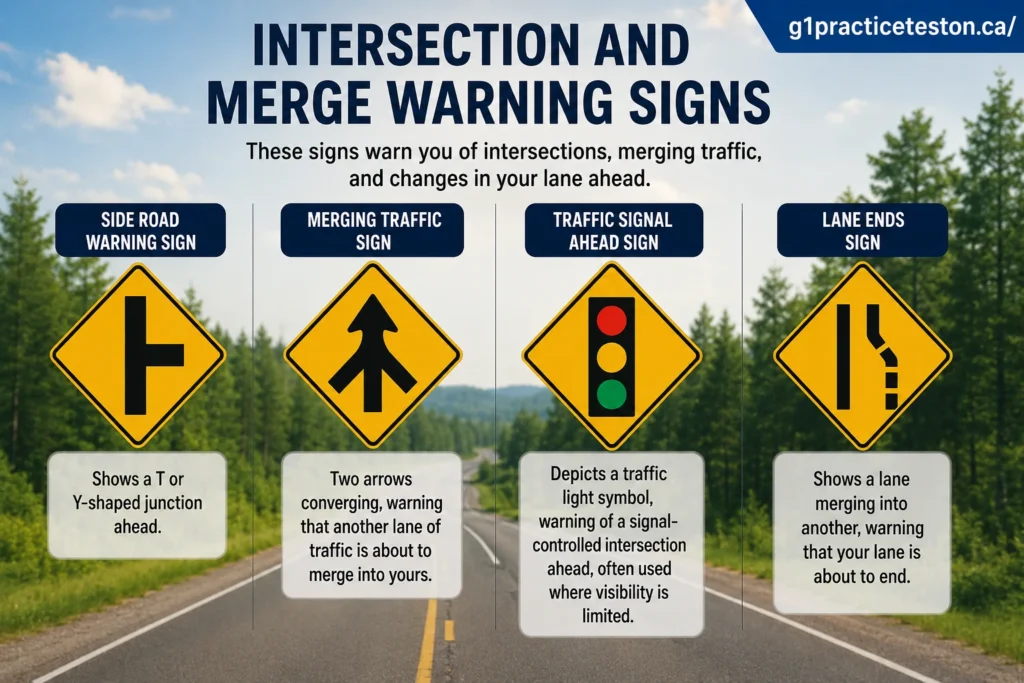
  • Side Road Warning Sign — Shows a T or Y-shaped junction ahead.
  • Merging Traffic Sign — Two arrows converging, warning that another lane of traffic is about to merge into yours.
  • Traffic Signal Ahead Sign — Depicts a traffic light symbol, warning of a signal-controlled intersection ahead, often used where visibility is limited.
  • Lane Ends Sign — Shows a lane merging into another, warning that your lane is about to end.
Intersection and Merge g1practiceteston.ca
Pedestrian School g1practiceteston.ca

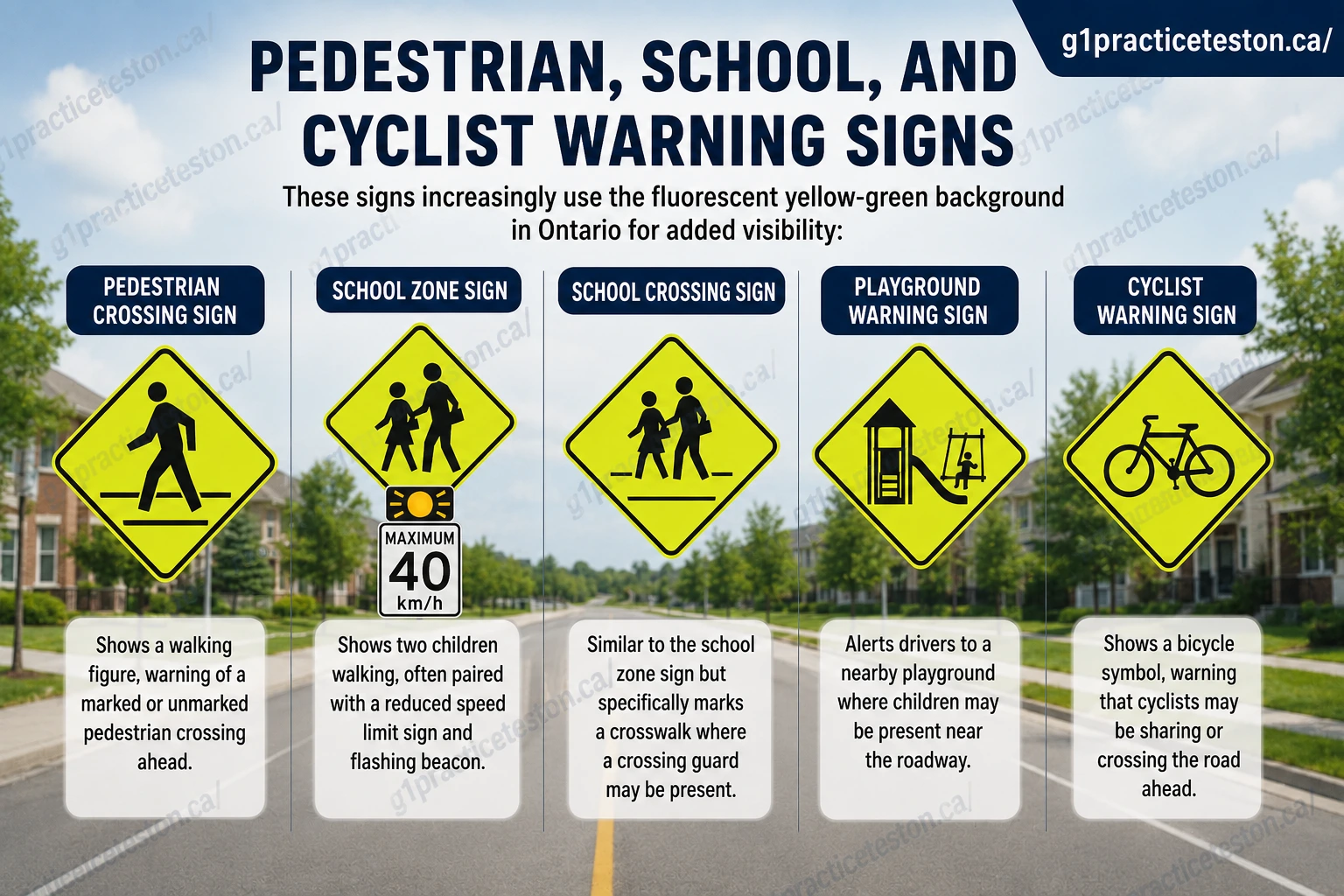
Pedestrian, School, and Cyclist Warning Signs

These signs increasingly use the fluorescent yellow-green background in Ontario for added visibility:

  • Pedestrian Crossing Sign — Shows a walking figure, warning of a marked or unmarked pedestrian crossing ahead.
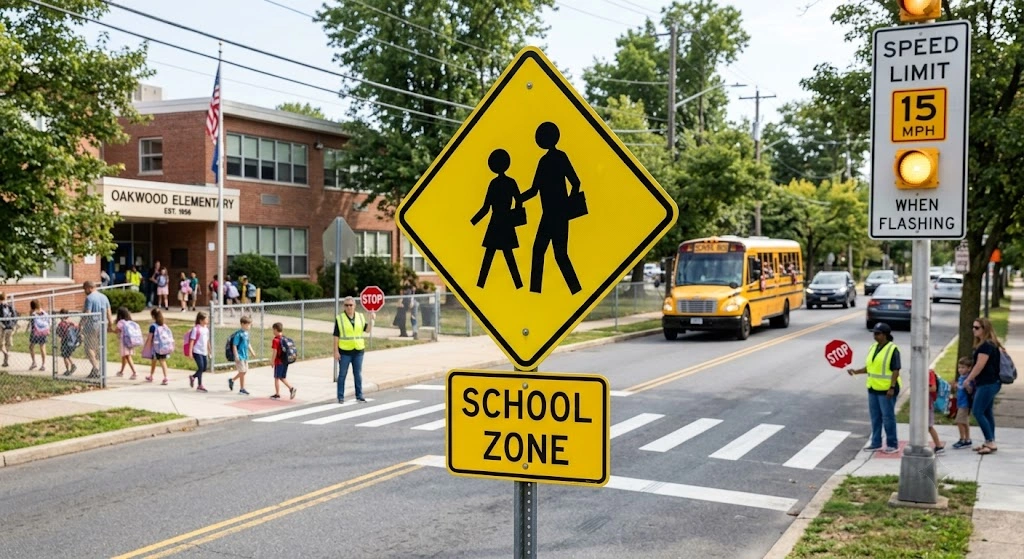
  • School Zone Sign — Shows two children walking, often paired with a reduced-speed-limit sign and a flashing beacon.
  • School Crossing Sign — Similar to the school zone sign, but specifically marks a crosswalk where a crossing guard may be present.
  • Playground Warning Sign — Alerts drivers to a nearby playground where children may be present near the roadway.
  • Cyclist Warning Road Sign — Shows a bicycle symbol, warning that cyclists may be sharing or crossing the road ahead.

tip g1practiceteston.ca e1783998811159

G1 tip

The test frequently asks you to distinguish a School Zone sign (general area) from a School Crossing sign (a specific crosswalk point), both use children symbols, but signal different things.

Railway and Level Crossing Warning Signs

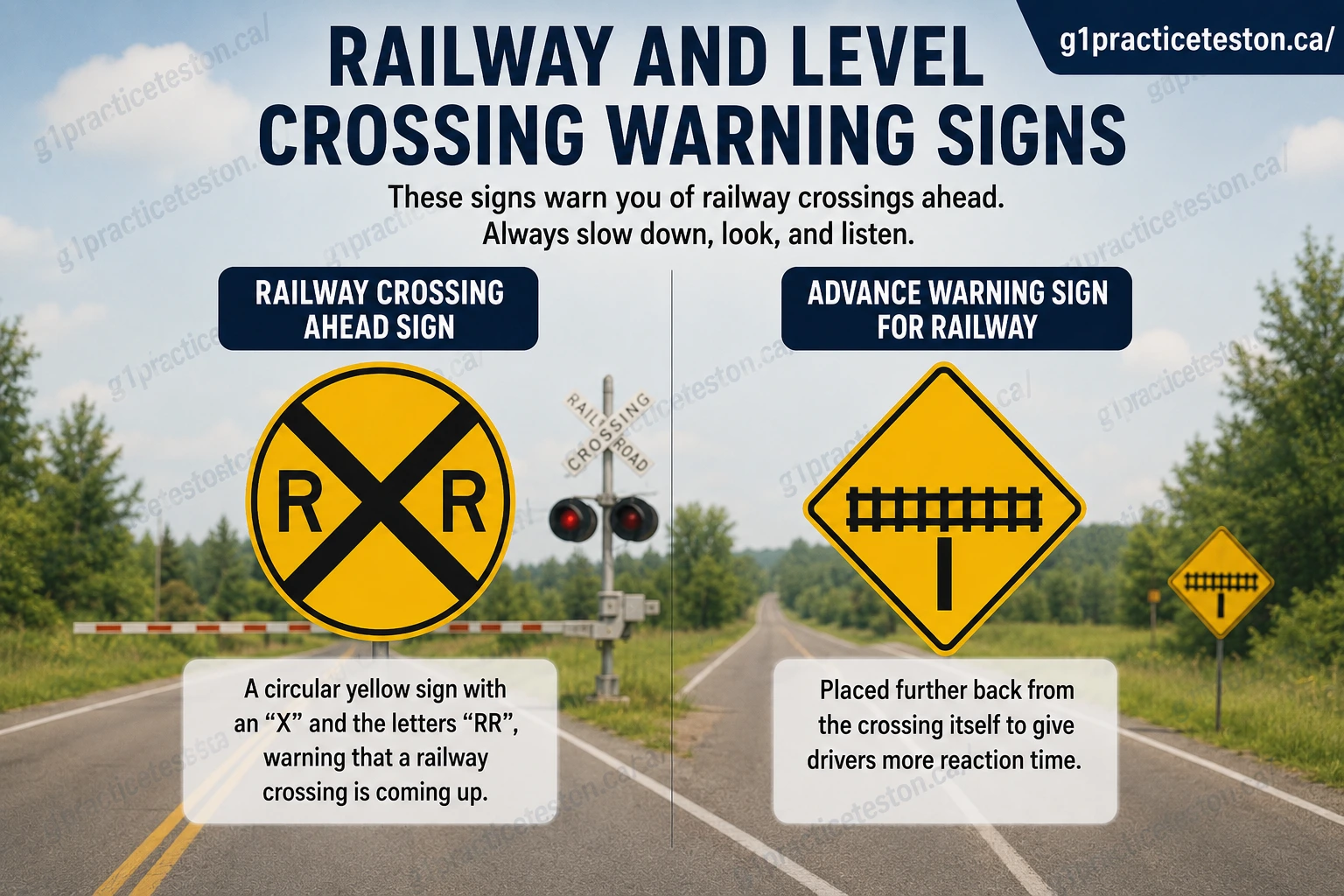
  • Railway Crossing Ahead Sign — A circular yellow sign with an “X” and the letters “RR,” warning that a railway crossing is coming up.
  • Advance Warning Sign for Railway — Placed further back from the crossing itself to give drivers more reaction time.
Railway and Level Crossing g1practiceteston.ca
Construction and Temporary g1practiceteston.ca

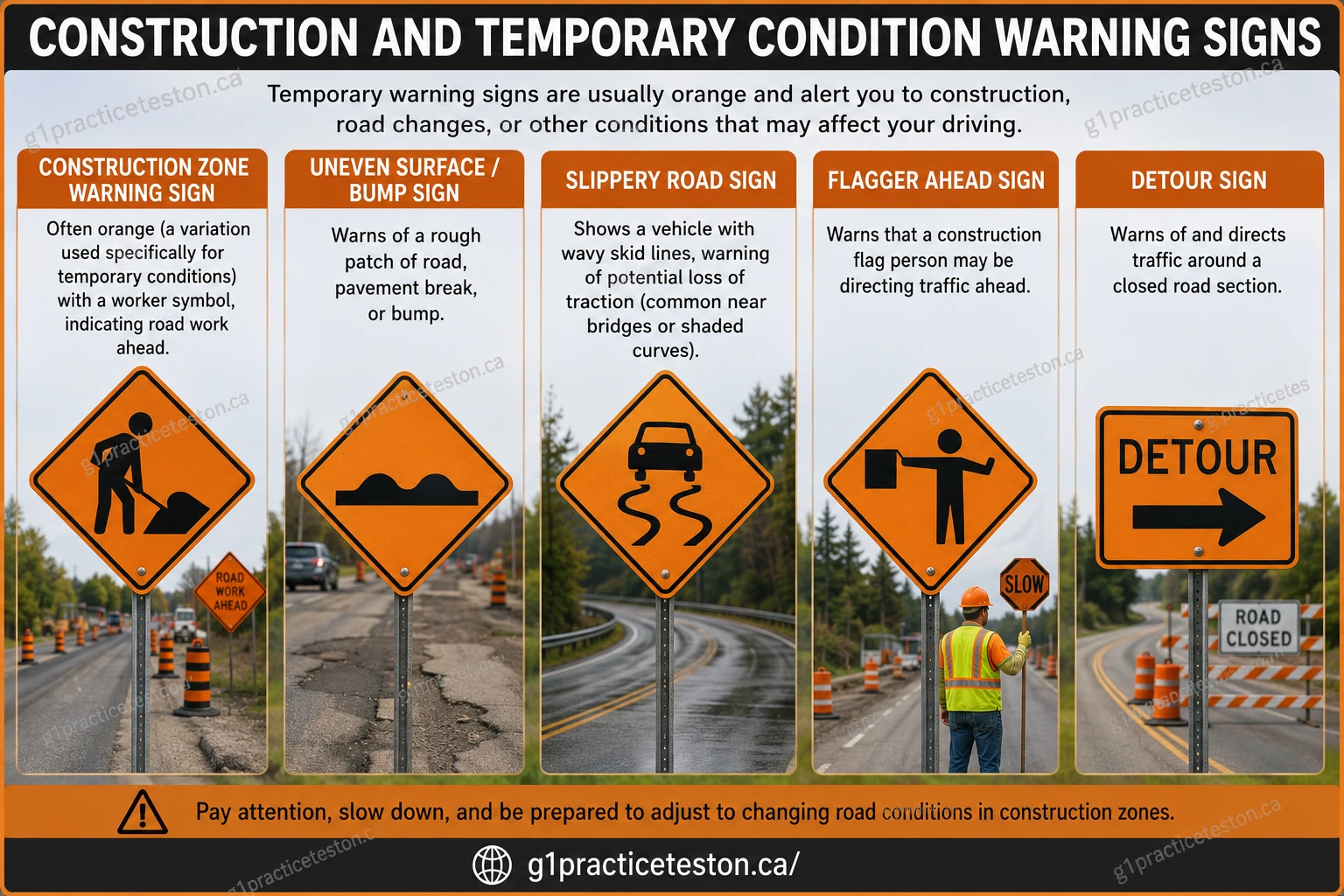
Construction and Temporary Condition Warning Signs

  • Construction Zone Warning Sign — Often orange (a variation used specifically for temporary conditions) with a worker symbol, indicating road work ahead.
  • Uneven Surface / Bump Sign — Warns of a rough patch of road, pavement break, or bump.
  • Slippery Road Sign — Shows a vehicle with wavy skid lines, warning of potential loss of traction (common near bridges or shaded curves).
  • Flagger Ahead Sign — Warns that a construction flag person may be directing traffic ahead.
  • Detour Sign — Warns of and directs traffic around a closed road section.

Wildlife and Environmental Warning Signs

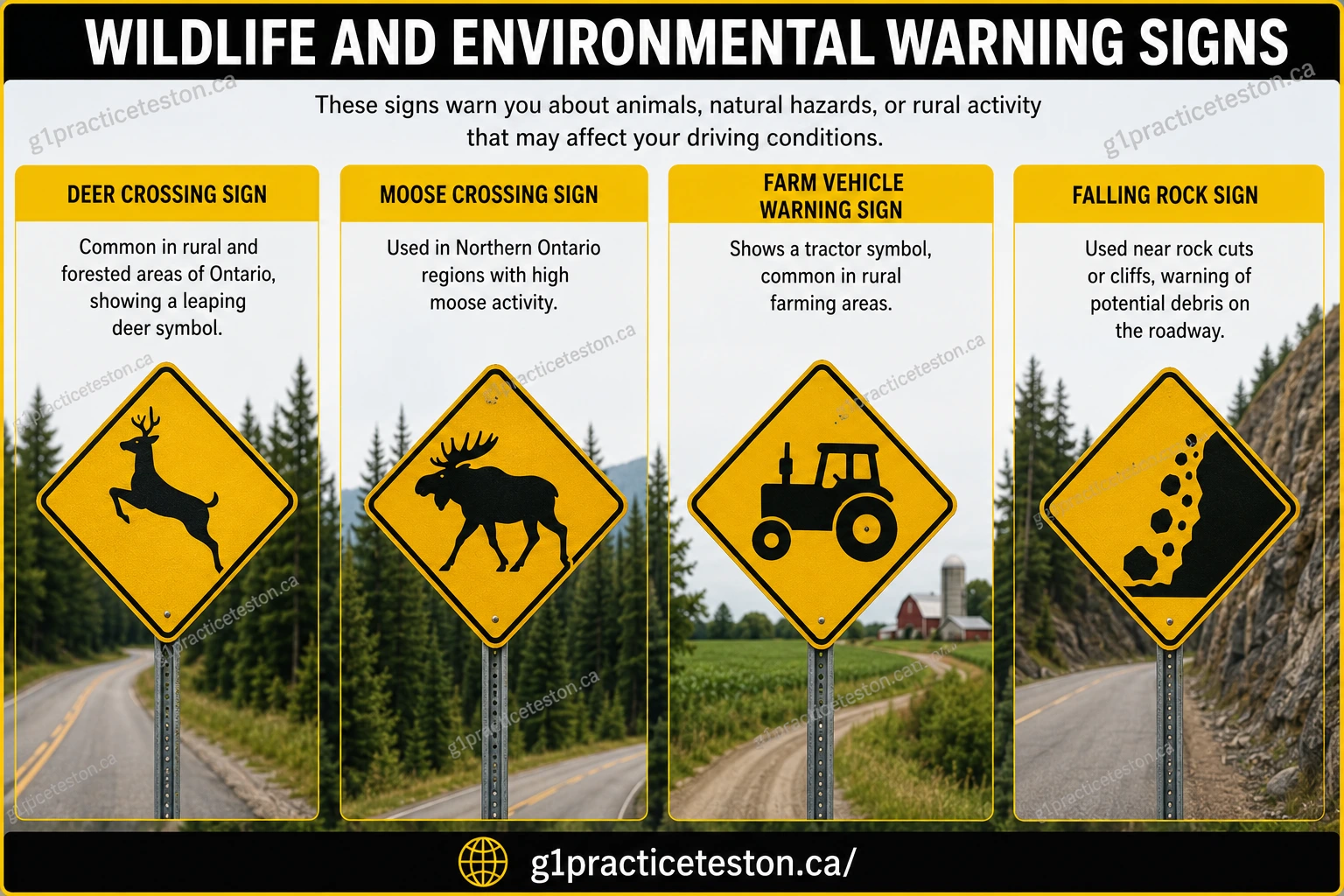
  • Deer Crossing Sign — Common in rural and forested areas of Ontario, showing a leaping deer symbol.
  • Moose Crossing Sign — Used in Northern Ontario regions with high moose activity.
  • Farm Vehicle Warning Sign — Shows a tractor symbol, common in rural farming areas.
  • Falling Rock Sign — Used near rock cuts or cliffs, warning of potential debris on the roadway.
Wildlife and Environmental Warning Signs g1practiceteston.ca
Lane and Traffic g1practiceteston.ca

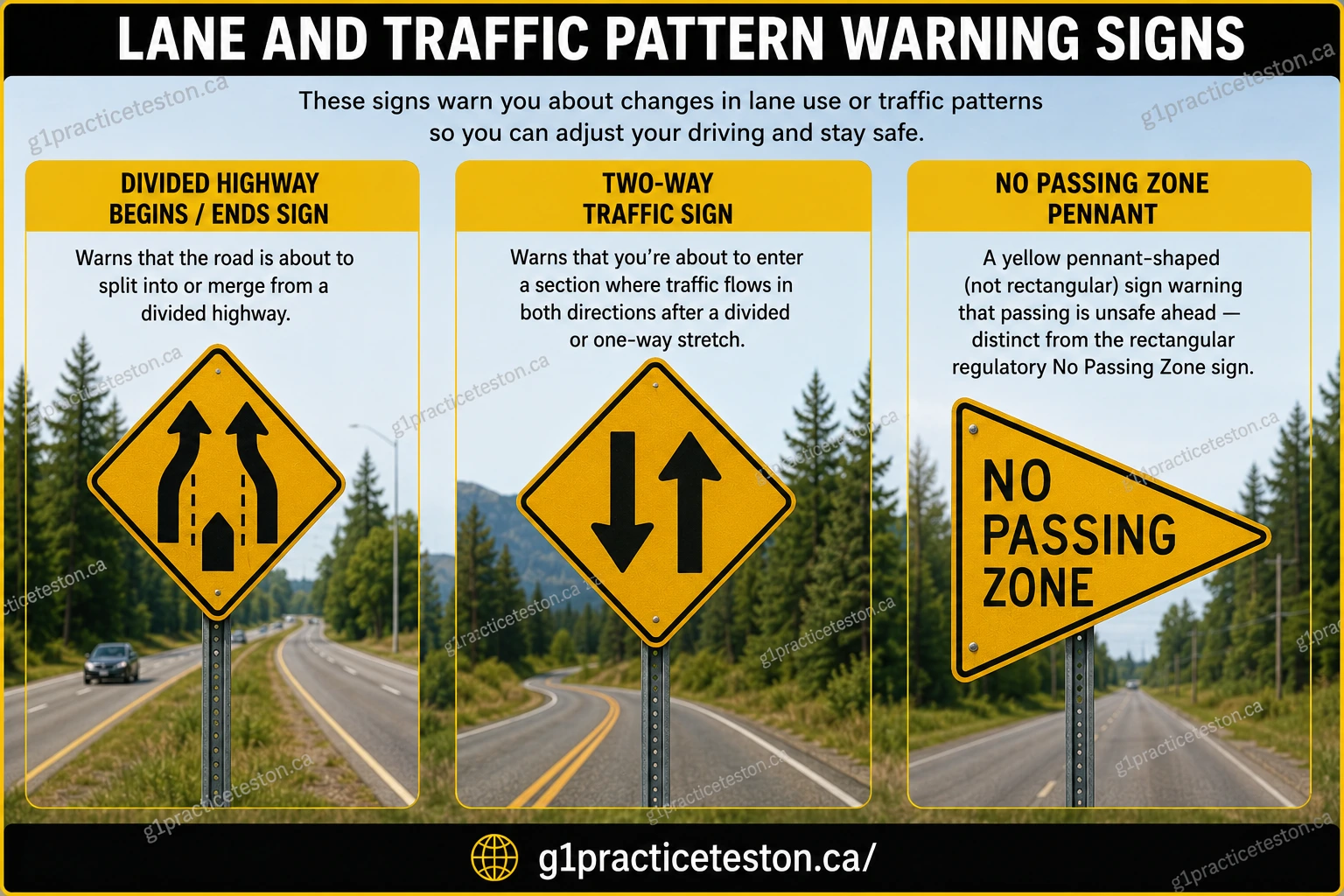
Lane and Traffic Pattern Warning Signs

  • Divided Highway Begins/Ends Sign — Warns that the road is about to split into or merge from a divided highway.
  • Two-Way Traffic Sign — Warns that you’re about to enter a section where traffic flows in both directions after a divided or one-way stretch.
  • No Passing Zone Pennant — A yellow pennant-shaped (not rectangular) sign warning that passing is unsafe ahead — distinct from the rectangular regulatory No Passing Zone sign.

Why Warning Signs Matter Beyond the G1 Test?

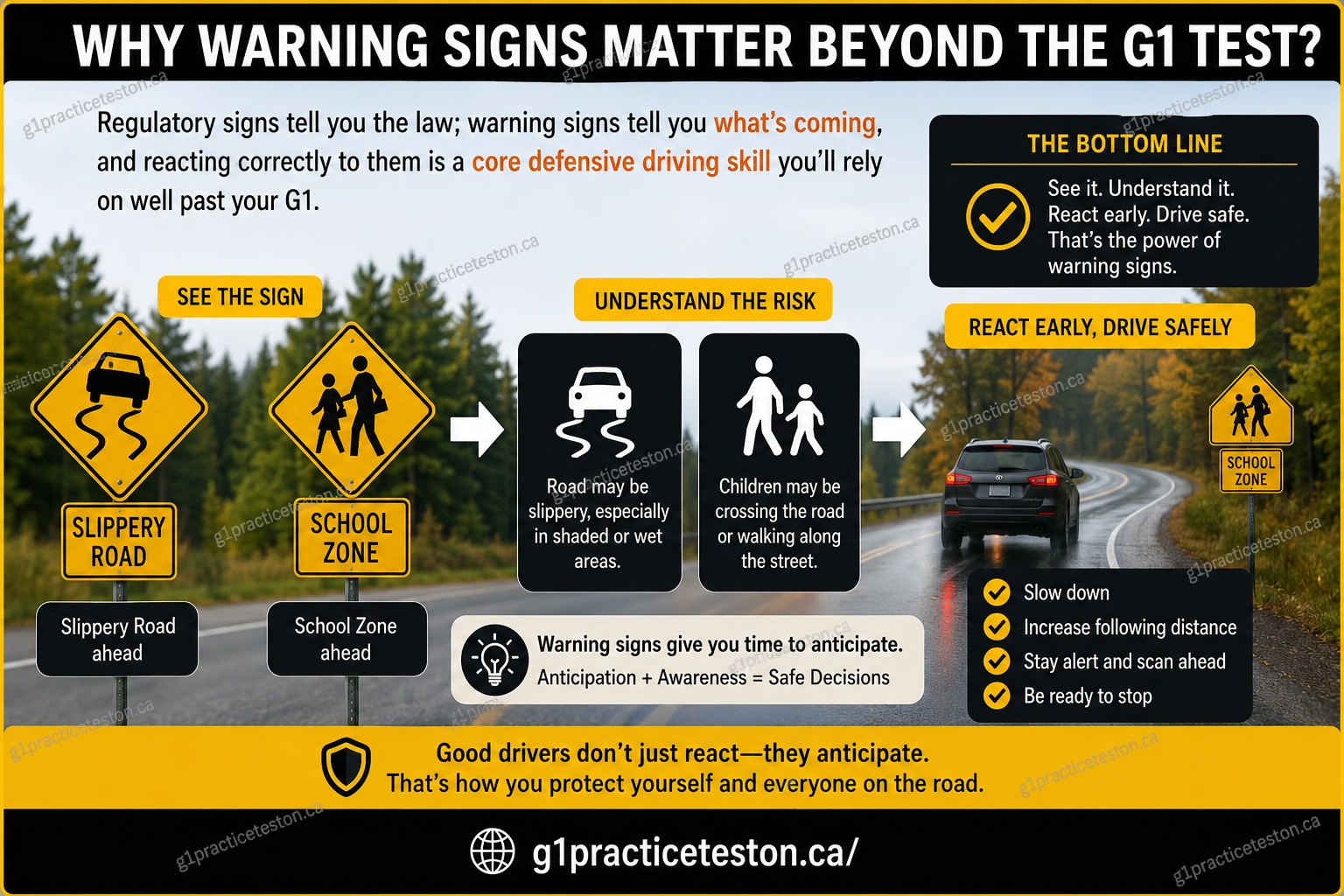
Regulatory signs tell you the law; warning road signs tell you what’s coming, and reacting correctly to them is a core defensive driving skill you’ll rely on well past your G1. Recognizing a Slippery Road sign before a shaded curve, or a School Zone sign before a stretch with kids nearby, is exactly the kind of anticipation examiners are testing for, both on paper and later during your road test.
why g1practiceteston.ca 1

Frequently Asked Questions

Most are yellow diamonds with black symbols or text, though signs involving pedestrians, cyclists, or school zones increasingly use a fluorescent yellow-green background for better visibility.

Not directly, you won’t be ticketed simply for “ignoring” a warning sign the way you would for running a stop sign. However, failing to adjust your driving appropriately (like speeding through a curve) can lead to careless driving charges if it results in a collision.

A School Zone sign warns of a general area near a school, often with a reduced speed limit. A School Crossing sign marks a specific crosswalk point, sometimes staffed by a crossing guard.

The fluorescent yellow-green colour is used by the MTO for signs involving pedestrians, school zones, and cyclists, specifically because it stands out more in daylight and low-visibility conditions, improving driver reaction time.

Conclusion

Warning road signs are your early alert system on Ontario roads; they don’t carry the legal weight of regulatory signs, but ignoring them is often what leads to the situations that regulatory signs and traffic laws are meant to prevent in the first place. Learning to recognize them by shape, colour, and symbol rather than memorizing each one individually will make both your G1 test and your actual driving noticeably safer.

Similar Posts

  • G1 Practice Test: Road Signs Edition (2026 Update)

    If you’ve been searching for a specifically focused G1 practice test road signs, you’re already ahead of most first-time test-takers. Road signs are one of the three core knowledge areas on Ontario’s G1 exam, alongside rules of the road and general driving knowledge.
    And they’re also the section where memorization actually pays off the most, because the signs themselves don’t change from test to test. What changes is whether you’ve actually trained yourself to recognize them quickly.
    This edition pulls together everything from our full sign-category guides — regulatory signs, warning signs, and information and guide signs — into one combined practice experience, based directly on the official MTO Driver’s Handbook and real recurring question patterns from the Ontario G1 knowledge test.

    How Road Signs Are Tested on the G1 Exam

    The G1 knowledge test is a computer-based, multiple-choice exam administered at DriveTest centres across Ontario. It covers rules of the road and road signs in two separate sections, and you’re required to pass both to receive your G1 licence. Road sign questions typically show an image of a sign and ask you to identify its meaning, or describe a sign and ask you to identify the correct category (regulatory, warning, or information).
    Because sign questions are visual and pattern-based, the most common reason people lose marks isn’t lack of studying. It’s studying signs individually instead of by category, shape, and colour, which is exactly how the guides in this cluster are structured.

    Road Signs Are Tested on the g1practiceteston.ca

    Sample Practice Questions (Mixed Categories)

    Here’s a short mixed sample pulling from all three sign categories, including one of the more commonly searched sign-recognition questions test takers run into:

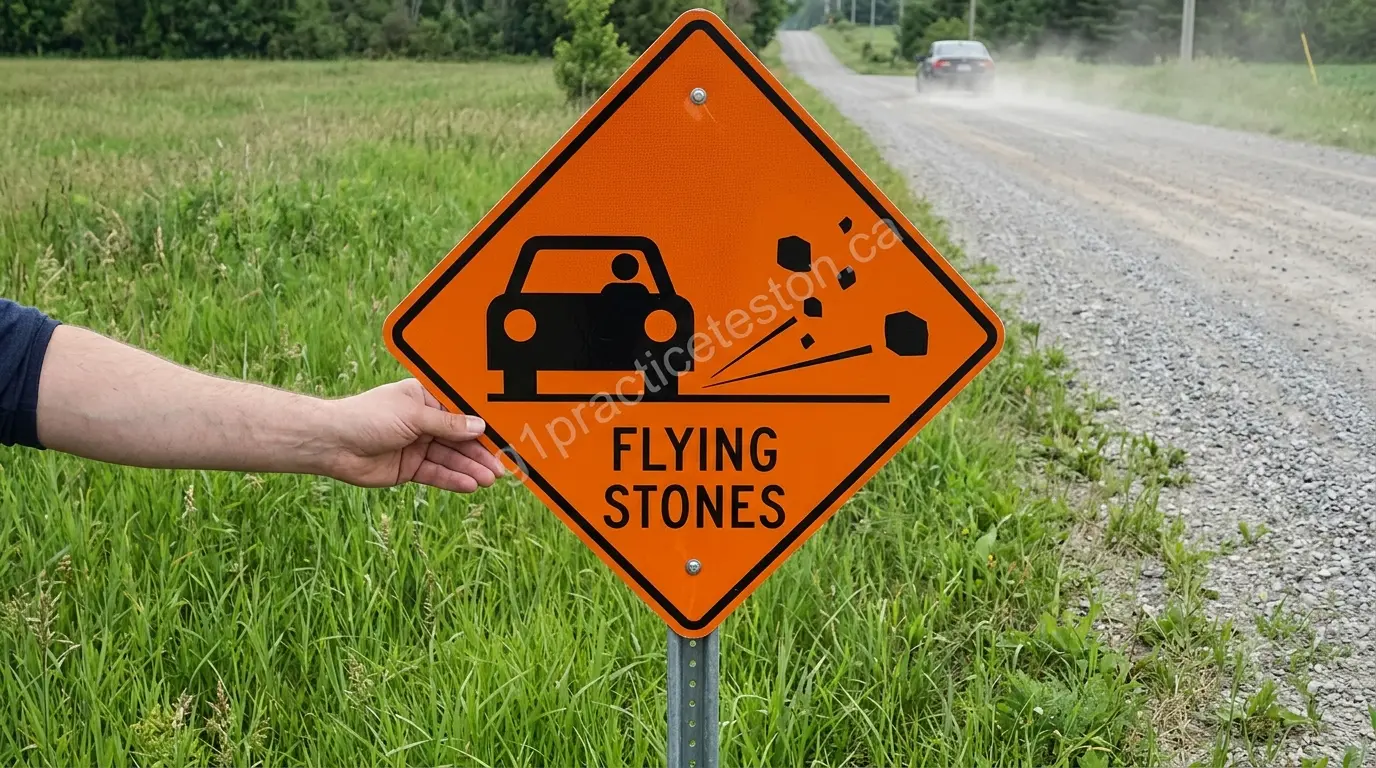
    This orange diamond-shaped sign shows a car with a driver on the left. On the right, black objects of various sizes and shapes are emerging from the area around the car’s wheels, connected to the wheels by black lines. What does this sign mean?
    • Wet roads
    • Slippery when wet
    • Falling rocks
    • Flying stones
    orange diamond shaped sign g1practiceteston.ca

    Correct Answer: D) Flying Stones

    This sign warns that loose stones or gravel may be thrown up by passing vehicles’ tires, which is different from a Falling Rocks sign (which warns of rock debris falling from a cliff or rock cut onto the roadway, not being kicked up by tires).

    G1 Practice Test – Start here
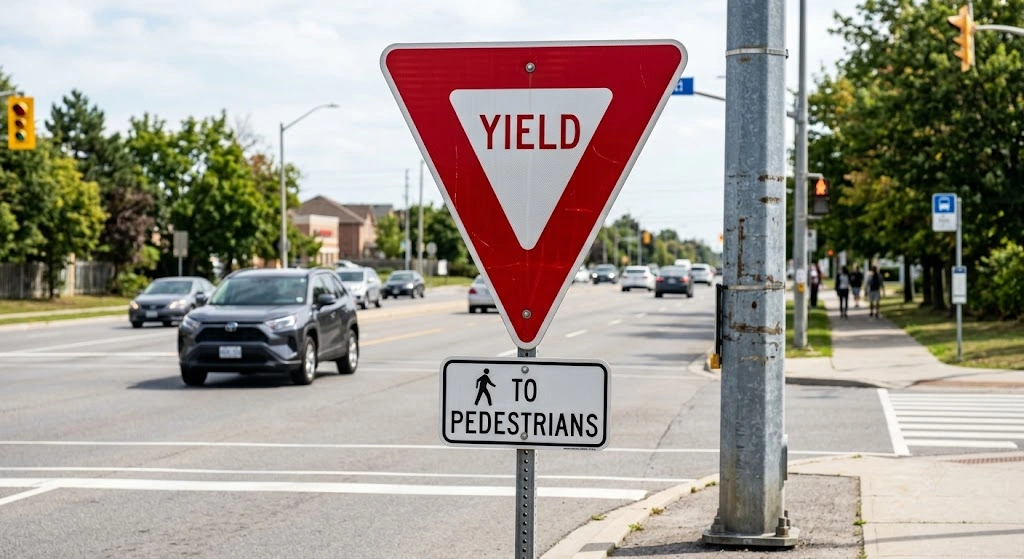
    What shape is a Yield sign in Ontario
    What shape is a Yield sign in Ontario?
    • Octagon
    • Red and white inverted triangle
    • Yellow diamond
    • Circle

    Correct Answer: B) Red and white inverted triangle

    A yellow diamond sign showing two children walking, often paired with a reduced speed limit, indicates:
    • A playground
    • A school zone
    • A pedestrian crossing
    • A school crossing

    Correct Answer: B) A school zone

    A yellow diamond sign showing two children walking, often paired with a reduced speed limit, indicates
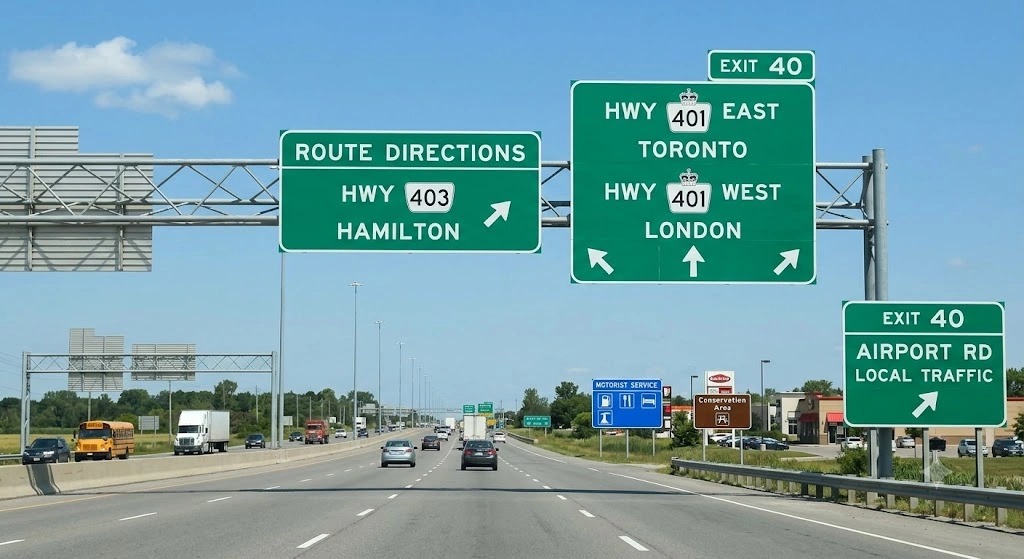
    What colour are Ontario highway guide signs showing exits and route directions
    What colour are Ontario highway guide signs showing exits and route directions?
    • Blue
    • Brown
    • Green
    • Yellow

    Correct Answer: C) Green

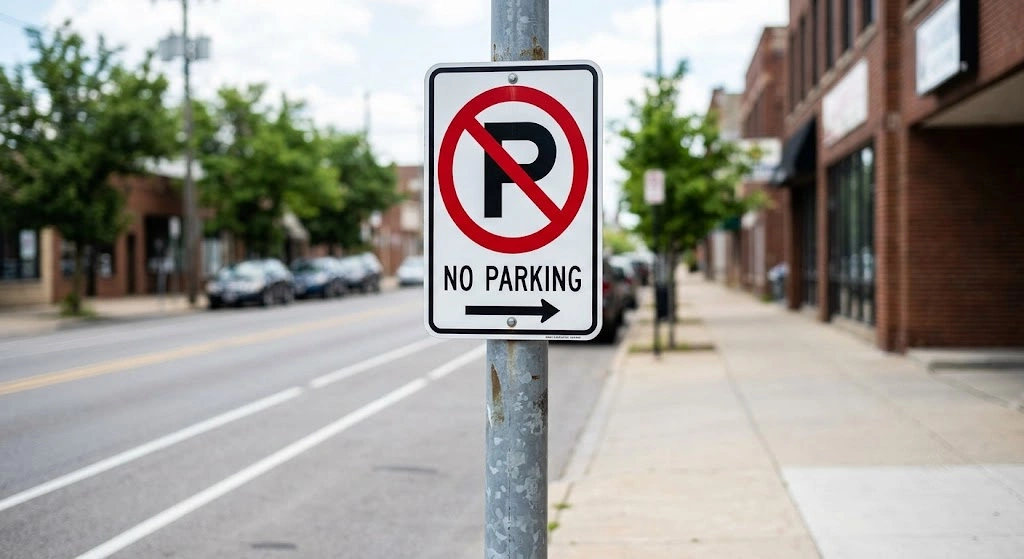
    A red circle with a “P” and a diagonal slash means:
    • Paid parking only
    • No Parking
    • No Stopping
    • Permit parking

    Correct Answer: B) No Parking

    A red circle with a P and a diagonal slash means

    For the complete question banks behind each category, see our full

    regulatory road signs Quiz

    Quick Answers to Common G1 Test Questions

    How many road sign questions are on the G1 test?

    The G1 test includes a mix of rules-of-the-road and road sign questions across its two sections. Road sign questions typically focus on recognizing regulatory, warning, and information/guide signs by shape, colour, and symbol.

    Is there a time limit for the G1 knowledge test?

    Yes, the test is timed, though most people finish well within the allotted time if they’ve studied the sign categories and rules of the road in advance. Exact timing can vary slightly by DriveTest location.

    How many mistakes are allowed on the G1 test?

    You need a minimum passing score on both the rules-of-the-road section and the road signs section to pass. Missing too many questions in either section means you’ll need to retake that section.

    What documents do I need to bring to my G1 test?

    You’ll generally need acceptable identification and, in some cases, additional documents depending on your immigration or residency status. ID requirements can vary and are strictly enforced by DriveTest centres. It’s worth confirming the latest accepted document list directly with DriveTest or the Ontario Ministry of Transportation before your appointment.

    Are demerit points tested on the G1 knowledge test?

    Demerit points aren’t usually a heavily tested topic on the G1 itself, but understanding the concept that traffic violations add points to your record and can lead to licence suspension. It is a part of general rules-of-the-road knowledge covered in the handbook.

    Strategy for the Road

    Study Strategy for the Road Signs Section

    • Learn by category, not in isolation. Group signs by regulatory, warning, and information; the colour and shape tell you the category before you even read the sign.
    • Focus on commonly confused pairs. No Parking vs. No Stopping, School Zone vs. School Crossing, Falling Rocks vs. Flying Stones. These recurring point-losers show up again and again in real test experiences.
    • Practice with images, not just text. The real exam shows you the sign. Test yourself the same way rather than just reading descriptions.
    • Take full-length practice quizzes. Work through our complete Regulatory Signs Quiz and Warning Signs Quiz to simulate real exam conditions.

    Conclusion

    Road signs are one of the most learnable parts of the entire G1 test. There’s no ambiguity, no judgment calls, just consistent shapes, colours, and meanings straight from the MTO handbook. Working through mixed practice questions like the ones above, alongside the full category quizzes in this cluster, is the fastest way to walk into your test confident instead of guessing.

    Related Posts:

  • |

    Information and Guide Signs in Ontario Explained (2026 Guide)

    By the time most people get to the information and guide signs section while studying for their G1, they usually relax a little and honestly, that’s fair. These signs aren’t testing your reflexes for a hazard or your knowledge of a legal rule.

    They’re testing whether you can quickly find your way, locate services, or understand where you are heading to your destination. But the G1 test still includes a handful of questions from this category, and it’s often where people lose easy points simply because they never studied it seriously.
    This guide walks through every major type of information and guide sign you’ll see across Ontario, following the same structure as our other sign guides. If you haven’t already, check out our Ontario Road Signs — Complete Guide, our Regulatory Road Signs guide, and our Warning Signs guide to round out all three categories tested on the G1.

    What Makes a Sign an “Information” or “Guide” Sign?

    Unlike regulatory signs or warning signs, information and guide signs exist purely to help you navigate showing directions, distances, services, and points of interest. They’re not asking you to do anything specific; they’re simply telling you what’s around you or how to get somewhere.
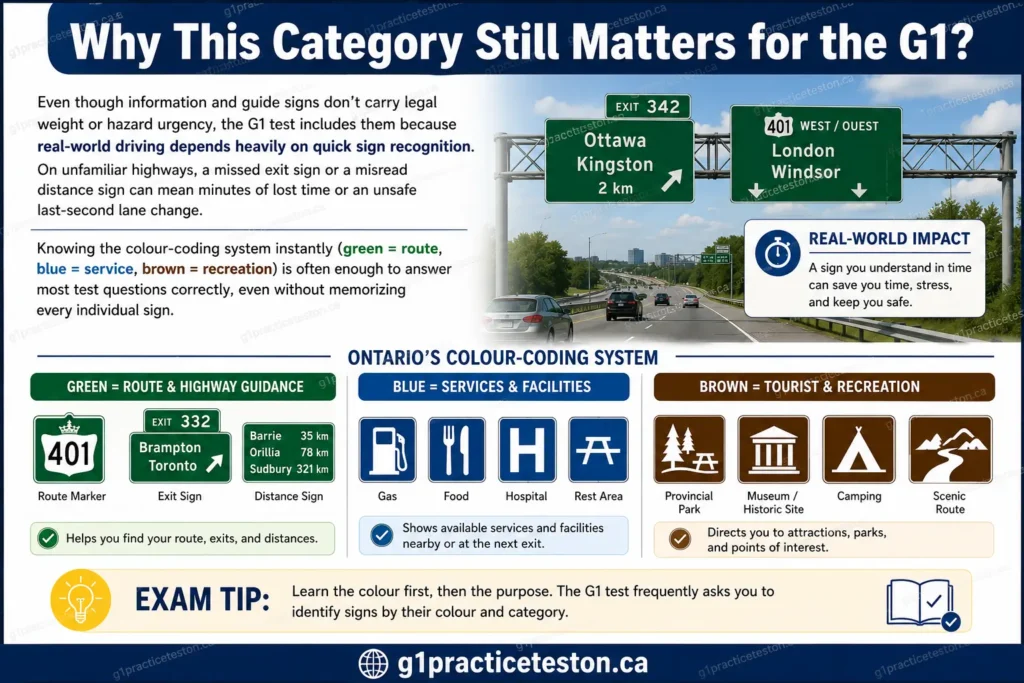
    In Ontario, these signs generally follow a consistent colour code:

    • Green — Highway and route guidance (directions, exits, distances)
    • Blue — Services (gas, food, lodging, hospitals, rest areas)
    • Brown — Tourist attractions, parks, and recreational sites
    • White or black text on a light background — General information notices

    Recognizing the colour first tells you the category of information before you even read the text.

    Information and guide signs
    Highway and route g1practiceteston.ca

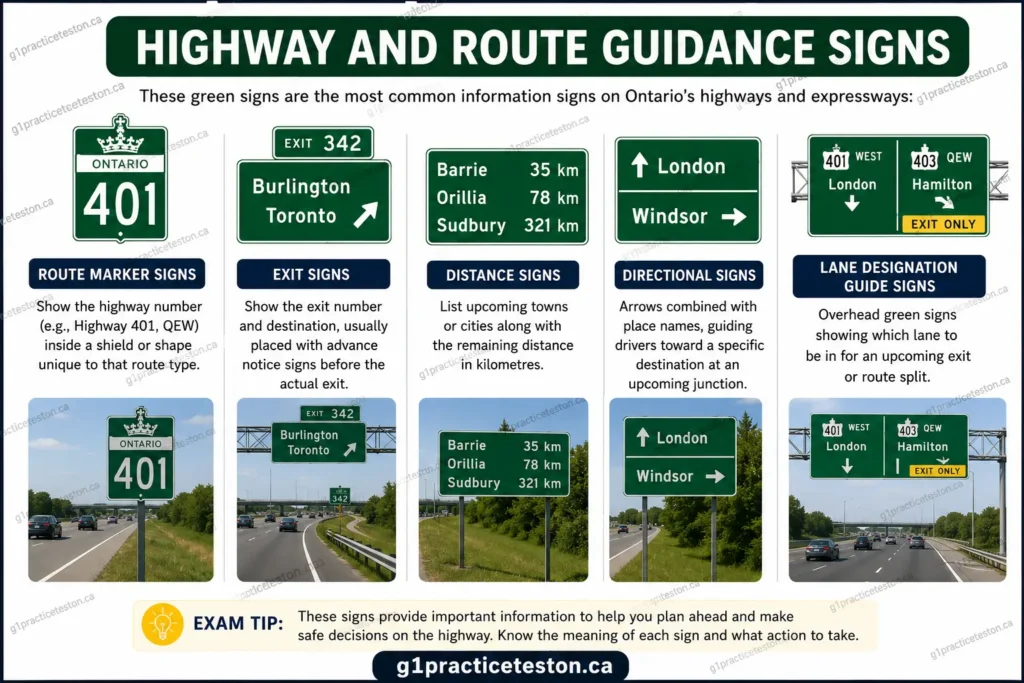
    Highway and Route Guidance Signs

    These green signs are the most common information signs on Ontario’s highways and expressways:

    • Route Marker Signs — Show the highway number (e.g., Highway 401, QEW) inside a shield or shape unique to that route type.
    • Exit Signs — Show the exit number and destination, usually placed with advance notice signs before the actual exit.
    • Distance Signs — List upcoming towns or cities along with the remaining distance in kilometres.
    • Directional Signs — Arrows combined with place names, guiding drivers toward a specific destination at an upcoming junction.
    • Lane Designation Guide Signs — Overhead green signs showing which lane to be in for an upcoming exit or route split.

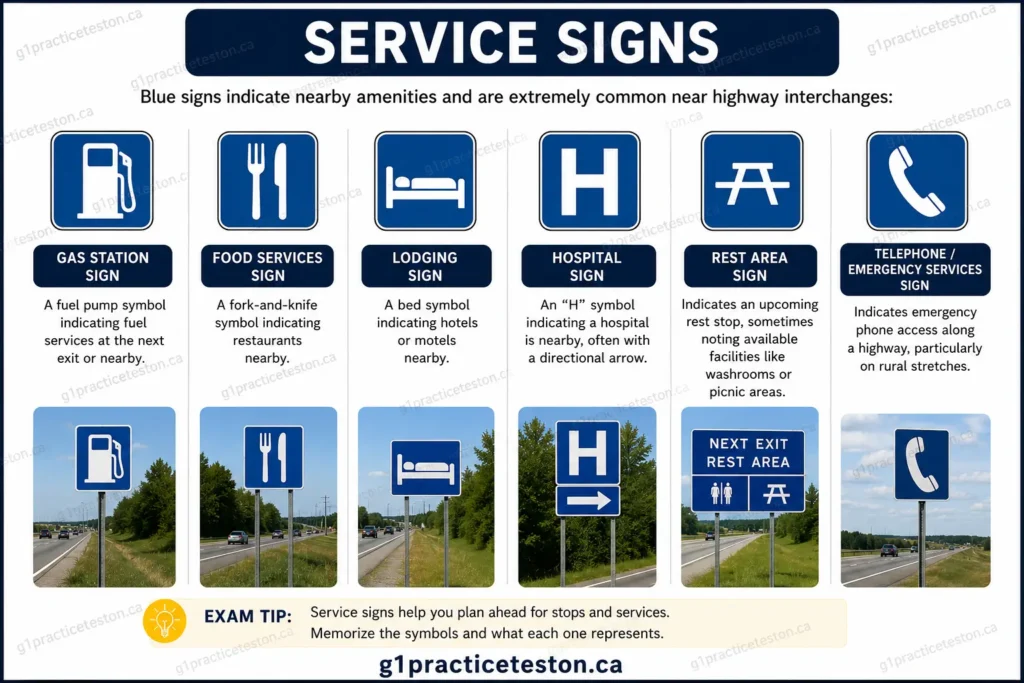
    Service Signs

    Blue signs indicate nearby amenities and are extremely common near highway interchanges:

    • Gas Station Sign — A fuel pump symbol indicating fuel services at the next exit or nearby.
    • Food Services Sign — A fork-and-knife symbol indicating restaurants nearby.
    • Lodging Sign — A bed symbol indicating hotels or motels nearby.
    • Hospital Sign — An “H” symbol indicating a hospital is nearby, often with a directional arrow.
    • Rest Area Sign — Indicates an upcoming rest stop, sometimes noting available facilities like washrooms or picnic areas.
    • Telephone/Emergency Services Sign — Indicates emergency phone access along a highway, particularly on rural stretches.
    service sign g1practiceteston.ca
    Tourist and Recreational g1practiceteston.ca

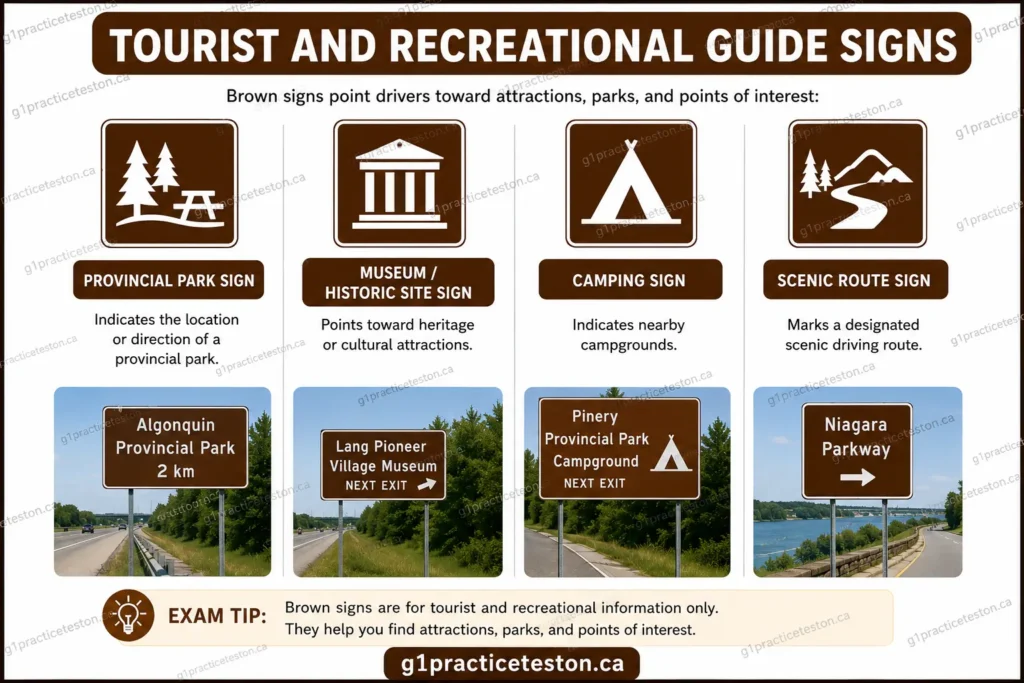
    Tourist and Recreational Guide Signs

    Brown signs point drivers toward attractions, parks, and points of interest:

    • Provincial Park Sign — Indicates the location or direction of a provincial park.
    • Museum/Historic Site Sign — Points toward heritage or cultural attractions.
    • Camping Sign — Indicates nearby campgrounds.
    • Scenic Route Sign — Marks a designated scenic driving route.

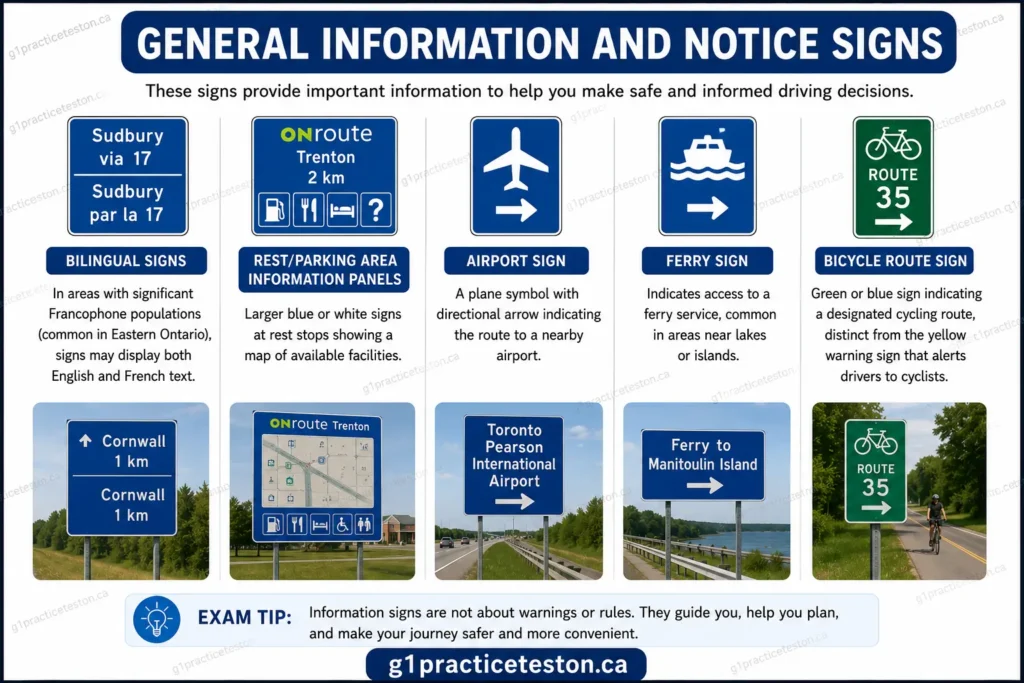
    General Information and Notice Signs

    • Bilingual Signs — In areas with significant Francophone populations (common in Eastern Ontario), signs may display both English and French text.
    • Rest/Parking Area Information Panels — Larger blue or white signs at rest stops showing a map of available facilities.
    • Airport Sign — A plane symbol with directional arrow indicating the route to a nearby airport.
    • Ferry Sign — Indicates access to a ferry service, common in areas near lakes or islands.
    • Bicycle Route Sign — Green or blue sign indicating a designated cycling route, distinct from the yellow warning sign that alerts drivers to cyclists.
    General Information g1practiceteston.ca
    Why This Category g1practiceteston.ca

    Why This Category Still Matters for the G1?

    Even though information and guide signs don’t carry legal weight or hazard urgency, the G1 test includes them because real-world driving depends heavily on quick sign recognition especially on unfamiliar highways where a missed exit sign or misread distance sign can mean minutes of lost time or an unsafe last-second lane change. Knowing the colour-coding system instantly (green = route, blue = service, brown = recreation) is often enough to answer most test questions correctly, even without memorizing every individual sign.
    Frequently Asked Questions

    Not as heavily as regulatory or warning signs, but they still appear, particularly questions about colour coding (green vs. blue vs. brown) and specific symbols like hospital, gas, or rest area signs.
    Ontario has significant Francophone communities, particularly in Eastern Ontario and parts of the North, and provincial policy requires bilingual signage in designated areas under the French Language Services Act.

    Green means route/direction, blue means service, and brown means recreation or tourism. Once that’s memorized, most individual signs become easy to interpret even without prior exposure.

    No. Unlike regulatory signs, information and guide signs are purely navigational and carry no legal obligation, though ignoring them (like missing a “Rest Area” sign) can still affect trip planning and safety on long drives.
    Conclusion

    Information and guide signs round out the third and final sign category tested on your G1 exam. They’re the easiest to master once you understand the colour-coding logic behind them green for routes, blue for services, brown for recreation and they matter just as much for real-world driving as they do for the test, especially on unfamiliar highways where quick recognition saves both time and stress.

    Related Posts:

  • G1 Test Eligibility Ontario: Age, Documents & Requirements (2026 Guide)

    Before you book your G1 knowledge test, it’s worth checking the G1 driving test requirements and that you actually meet Ontario’s eligibility rules. Getting turned away at a DriveTest centre because of a missing document or a misunderstanding about age is a common and completely avoidable mistake. Here’s everything you need to know.

    Start full practice test →

    G1 Driving Test Requirements

    To take the G1 knowledge test in Ontario, you need to meet a short list of requirements:

    16+ years old

    There’s no exception for this, regardless of how prepared you are.

    Ontario resident

    Be a resident of Ontario, or fall under one of the newcomer/exchange categories below.

    Vision screening

    at the DriveTest centre before you’re allowed to write the test.

    Pass the knowledge test

    40 multiple-choice questions split into two 20-question sections (road signs and rules of the road), with a minimum of 16 out of 20 needed per section to pass.

    Newcomers to Ontario

    If you’re new to Canada, you can still take the G1 test at 16+ regardless of immigration status. If your home country has a licence-exchange agreement with Ontario (this includes countries like Germany, France, the UK, the US, Japan, South Korea, Australia, and a few others), you may be able to skip the G1 stage entirely and convert straight to a G2 or full G licence, worth checking before you assume you need to start from scratch.

    Foreign driving experience

    If you don’t qualify for a direct licence exchange, you may still be able to count up to 12 months of verified foreign driving experience toward your waiting period between G1 and G2, provided you can document it with an authenticated letter from the issuing jurisdiction.

    Documents required for the G1 test

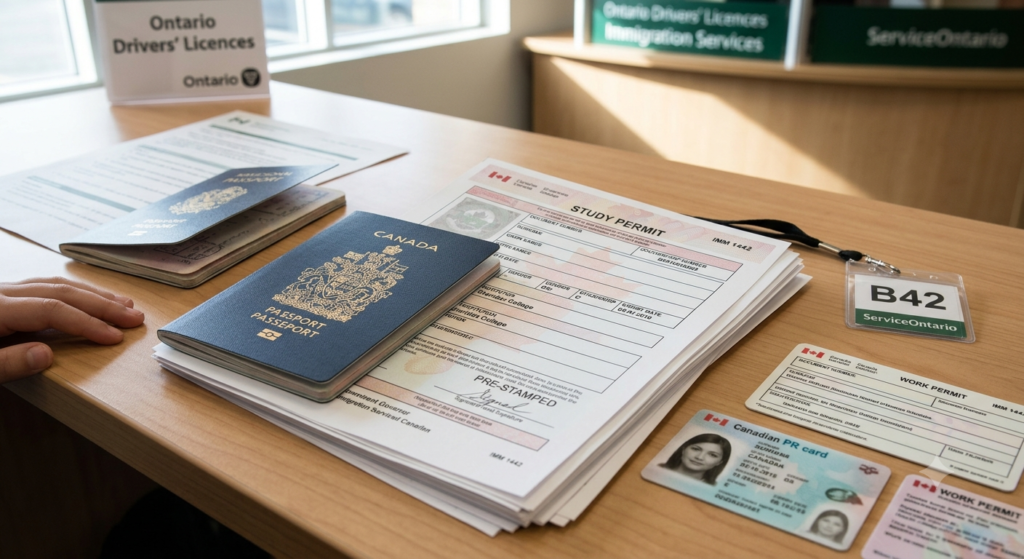
    DriveTest centres are strict about ID. Arriving with the wrong documents is one of the most common reasons people get sent home. You’ll need:

    Primary ID

    one document proving your legal name and date of birth, such as:

    • A valid passport
    • A Canadian birth certificate
    • A Permanent Resident card
    • A Secure Certificate of Indian Status
    • A Confirmation of Permanent Residence (IMM 5292), paired with a valid passport from your country of origin
    G1 Driving Test Requirements
    G1 Driving Test Requirements

    A document with your signature

    if your primary ID doesn’t include one (a birth certificate, for example), bring a secondary piece of ID that does, like a bank card or credit card.

    For newcomers/students specifically:

    • A foreign passport plus a valid immigration document (study permit, work permit, or PR card)
    • International students should bring their passport and current study permit
    documents g1practiceteston.ca

    A few important notes:

    • No photocopies; documents must be original.
    • No expired documents.
    • No visibly altered documents.
    • Payment for the test fee (approximately $158–160, which typically bundles your G1 licence and first G2 road test booking).

    G1 Driving Test Age Ontario

    • Minimum age: 16. The DriveTest staff check ID on the spot, and there’s no flexibility for someone who’s “almost 16.”
    • Maximum age: none. Whether you’re 16 or 76, the eligibility criteria and test format are identical.

    Requirement

    Detail

    Minimum age

    16 (no exceptions)

    Maximum age

    None

    Residency

    Ontario resident (or eligible newcomer)

    Vision test

    Required before the knowledge test

    Primary ID

    Passport, birth certificate, PR card, etc.

    Signature ID

    Required if the primary ID lacks one

    Test fee

    ~$158–160

    Test format

    40 questions, 2 sections, 16/20 to pass each

    No. Any Ontario resident aged 16+ can take the test regardless of citizenship or immigration status, as long as you bring acceptable ID.

    No, DriveTest requires original documents. Photocopies will not be accepted.

    No. There’s no upper age limit for obtaining a G1 licence in Ontario.

    Bring a second piece of ID that does, such as a credit card, bank card, or another government-issued document with a signature.

    3d notes icon png

    Note

    MTO fees, ID rules, and exchange-agreement countries can change — double-check current details on ontario.ca or with your local DriveTest centre before booking.

  • G1 Licence Restrictions in Ontario

    The G1 Roadbook · Ontario Graduated Licensing Guide

    G1 Licence Restrictions In Ontario

    A complete, plain-English guide to G1 licence restrictions in Ontario. The G1 licence requirements you need to meet, how Ontario’s graduated licensing system carries you from G1 to G2 to a full G, what car insurance for G1 drivers really looks like, current G1 licence fees, and the two things almost nobody explains correctly.

    What is a G1 licence?

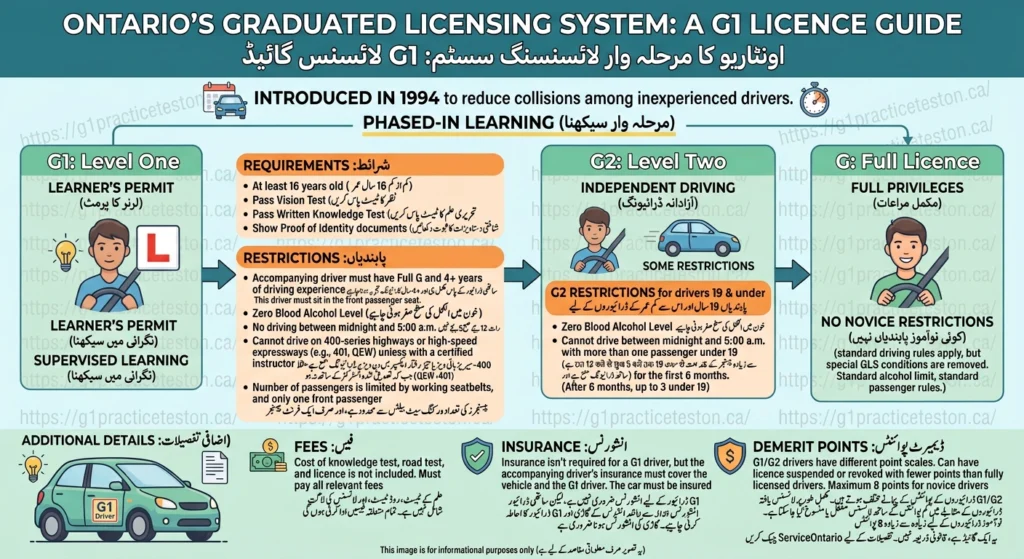
    A G1 licence is Level One of Ontario’s graduated licensing system (GLS), introduced in 1994 to reduce collisions among inexperienced drivers. Instead of handing new drivers full privileges immediately.

    The province phases them in across three stages: 
    G1 supervised learning, most restrictions apply; 
    G2 independent driving, some restrictions remain for younger drivers;
    Full G: no novice-driver restrictions.

    A G1 is often compared to a learner’s permit: it lets you sit behind the wheel and build real experience, but only under specific, legally defined conditions.
    This guide walks through the G1 licence requirements, the G1 licence restrictions in Ontario you’ll need to follow, and everything that sits between them.
    Fees, insurance, demerit points, and a couple of things most sites get wrong.

    What is a G1 licence g1practiceteston.ca

    G1 licence requirements in Ontario

    To apply for a G1, you must:

    • Be at least 16 years old
    • Be a resident of Ontario (visitors aren’t eligible for an Ontario licence)
    • Pass a vision test at a DriveTest centre
    • Pass a written knowledge test on the rules of the road and traffic signs

    Identification you’ll need

    Proof of legal name, date of birth, and signature. One primary document such as :
    A Canadian or foreign passport,
    Canadian Citizenship Card with photo,
    Permanent Resident Card,
    Ontario Photo Card,
    or valid temporary immigration documents.

    If your document doesn’t show both your legal name and full date of birth, a secondary document (commonly a birth certificate) is required.

    About the knowledge test

    It’s 40 multiple-choice questions.
    20 on road signs,
    20 on rules of the road

    and you typically need at least 16/20 in each section (80%) to pass.

    It takes about 20–30 minutes; walk-ins are accepted at any DriveTest centre, and some locations offer a computer-based version.

    Check our detailed guidelines for G1 Driving test requirements.

    As of May 11, 2026

    When you apply for a Class G or Class M licence, you must also declare that Ontario is your primary place of residence and that your presence in Canada is legal.

    G1 licence fees in Ontario 2026 g1practiceteston.ca

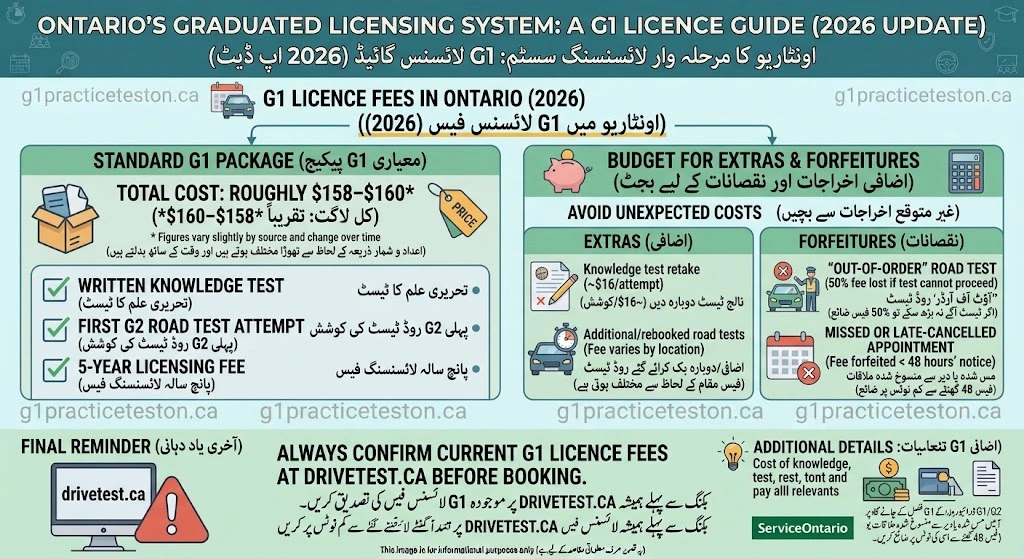
    G1 licence fees in Ontario (2026)

    The standard G1 package costs roughly $158–$160 (figures vary slightly by source and change over time), typically bundling the written knowledge test, your first G2 road test attempt, and a five-year licensing fee.
    Budget for extras: knowledge test retake (~$16/attempt), additional or rebooked road tests (fee varies by location), an out-of-order road test (50% of the fee is lost if the test can’t proceed), and a missed or late-cancelled appointment (prepaid fee forfeited under 48 hours’ notice).

    Always confirm current G1 licence fees at drivetest.ca before booking. They’re periodically adjusted.

    How Ontario’s graduated licensing system works

    Stage

    What happens

    Minimum time held

    G1

    Written test passed, supervised driving only

    12 months (or 8 with a BDE course)

    G2

    G1 exit road test passed, independent with conditions

    12 months

    Full G

    G2 exit road test passed, no novice restrictions

    For most people, the entire process takes 20 to 24 months. You have up to five years from the date you receive your G1 to complete it.
    If you don’t finish in time: still at G1 when the five years are up means you must rewrite the knowledge test for a new G1; already at G2 means you can retake the G1 road test to renew your G2 status for another five years.

    G1 licence restrictions you must follow in Ontario

    Once you have your G1, Ontario applies a specific set of restrictions every time you get behind the wheel:

    No driving alone. 

    You must always be accompanied by a fully licensed driver with at least four years of experience, seated in the front passenger seat. The only other person permitted up front.

    Zero blood alcohol. 

    Your BAC must be 0.00. No alcohol, no cannabis, no impairing substances, no exceptions.

    No driving midnight–5 a.m.

    Fatigue and low visibility disproportionately affect new drivers’ collision risk.

    No 400-series highways or high-speed expressways

    Unless your accompanying driver is a certified instructor. (The next section covers exactly which roads this G1 highway restriction means in practice.)

    Seatbelt rule.

    Every passenger needs a working seatbelt, and you can’t carry more passengers than working seatbelts.

    Which roads are you actually restricted from?

    In practice: a rural county road, a provincial highway, or a municipal expressway posted at 90 km/h is generally fine for a G1 driver to use — unless it’s specifically on that list. This is why new drivers in Huron County, along Highway 17 near Thunder Bay, or on Highway 11 between Barrie and North Bay can legally practise on those roads: they’re not “King’s Highways” on the restricted list, regardless of posted speed.

    Roads that surprise people by being legal for G1 drivers despite feeling like highways:

    • Lincoln Alexander Parkway and Red Hill Valley Parkway (Hamilton)
    • Highway 35/115 between Oshawa and Peterborough
    • The 80 km/h section of Highway 406 in St. Catharines
    • Highway 174 (Ottawa)

    The actual rule (Ontario Regulation 340/94, Section 5) restricts only the highways specifically named in the regulation. Not every road posted above 80 km/h. The named list behind Ontario’s 400-series highway restriction for G1 drivers is:

    • 400-series highways (400, 401, 402, 403, 404, 405, 406, 409, 410, 412, 416, 417, 418, 420, 427) where the posted limit exceeds 80 km/h
    • Highway 407, including 407 East
    • The Queen Elizabeth Way (QEW)
    • The Don Valley Parkway, Gardiner Expressway, and E.C. Row Expressway
    • The Conestoga Parkway (between its Highway 7/8 and Highway 86 limits)

    The instructor exception: if your accompanying driver is a certified Ontario driving instructor, the highway restriction lifts entirely. You can drive on any road.

    Correcting a common mistake

    In an Ontario driving forum, a parent whose son held a G1 was told by his instructor that he couldn’t drive on any road with a speed limit over 80 km/h. That’s incorrect, and it matters a lot if you live outside a major city.

    Who can be your accompanying driver?

    Your supervising driver must:

    • Hold a full Class G licence (or equivalent) with at least four years of driving experience. The time at G2 counts, as long as that licence was never suspended
    • Have a BAC below 0.05%, or zero, if they’re 21 or under
    • Sit in the front passenger seat and be the only other person up front
    • Not be under licence suspension (demerit points are fine; suspension isn’t)

    G1 demerit points and the consequences of breaking the rules

    Novice drivers are held to tighter demerit-point thresholds than fully licensed drivers: 2–5 points brings a warning letter from the MTO, 6–8 points a second, more serious warning, and 9 or more a 60-day licence suspension.

    Violation

    Typical suspension

    Typical fine

    Driving without a supervisor

    30–90 days

    ~$110

    Impaired driving

    3-day roadside + 30–90 days

    $60–$1,000 + reinstatement

    Driving midnight–5 a.m.

    30–90 days

    $60–$500

    Passengers > seatbelts

    30–90 days

    $60–$500

    Distracted driving

    30–90 days

    $615–$1,000

    Novice drivers also fall under Ontario’s escalating penalties program; repeated violations can mean losing your licence and restarting the graduated licensing process from scratch. These penalties don’t disappear once you reach G2 or full G either: HTA convictions, at-fault collisions, and suspensions stay visible to insurers for three to six years, which is exactly why a clean G1/G2 record matters for future premiums.

    Moving from G1 to G2

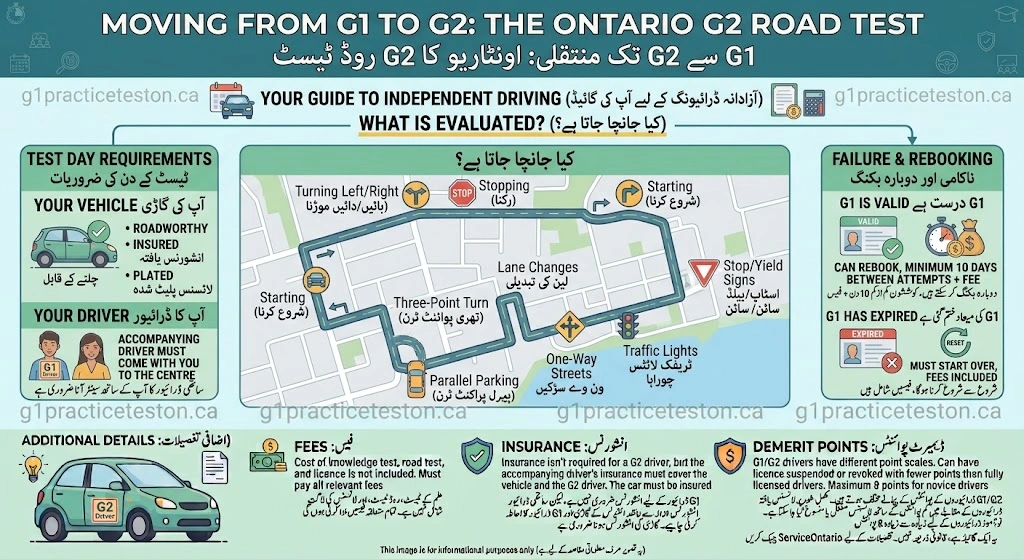
    Once you’ve held your G1 for the required period, you can book the G2 road test. It evaluates fundamentals: turning left and right, stopping, starting, parallel parking, three-point turns, lane changes, one-way streets, intersections, traffic lights, and stop/yield signs.

    You’ll need a roadworthy, insured, plated vehicle for the test, and your accompanying driver must come with you to the test centre. If you fail and your G1 is still valid, you can rebook (minimum 10 days between attempts, plus the fee).
    If your G1 has expired, you’ll need to start over, fees included.

    Moving from G1 to G2 g1practiceteston.ca

    How long do you have to hold a G1?

    • 12 months minimum, standard timeline
    • 8 months if you complete a ministry-approved Beginner Driver Education (BDE) course
    • Your G1 itself is valid for 5 years from the date it’s issued

    A BDE course must run at least 40 hours (roughly 20 in-class, 10 in-vehicle, 10 flexible), delivered only by ministry-licensed schools and instructors.

    Car insurance for G1 drivers

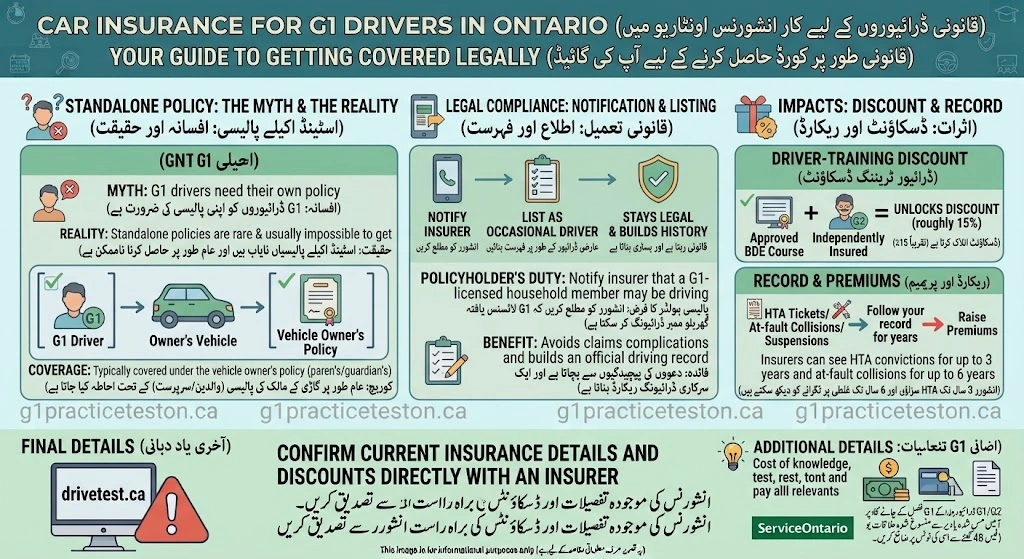
    A common misconception is that G1 drivers need their own policy. They don’t, and in most cases can’t get one as a standalone product.

    • G1 drivers are typically covered under the vehicle owner’s policy (usually a parent’s or guardian’s)
    • The policyholder should notify their insurer that a G1-licensed household member may be driving. This avoids complications with claims later
    • Being listed as an occasional or secondary driver keeps things legal while you build a driving history
    • An approved BDE course can unlock a driver-training discount of up to roughly 15% once you’re independently insured
    • Tickets, at-fault collisions, or suspensions during G1/G2 follow your record and can raise premiums for years after. Insurers can see HTA convictions for up to three years and at-fault collisions for up to six
    Car insurance for G1 drivers g1practiceteston.ca
    Buying a car with a G1 licence can you g1practiceteston.ca

    Buying a car with a G1 licence, can you?

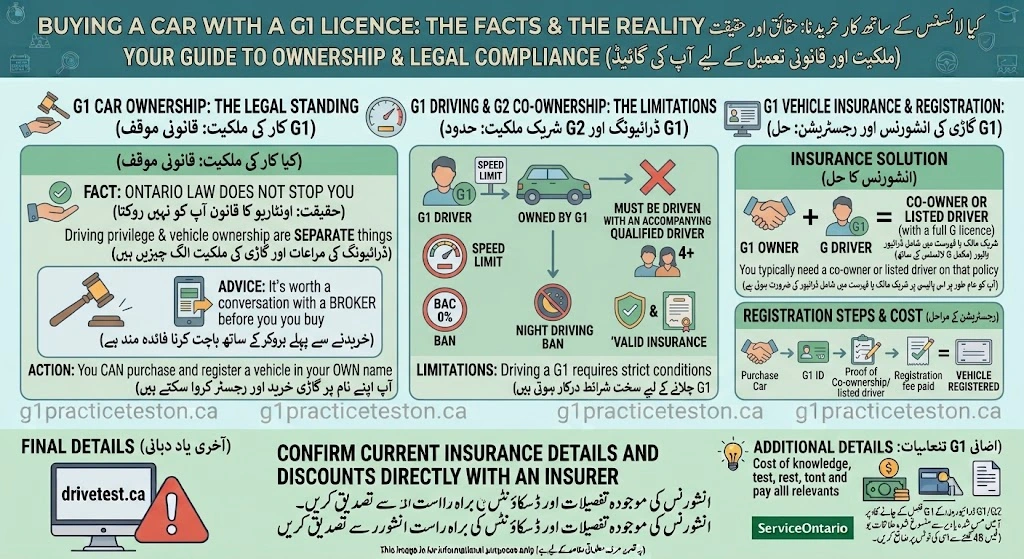
    Yes. Ontario law doesn’t stop a G1 holder from purchasing or registering a vehicle in their own name. Driving privilege and vehicle ownership are separate things.
    You can buy and register a car while still on your G1, but you still can’t drive it without an accompanying qualified driver and valid insurance in place. Since you can’t hold a standalone policy as a G1 driver, you’ll typically need a co-owner or listed driver with a full licence on that policy, worth a conversation with a broker before you buy.

    Getting a G1 licence without a car to practice in

    From real driver questions

    This comes up more than people assume. Plenty of new drivers are adults in their 20s, 30s, or later who never learned at 16 and don’t have a family member or friend with a car.
    It’s genuinely common, and there’s no meaningful “too late”. People have gone through the G1 process successfully in their late 20s, 30s, and even 50s.

    If you’re starting with zero car access:

    • Driving schools supply the car. Most licensed schools provide the vehicle for both lessons and, often, the road test itself, since the instructor’s car has dual brake pedals.
    • Typical lesson packages run 10–20 hours of in-car instruction; many new drivers find 15–20 hours gives noticeably more confidence than the legal minimum.
    • Car-sharing isn’t a reliable backup for testing. Most car-share providers, Zipcar included, no longer permit their vehicles for road tests. Confirm current policy before planning around it.
    • There’s no need to rush. You have up to five years to complete the whole GDL process, so pace your G1 stage around your actual budget and schedule.
    • Ask before assuming no one can help. Even occasional supervised practice. A rented car, a driving school’s car outside paid lesson time — can meaningfully cut down how many paid hours you need.
    G1 licence restrictions

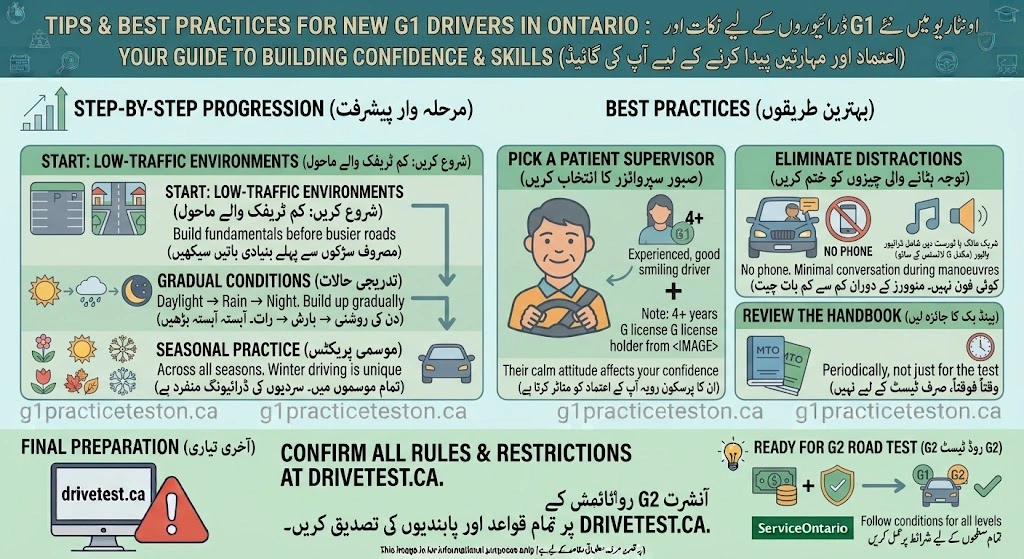
    Tips & best practices for new G1 drivers

    • Start in low-traffic environments, quiet residential streets, empty parking lots. Before busier roads
    • Practise in daylight and good weather first; build up to harder conditions gradually
    • Pick a supervising driver who’s patient and calm; their attitude affects your confidence more than you’d expect
    • Keep the car free of distractions. No phone, minimal conversation during tricky manoeuvres
    • Review the Official MTO Driver’s Handbook periodically, not just before the knowledge test
    • Get practice across different seasons if your window allows. Winter driving is a different skill entirely

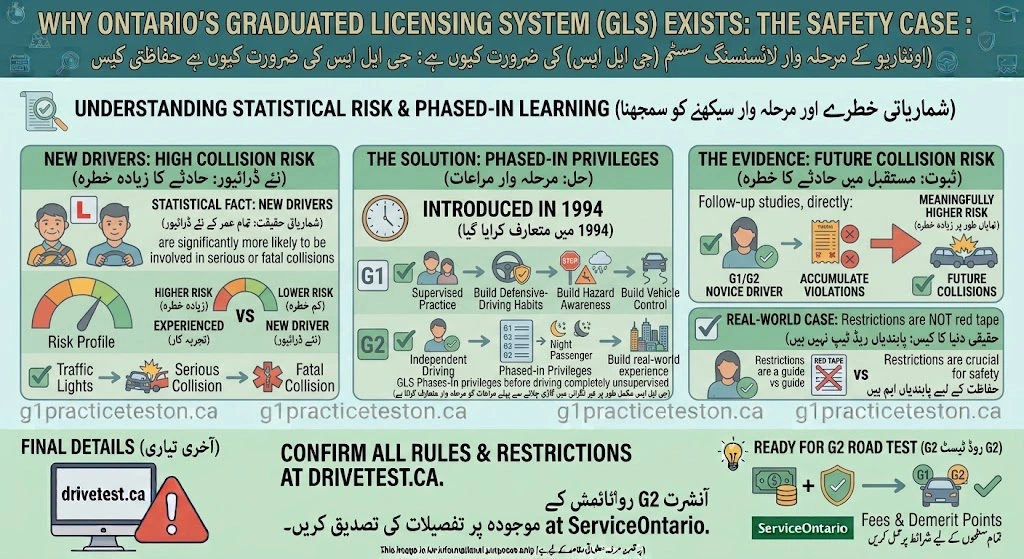
    Why the graduated licensing system exists

    New drivers, regardless of age, are statistically far more likely to be involved in serious or fatal collisions than experienced drivers.
    That risk profile is exactly why Ontario introduced the GLS in 1994: phasing in privileges gives new drivers time to build defensive-driving habits, hazard awareness, and vehicle control before driving completely unsupervised.
    Studies following novice drivers have found that those who accumulate violations during G1/G2 face a meaningfully higher risk of future collisions. The real-world case for taking the restrictions seriously rather than treating them as red tape.

    Why the graduated licensing system exists g1practiceteston.ca
    G1 for new residents foreign drivers g1practiceteston.ca

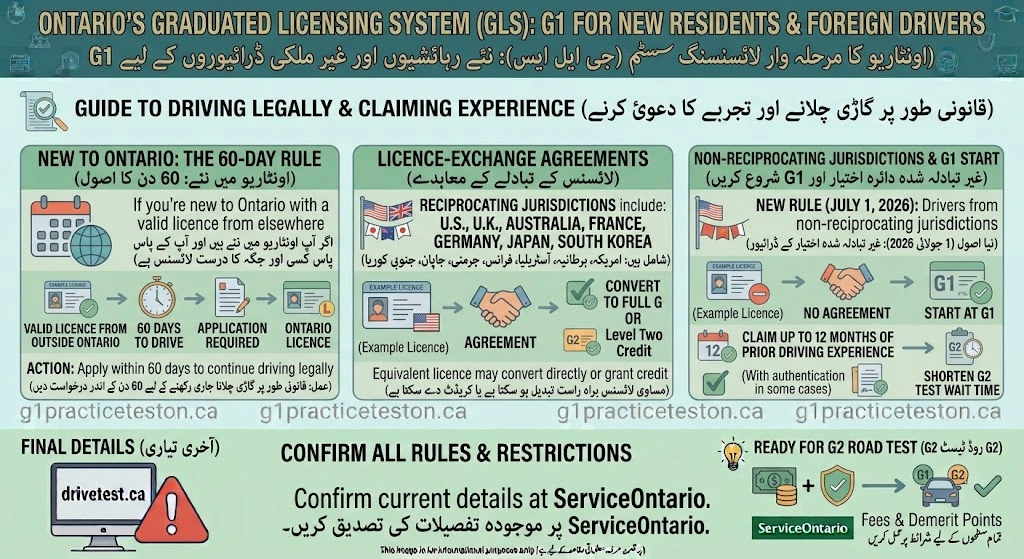
    G1 for new residents & foreign drivers

    If you’re new to Ontario with a valid licence from elsewhere, you can drive on it for 60 days, after which you must apply for an Ontario licence. Ontario has licence-exchange agreements with every Canadian province/territory and with countries including the U.S., U.K., Australia, France, Germany, Japan, and South Korea.
    An equivalent licence from these jurisdictions may convert directly to a full Class G, or grant credit toward Level Two.
    Drivers from non-reciprocating jurisdictions generally start at G1, but new rules effective July 1, 2026 allow claiming up to 12 months of prior driving experience (with authentication in some cases) to shorten the wait before the G2 test.

    Frequently Asked Questions

    No. A G1 driver must always have a qualified accompanying driver in the front passenger seat. There’s no exception for short trips.

    Generally yes, as long as the road isn’t one of the specifically named highways in Ontario Regulation 340/94. Many rural and northern Ontario roads posted at 90 km/h are legal for G1 drivers.

    No, there’s no upper age limit, and it’s common enough that driving schools are used to teaching adult beginners.

    Yes, ownership and driving privileges are separate. You’ll need appropriate insurance in place before you can drive it, though.

    Not a standalone policy. You’re typically covered as a listed driver under the vehicle owner’s policy, but the insurer must be notified.

    Consequences can include fines, an immediate suspension (30–90 days for most violations), demerit points, delays reaching G2, and higher insurance costs down the line.

    Most car-share providers, including Zipcar, no longer allow their vehicles to be used for driving tests. Confirm current policy before relying on this option.

    There’s no strict legal minimum beyond holding your G1 for 12 (or 8) months, but many new drivers find 15–20 hours of supervised in-car practice gives noticeably more confidence than the bare minimum.

    Generally no. Most other provinces and jurisdictions don’t recognize a G1 as a valid standalone licence.

    Five years from the date it’s issued.

    The bottom line on G1 licence restrictions in Ontario

    The G1 licence requirements themselves are simple. Turn 16, pass two tests. It’s the G1 licence restrictions in Ontario that trip people up: who can sit beside you, when you can drive, which roads are genuinely off-limits, and what a mistake actually costs. Respect them, budget for the real G1 licence fees and insurance implications, and the road from G1 to a full G is straightforward. Even if you’re starting later in life, or without a car of your own to practise in.

  • Construction Signs in Ontario: The Complete Guide to Meanings, Types & Rules

    Road Signs · Temporary Conditions

    Construction Signs Ontario

    The complete guide to meanings, types, and the exact rules G1 examiners test.

    If you’ve driven or studied for your G1 anywhere in Ontario during the warmer months, you already know construction signs are impossible to avoid. Every spring, orange diamonds start popping up on highways, side streets, and school routes across the province, and every year candidates make the same mistake.

    They can spot a construction sign from a mile away, but freeze the moment they’re asked what it actually means.
    This guide closes that gap: every temporary condition sign the MTO expects you to know, exactly what each one is telling you to do, and the specific details examiners love to test.

    Quick Answer

    Construction signs Ontario, officially temporary condition signs in the Ontario Driver’s Handbook, are the orange, diamond-shaped signs that warn you about short-term hazards: road work, detours, lane closures, or crews working near traffic. They’re orange rather than yellow because orange is reserved specifically for temporary, changing conditions, not fixed road features.

    Why Construction Signs Ontario Matter More Than Most Drivers Realize

    It’s tempting to treat construction signs Ontario as background noise. But mixing up “lane ends, merge now” with “reduce speed, prepare to stop,” or missing a flagger’s signal because you assumed the sign was decorative, is exactly the kind of mistake that causes real collisions in active work zones. A flagger may be standing a few metres from moving traffic with nothing but a sign or a hand signal protecting them, which is also why this topic shows up consistently on G1 knowledge tests.

    The Colour & Shape System – Construction Signs and Meanings

    Ontario’s road signs follow a strict, predictable code. Knowing it lets you correctly guess a sign’s category the instant you see it, a skill G1 examiners specifically test for.

    Sign Type

    Shape

    Colour

    What It Tells You

    Temporary Condition Signs

    Diamond

    Orange/black

    Short-term hazard: work zones, detours, closures

    Warning

    Diamond

    Yellow/black

    Permanent, unusual condition: curves, crossings, hills

    Regulatory

    Rectangle

    White or black

    A rule you must legally obey

    Information & Direction

    Rectangle

    Green (mostly)

    Distances, exits, and destinations

    If you remember one rule from this table, remember this: orange means temporary.

    Complete List of Construction Signs Ontario

    Grouped the way you’ll actually meet them, in order, as you approach a work zone.

    Advance Warning Signs

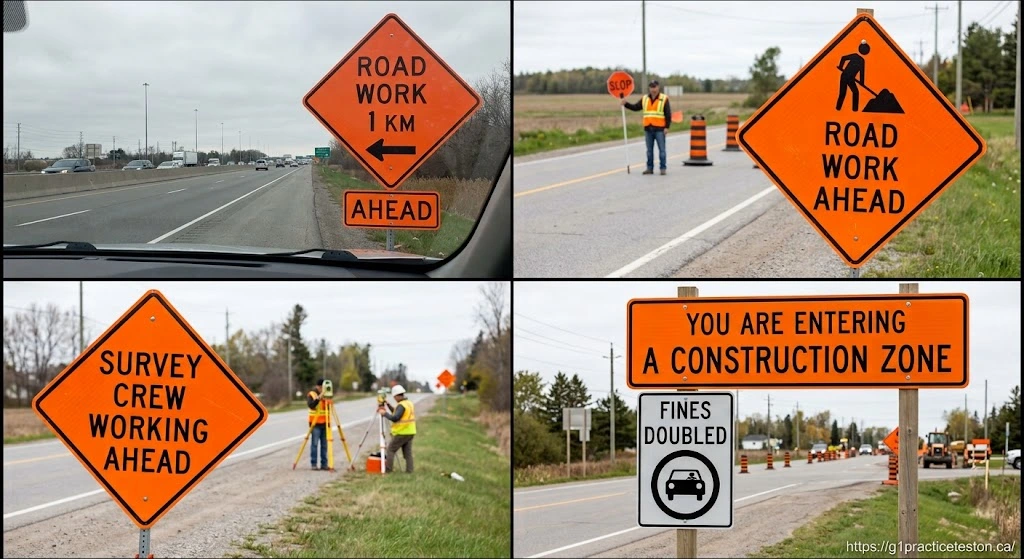
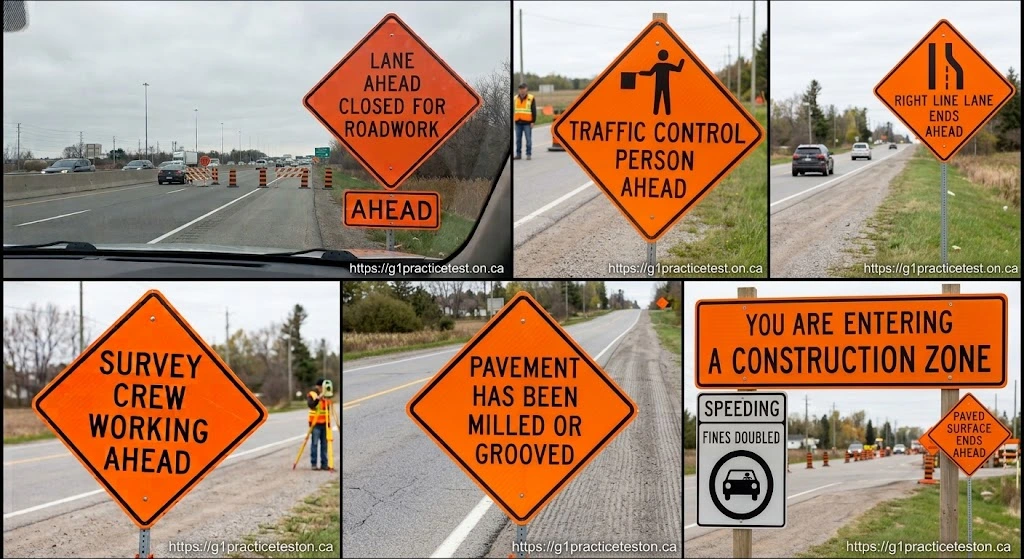
    • Construction Work One Kilometre Ahead — tells you exactly how far you are from the work zone. Ease off the accelerator now.
    • Road Work Ahead — a general warning; distance isn’t specified, so treat it as “any moment now.”
    • Survey Crew Working on the Road Ahead — workers taking measurements, often with equipment on the shoulder.
    • You Are Entering a Construction Zone — the formal boundary marker; doubled fines apply from here.
    Advance Warning Signs
    Construction Signs Ontario

    Worker & Traffic Control Signs

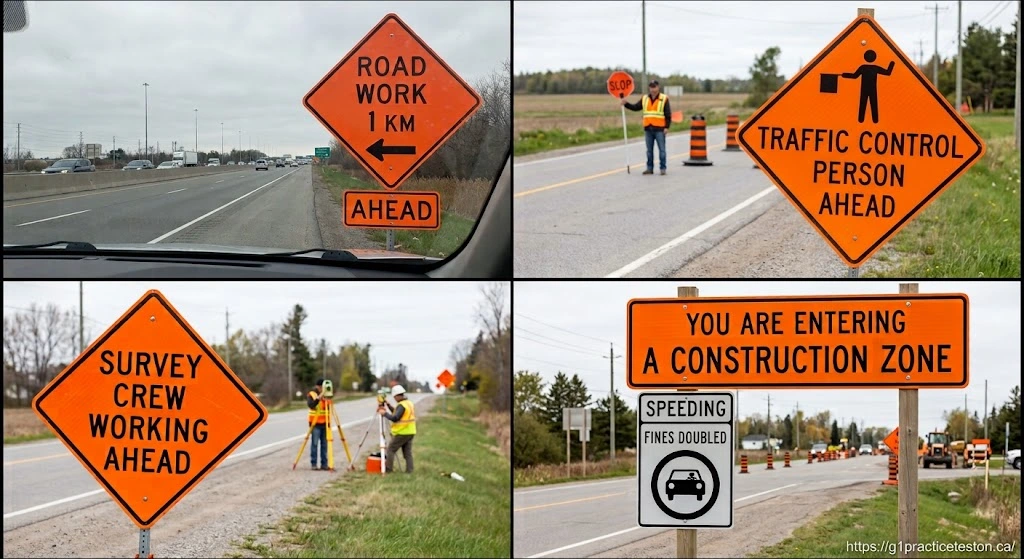
    • Traffic Control Person Ahead — a flagger will direct traffic manually. Their signals override the posted speed limit and most other signage in that moment.
    • Doubled Fines for Speeding in a Designated Construction Zone — HTA fines double when workers are present. One of the most commonly tested facts on the G1.

    Lane, Merge & Pavement Signs

    • Lane Ahead Is Closed for Roadwork — merge into the open lane well before the closure, not at the last second.
    • Closed Lane — Merge Arrow — a directional arrow shows exactly which lane to merge into.
    • Right Lane Ends Ahead — you’re legally required to merge safely into the lane to the left.
    • Pavement Has Been Milled or Grooved — reduced tire grip; motorcyclists especially should expect less traction.
    • Paved Surface Ends Ahead — smooth pavement is about to become gravel or an unfinished surface.
    Lane Merge Pavement Signs
    Detour Route Signs

    Detour & Route Signs

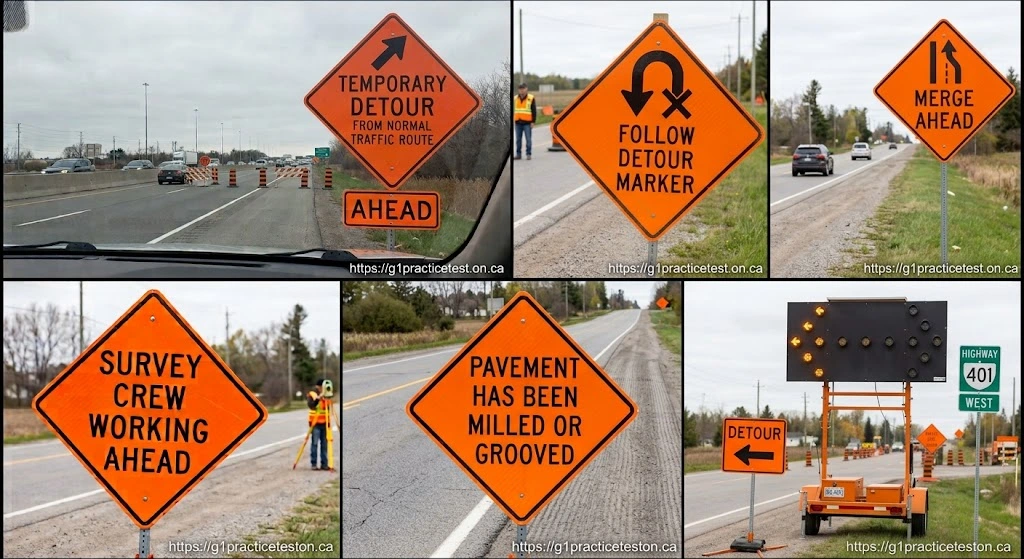
    • Temporary Detour From Normal Traffic Route — the road ahead is closed; follow posted markers.
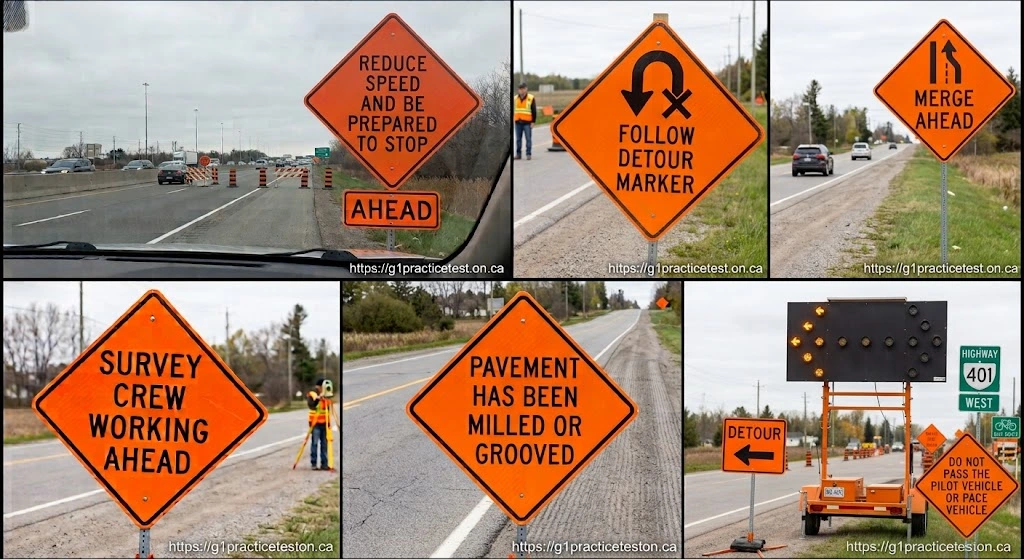
    • Follow Detour Marker Until You Return to Regular Route — confirms you’re still on the correct detour path.
    • Flashing Arrow Board — flashing lights show which direction to move; treat like a lane-merge instruction.

    Speed & Behaviour Signs

    • Reduce Speed and Be Prepared to Stop — often placed right before a flagger; stopping may be required imminently.
    • Do Not Pass the Pilot Vehicle or Pace Vehicle — stay behind it through single-lane work zones, even if there appears to be room.
    Construction Signs Ontario

    Construction Site Signage Requirements in Ontario

    Temporary traffic control on active work sites is governed primarily by the Ontario Traffic Manual (OTM), Book 7 – Temporary Conditions, published by the Ministry of Transportation. Book 7 sets the official standards for how construction signs must be sized, placed, spaced, and removed once work is complete.
    It applies to municipal roads and provincial highways alike. Contractors typically work under a road-occupancy permit and an approved traffic control plan based on Book 7; municipalities may add local bylaw requirements on top.
    For everyday drivers, the takeaway is simple: any sign in a work zone was placed under a specific regulatory framework, not at random — which is exactly why misreading it carries real legal and safety consequences.

    G1 Test Tips: What Examiners Actually Ask

    • Construction signs are orange and diamond-shaped — this answers a large share of “identify the category” questions.
    • Speeding fines double in a construction zone when workers are present — one of the most frequently tested standalone facts.
    • traffic control person’s instructions take priority over the posted speed limit and most other signage.
    • merge sign (move into a lane) is not the same as a lane-ends warning (your lane is disappearing).
    • You cannot pass a pilot vehicle, even if the lane looks clear — a common “trick” question.

    Frequently Asked Questions

    Construction signs, officially called temporary condition signs in Ontario, are orange, diamond-shaped road signs that warn drivers about short-term hazards such as road work, detours, lane closures, survey crews, or workers on or near the roadway.

    Across Canada, construction signage follows a broadly similar orange-diamond system. Common signs nationwide include Road Work Ahead, Construction Zone, Lane Closed, Detour, Flagger/Traffic Control Person Ahead, Reduce Speed Ahead, and Doubled Fines in a Designated Construction Zone.

    The Official MTO Driver’s Handbook groups Ontario road signs into four main categories: regulatory, warning, temporary condition (construction), and information & direction — plus smaller groups like emergency response and bilingual signs. Some general resources simplify this to three by folding construction into “warning.” For G1 purposes, use the four-category MTO breakdown.

    Ontario’s construction signs fall into five functional groups: warning, worker & traffic control, lane & pavement, detour & route, and speed/behaviour signs. The same five groups covered above.

    There’s no official “20/20 rule” in the Ontario Driver’s Handbook or the Ontario Traffic Manual. If you’ve seen this phrase, it likely refers to an unrelated workplace guideline — sometimes confused with the “20-20-20” eye-strain rule used for screen work.

    Key Takeaways

    • Construction signs are officially temporary condition signs — almost always orange diamonds with black symbols or text.
    • They warn of short-term hazards: road work, detours, lane closures, survey crews, and workers.
    • Speeding fines double in a designated construction zone when workers are present.
    • traffic control person’s signals override the posted speed limit and most other signage.
    • You are never permitted to pass a pilot vehicle in a single-lane work zone.
    • Contractors follow the Ontario Traffic Manual, Book 7 for how these signs are placed and maintained.

  • |

    Regulatory Road Signs in Ontario — Full List & Meanings (2026 Guide)

    When I sat down to study for my own G1 knowledge test, regulatory road signs Ontario were the section that actually made me confused, and the marks on my first try weren’t good, not because they’re complicated, but because there are so many of them and they all look similar at first.

    Round, rectangular, red circles, white backgrounds, it’s easy to mix up a “No Left Turn” with a “No U-Turn” if you’re skimming instead of studying properly.
    This guide breaks down every major category of regulatory sign you’ll see on Ontario roads and on your G1 test, based directly on the official MTO Driver’s Handbook. I’ve grouped them the way they actually show up on the exam.

    By function, not just by shape, so you can build real recognition instead of just memorizing pictures the night before your test.
    If you haven’t already, it’s worth reading our Ontario Road Signs — Complete Guide first, since this article goes deeper specifically into the regulatory category, one of the three main sign types (regulatory, warning, and information) tested on the G1.

    Practice Regulatory Signs test →

    What Makes a Sign “Regulatory”?

    Regulatory signs tell you what you must or must not do. They carry the force of law; ignoring one isn’t just bad driving etiquette. It’s a traffic violation that can get you fined or, in more serious cases, get demerit points added to your licence once you’re past the G1 stage.
    You’ll recognize most regulatory signs by their shape and colour pattern:

    • Red circle with a diagonal slash — something is prohibited
    • White rectangle with black text/symbols — a rule or requirement
    • Red octagon — Stop (always)
    • Red-and-white inverted triangle — Yield (always)

    This is different from warning signs (yellow diamonds, alerting you to hazards ahead) and information/guide signs (green or blue, giving directions or services). If you mix these three categories up on the test, it’s usually because the studying was done by shape alone rather than by purpose, which is the approach we’re using here.

    regulatory road signs ontario
ontario regulatory signs list, g1 regulatory signs, stop and yield signs ontario, speed limit signs ontario, turn restriction signs ontario
    Stop Yield g1practiceteston.ca

    Stop and Yield Signs

    These are the most fundamental regulatory signs and the ones examiners expect you to know cold.

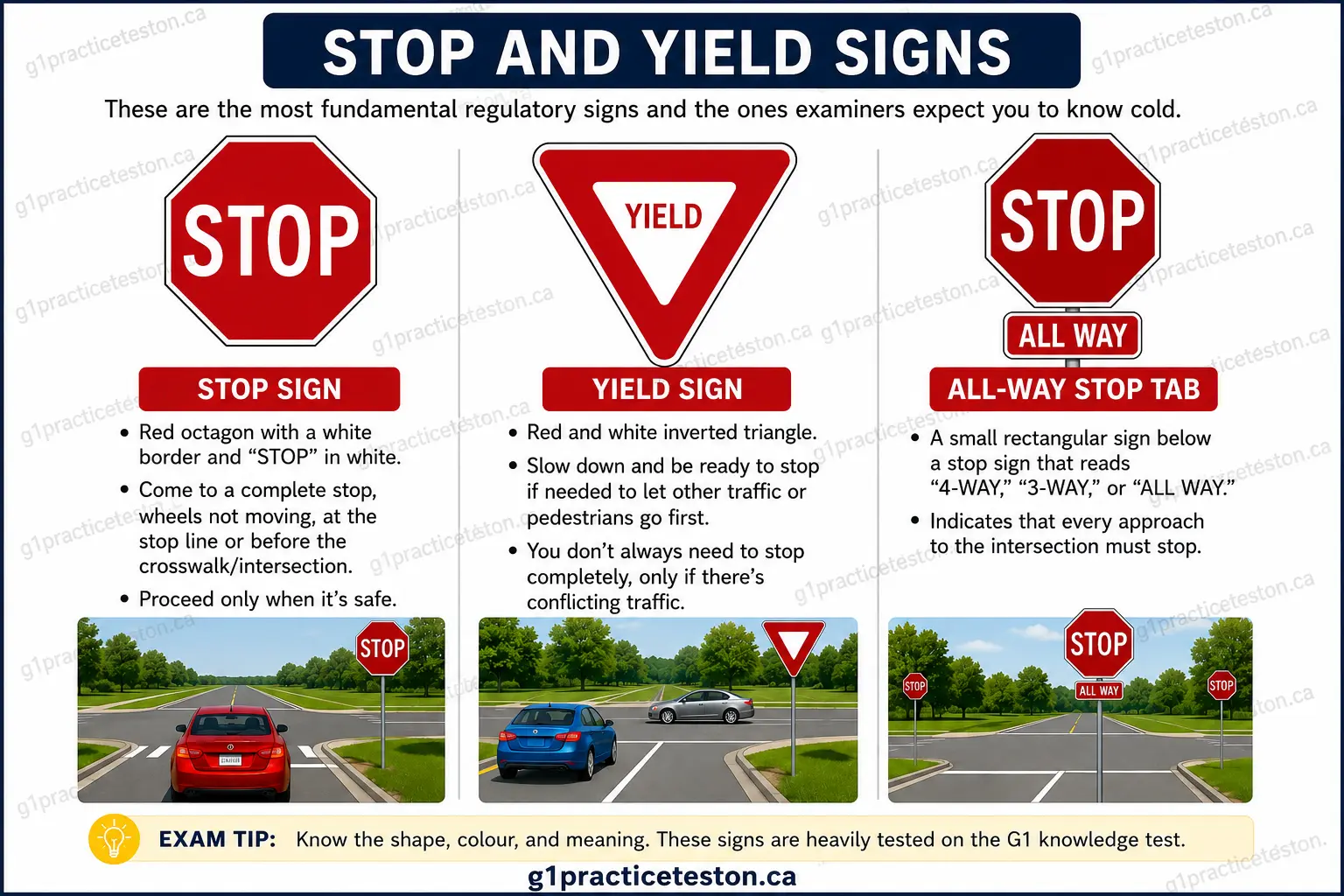
    • Stop Sign — Red octagon with a white border and “STOP” in white. Come to a complete stop, wheels not moving, at the stop line or before the crosswalk/intersection. Proceed only when it’s safe.
    • Yield Sign — Red and white inverted triangle. Slow down and be ready to stop if needed to let other traffic or pedestrians go first. You don’t always need to stop completely, only if there’s conflicting traffic.
    • All-Way Stop Tab — A small rectangular sign below a stop sign that reads “4-WAY,” “3-WAY,” or “ALL WAY,” indicating that every approach to the intersection must stop.

    Speed Limit Signs

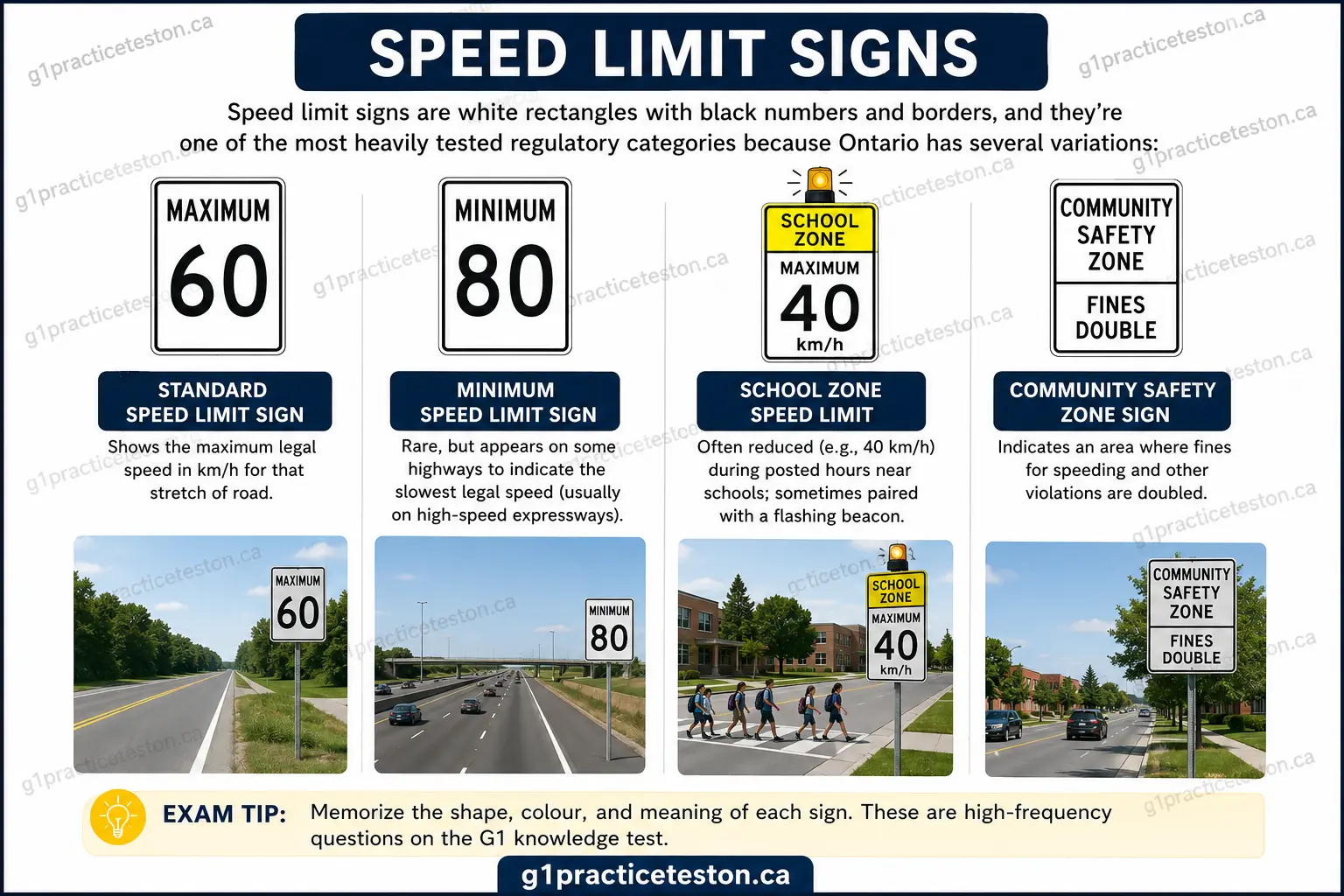
    Speed limit signs are white rectangles with black numbers and borders, and they’re one of the most heavily tested regulatory categories because Ontario has several variations:

    • Standard Speed Limit Sign — Shows the maximum legal speed in km/h for that stretch of road.
    • Minimum Speed Limit Sign — Rare, but appears on some highways to indicate the slowest legal speed (usually on high-speed expressways).
    • School Zone Speed Limit — Often reduced (e.g., 40 km/h) during posted hours near schools; sometimes paired with a flashing beacon.
    • Community Safety Zone Sign — Indicates an area where fines for speeding and other violations are doubled.
    Speed Limit Signs g1practiceteston.ca
    tip g1practiceteston.ca e1783998811159

    G1 tip

    Know that the default speed limit in an Ontario municipality (if unposted) is 50 km/h, and 80 km/h on most rural roads unless otherwise signed. This is one of the most commonly tested unposted-limit questions.

    turn g1practiceteston.ca

    Turn and Movement Restriction Signs

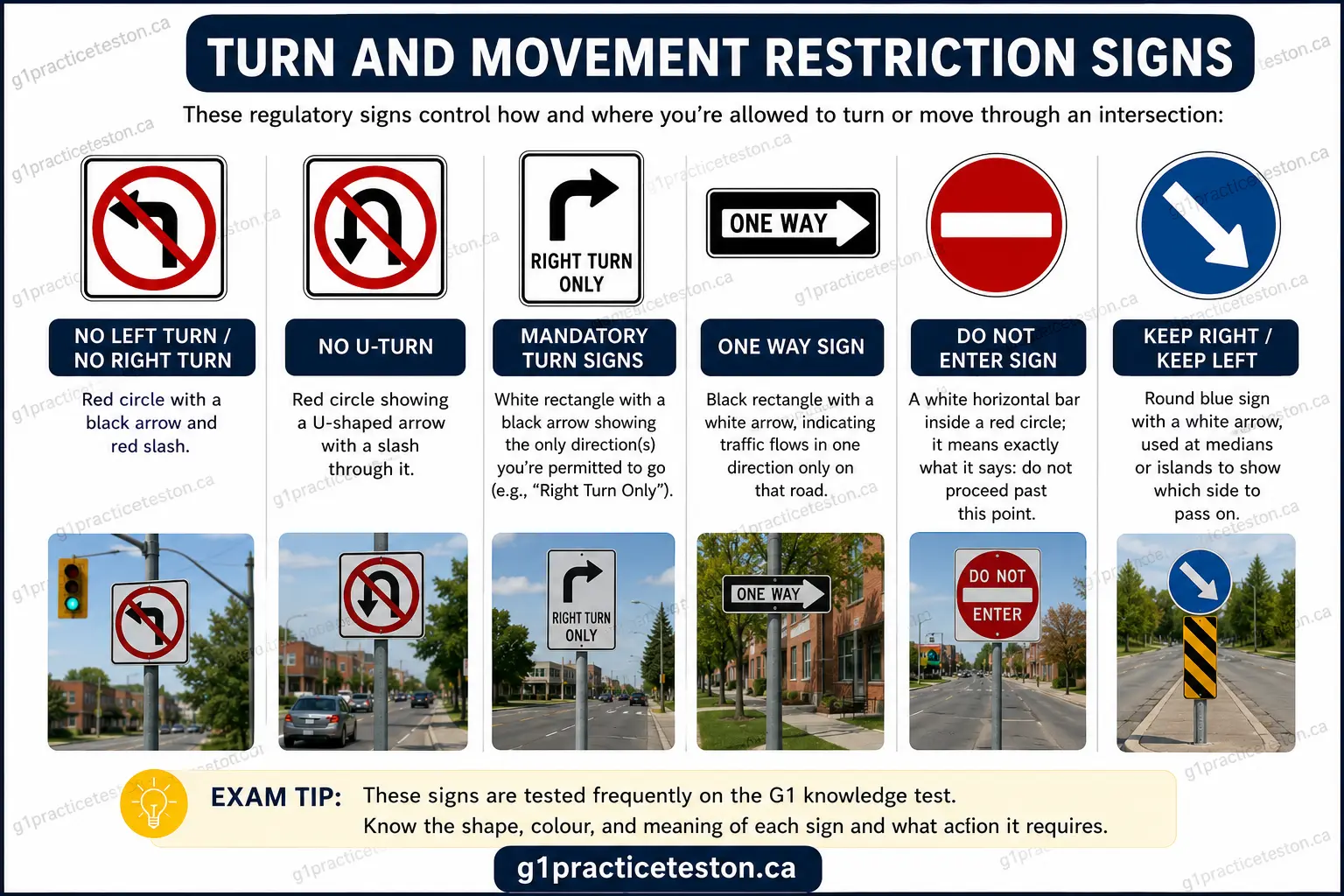
    These regulatory signs control how and where you’re allowed to turn or move through an intersection:

    • No Left Turn / No Right Turn — Red circle with a black arrow and red slash.
    • No U-Turn — Red circle showing a U-shaped arrow with a slash through it.
    • Mandatory Turn Signs — White rectangle with a black arrow showing the only direction(s) you’re permitted to go (e.g., “Right Turn Only”).
    • One Way Sign — Black rectangle with a white arrow, indicating traffic flows in one direction only on that road.
    • Do Not Enter Sign — A white horizontal bar inside a red circle; it means exactly what it says: do not proceed past this point.
    • Keep Right / Keep Left — Round blue sign with a white arrow, used at medians or islands to show which side to pass on.

    Lane Use and Movement Control Signs

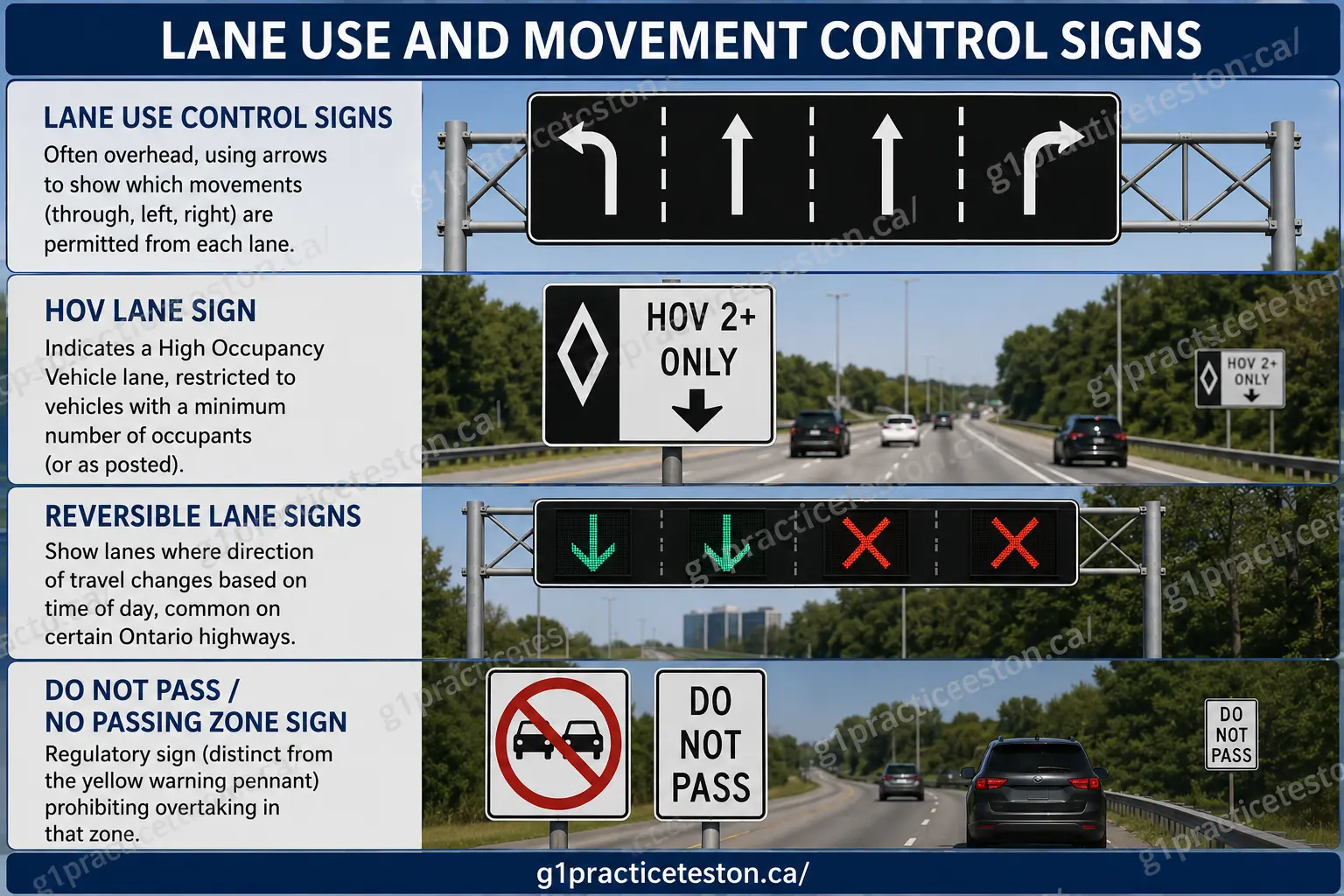
    • Lane Use Control Signs — Often overhead, using arrows to show which movements (through, left, right) are permitted from each lane.
    • HOV Lane Sign — Indicates a High Occupancy Vehicle lane, restricted to vehicles with a minimum number of occupants (or as posted).
    • Reversible Lane Signs — Show lanes where direction of travel changes based on time of day, common on certain Ontario highways.
    • Do Not Pass / No Passing Zone Sign — Regulatory sign (distinct from the yellow warning pennant) prohibiting overtaking in that zone.
    Lane use g1practiceteston.ca
    Parking g1practiceteston.ca

    Parking and Stopping Regulation Signs

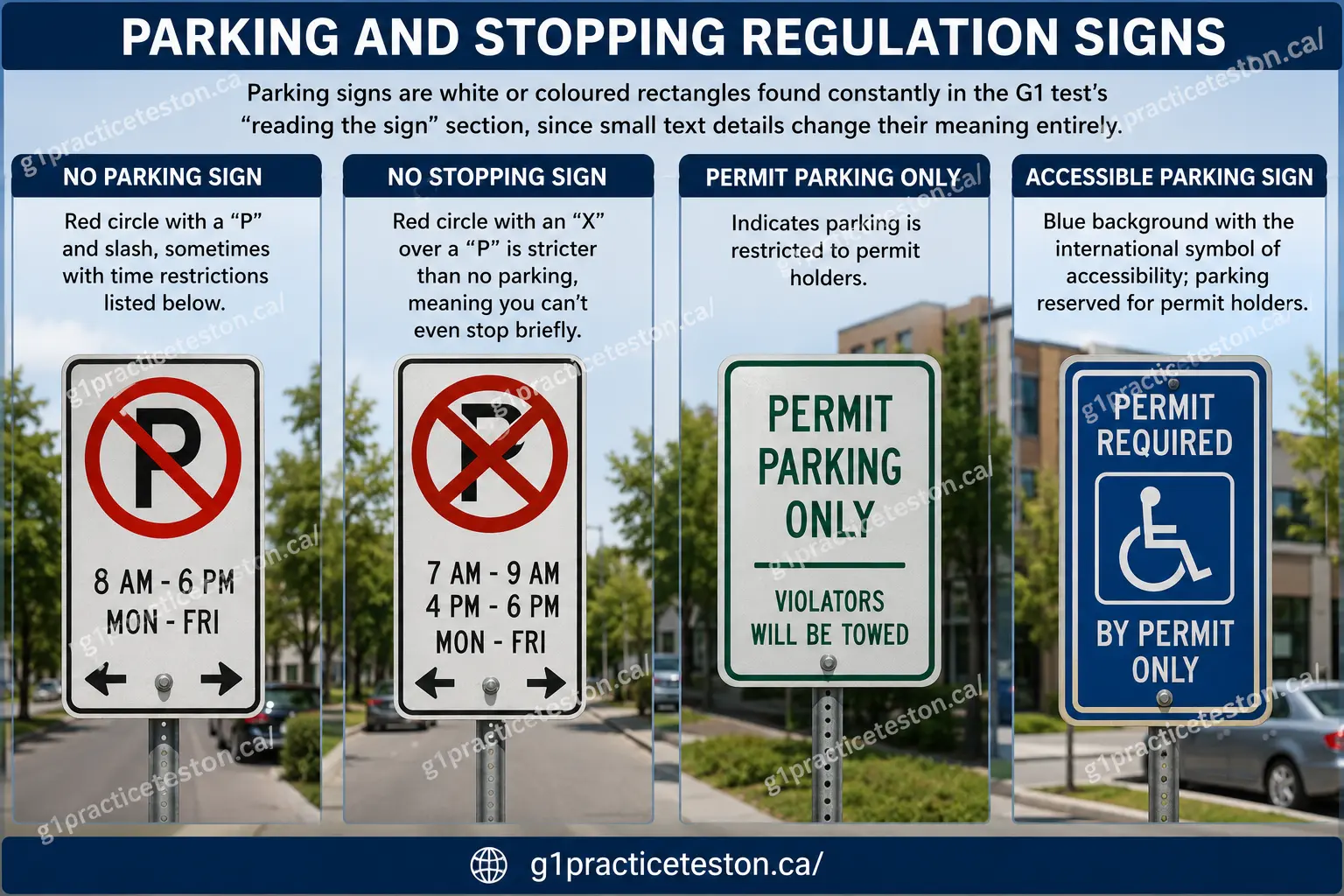
    Parking signs are white or coloured rectangles found constantly in the G1 test’s “reading the sign” section, since small text details change their meaning entirely:

    • No Parking Sign — Red circle with a “P” and slash, sometimes with time restrictions listed below.
    • No Stopping Sign — Red circle with an “X” over a “P” is stricter than no parking, meaning you can’t even stop briefly.
    • Permit Parking Only — Indicates parking is restricted to permit holders.
    • Accessible Parking Sign — Blue background with the international symbol of accessibility; parking reserved for permit holders.
    tip g1practiceteston.ca e1783998811159

    G1 tip

    The test often asks you to distinguish “No Parking” from “No Stopping.” Remember, No Stopping is the stricter rule with zero exceptions, even to drop someone off.

    Weight, Height, and Vehicle-Type Restriction Signs

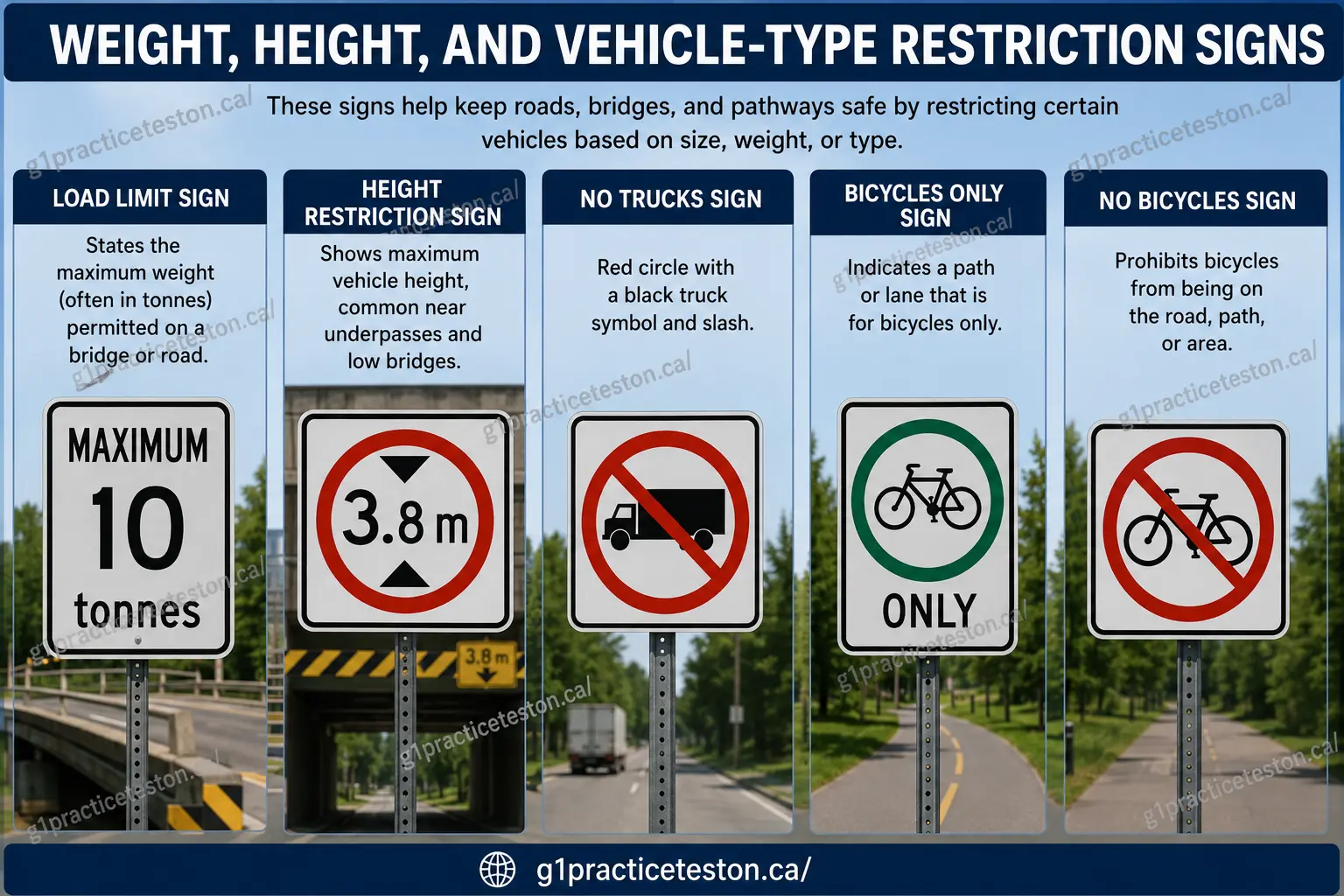
    • Load Limit Sign — States the maximum weight (often in tonnes) permitted on a bridge or road.
    • Height Restriction Sign — Shows maximum vehicle height, common near underpasses and low bridges.
    • No Trucks Sign — Red circle with a black truck symbol and slash.
    • Bicycles Only / No Bicycles Signs — Regulate where cyclists must or must not ride.
    Weight Height g1practiceteston.ca
    Other Common Regulatory Signs g1practiceteston.ca

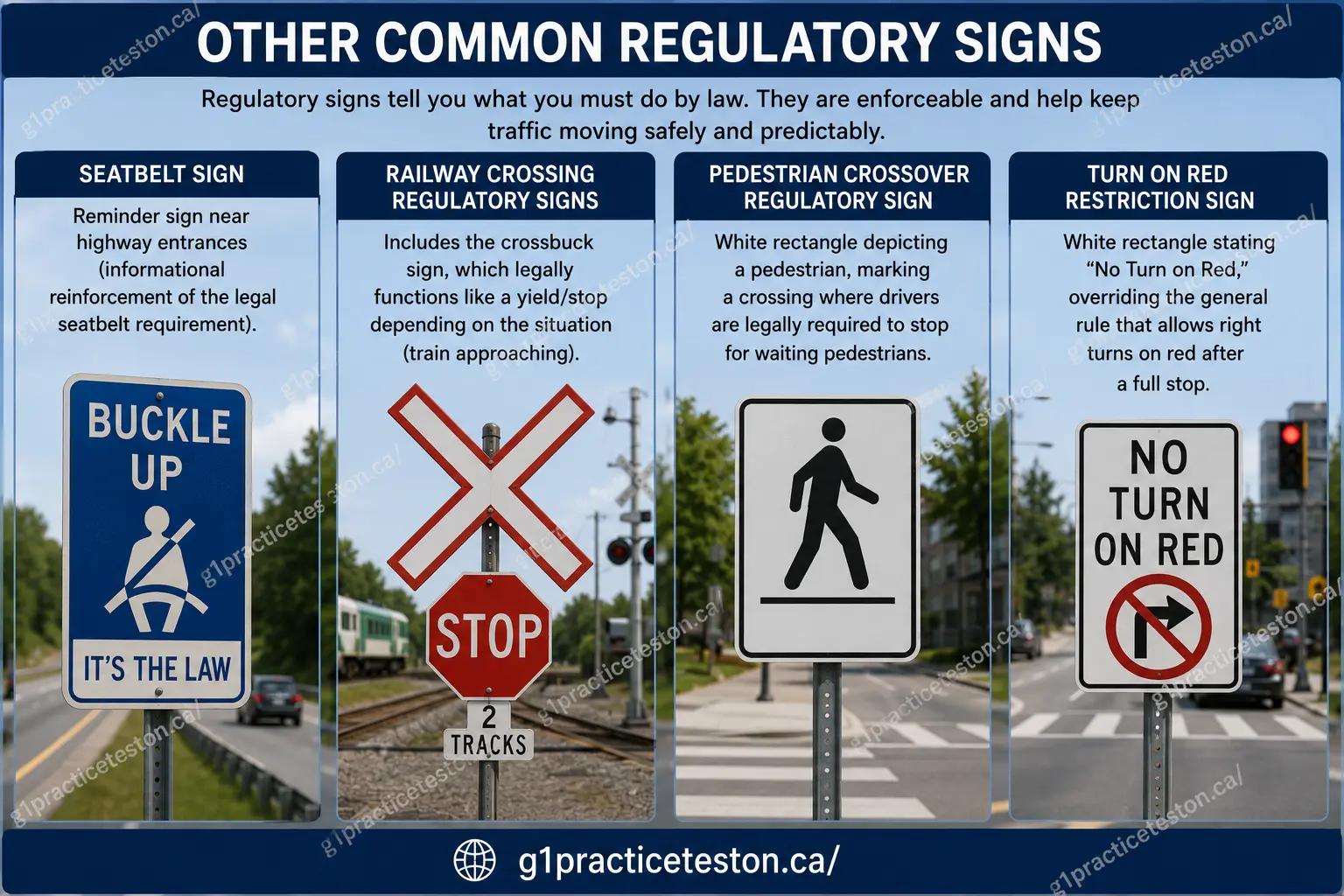
    Other Common Regulatory Signs

    • Seatbelt Sign — Reminder sign near highway entrances (informational reinforcement of the legal seatbelt requirement).
    • Railway Crossing Regulatory Signs — Includes the crossbuck sign, which legally functions like a yield/stop depending on the situation (train approaching).
    • Pedestrian Crossover Regulatory Sign — White rectangle depicting a pedestrian, marking a crossing where drivers are legally required to stop for waiting pedestrians.
    • Turn on Red Restriction Sign — White rectangle stating “No Turn on Red,” overriding the general rule that allows right turns on red after a full stop.

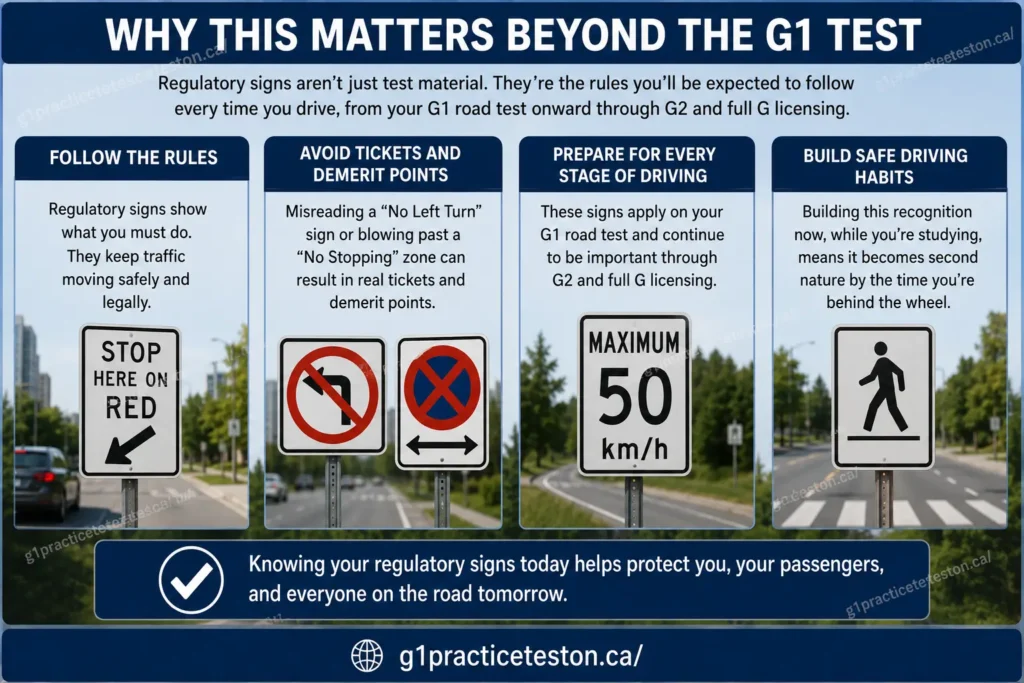
    Why This Matters Beyond the G1 Test

    Regulatory signs aren’t just test material. They’re the rules you’ll be expected to follow every time you drive, from your G1 road test onward through G2 and full G licensing. Misreading a “No Left Turn” sign or blowing past a “No Stopping” zone doesn’t just cost test points; it can result in real tickets and demerit points later. Building this recognition now, while you’re studying, means it becomes second nature by the time you’re behind the wheel.

    why g1practiceteston.ca

    Frequently Asked Questions

    The exact number varies by test version, but regulatory signs typically make up a meaningful portion of the road signs section, alongside warning and information signs. Expect several direct “what does this sign mean” questions.

    Regulatory signs (white/red, often circular or rectangular) tell you what’s legally required. Warning signs (yellow diamonds) alert you to hazards or conditions ahead, but aren’t legal requirements themselves.

    Yes, shape and colour are intentional and consistent across Ontario, so recognizing the pattern (red circle = prohibition, white rectangle = rule/requirement) will help you correctly guess even unfamiliar signs on the test.

    No. No Parking allows brief stops (like dropping off a passenger); No Stopping does not allow you to stop at all, except in an emergency.

    Conclusion

    Regulatory signs make up one of the most testable and most practical sections of your G1 knowledge exam. The key isn’t memorizing every sign individually, but learning to recognize the pattern: shape and colour tell you the sign’s function before you even read the text. Once that clicks, questions about stop/yield, turn restrictions, speed limits, and parking rules become quick, easy points rather than guesswork.

    Related Posts:

One Comment

Leave a Reply

Your email address will not be published. Required fields are marked *